Pay Raise Calculator

Estimate your new pay after a raise — see weekly, monthly and annual results.

Pay before raise

Raise

Pay after raise

References

e.g. Use this calculator to find your new salary after a percentage or fixed raise. Currency: USD.

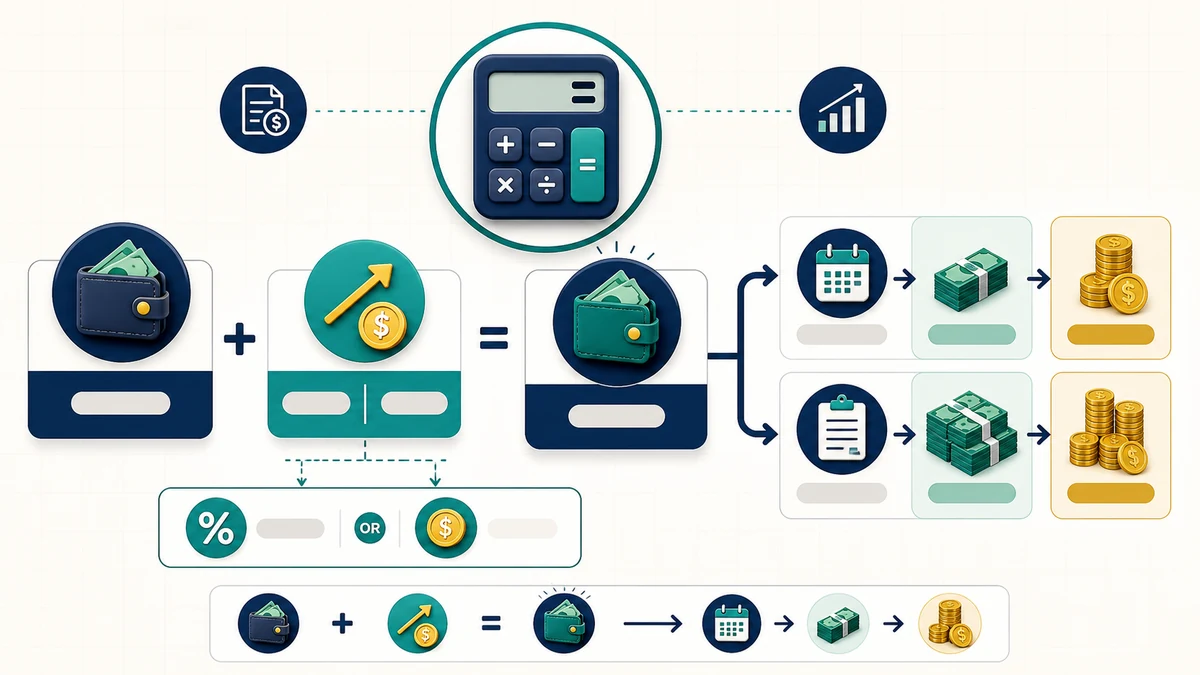
Use this Pay Raise Calculator to estimate your new pay after a raise. Enter your hours per week, current pay, and raise amount to calculate updated weekly, monthly, and annual pay. You can use a percentage raise or a fixed weekly, monthly, or annual raise amount.

Important Note: This Pay Raise Calculator estimates gross pay before and after a raise. It can calculate updated weekly, monthly, and annual pay from hourly, weekly, monthly, or annual pay and from either a percentage raise or a fixed raise amount.

The result is a gross-pay estimate only. It does not calculate income tax, payroll withholding, Social Security, Medicare, National Insurance, pension or retirement contributions, health insurance deductions, union dues, benefits, bonuses, commissions, tips, overtime, shift differentials, unpaid leave, paid time off, or actual take-home pay.

Use this calculator for quick raise planning, salary review checks, job-offer comparison, and negotiation preparation. For exact paycheck changes, review your employment agreement, pay stub, payroll system, tax withholding tools, or speak with your employer’s HR or payroll department.

Reviewed by: AjaxCalculators Editorial Team
Last updated: April 26, 2026
Method source: Standard gross-pay conversion formulas using hourly pay, hours per week, weekly pay, monthly pay, annual pay, and raise amount
Editorial standards: AjaxCalculators Editorial Policy

What This Pay Raise Calculator Calculates

This calculator estimates your pay before and after a raise across weekly, monthly, and annual pay periods. It can also convert hourly pay into weekly, monthly, and annual gross pay using your entered hours per week.

Input or Result What It Means Use Note
Hours per week The number of hours used to convert hourly pay into weekly pay. Used only when hourly pay is part of the calculation.
Pay before raise Your current gross pay before the raise. Can be entered as hourly, weekly, monthly, or annual pay.
Raise amount The increase in pay. Can be entered as a percentage or as a fixed weekly, monthly, or annual amount.
Pay after raise Your estimated new gross pay after the raise. Shown as weekly, monthly, and annual gross pay.
Weekly pay Estimated gross pay for one week. Usually annualized by multiplying by 52.
Monthly pay Average monthly gross pay. Usually calculated as annual pay divided by 12.
Annual pay Estimated yearly gross pay. Does not include taxes, deductions, bonuses, overtime, or benefits unless manually reflected in the input.

How the Pay Raise Calculator Works

1) Hourly Pay to Weekly Pay

If you enter hourly pay, the calculator uses your hours per week to estimate weekly pay.

Weekly pay = hourly pay × hours per week

For example, if you earn $20 per hour and work 40 hours per week:

Weekly pay = 20 × 40 = $800

2) Weekly Pay to Annual Pay

Annual pay is usually estimated by multiplying weekly pay by 52 weeks.

Annual pay = weekly pay × 52

For example:

Annual pay = 800 × 52 = $41,600

3) Annual Pay to Monthly Pay

Monthly pay is estimated by dividing annual pay by 12.

Monthly pay = annual pay ÷ 12

For example:

Monthly pay = 41,600 ÷ 12 = $3,466.67

4) Percentage Raise Formula

If the raise is entered as a percentage, the raise amount is calculated from the current pay.

Raise amount = current pay × raise percentage ÷ 100

New pay = current pay + raise amount

For example, if your annual pay is $50,000 and you receive a 6% raise:

Raise amount = 50,000 × 6 ÷ 100 = $3,000
New annual pay = 50,000 + 3,000 = $53,000

5) Fixed Raise Formula

If the raise is entered as a fixed amount, the calculator adds that amount to the matching pay period.

New pay = current pay + fixed raise amount

For example, if your weekly pay is $900 and your weekly raise is $75:

New weekly pay = 900 + 75 = $975

Pay Period Conversions Used by the Calculator

The calculator uses standard gross-pay conversions to move between hourly, weekly, monthly, and annual pay.

Conversion Formula Important Note
Hourly to weekly Weekly pay = hourly pay × hours per week Uses the hours per week entered by the user.
Weekly to annual Annual pay = weekly pay × 52 Assumes 52 paid weeks per year.
Annual to weekly Weekly pay = annual pay ÷ 52 Gives an average weekly gross amount.
Annual to monthly Monthly pay = annual pay ÷ 12 Gives an average monthly gross amount, not necessarily each paycheck amount.
Monthly to annual Annual pay = monthly pay × 12 Assumes the monthly amount is consistent across the year.
Weekly to monthly Monthly pay = weekly pay × 52 ÷ 12 Uses average months, not exactly four weeks per month.

Percentage Raise vs Fixed Raise

The calculator supports both percentage raises and fixed money raises. These can produce the same result, but they are entered differently.

Raise Type How It Works Example Best Use
Percentage raise Increases current pay by a percentage of the current pay amount. 5% of $60,000 = $3,000 raise. Annual reviews, merit raises, cost-of-living adjustments, and promotion raises.
Fixed weekly raise Adds a set amount to weekly pay. $50 more per week = $2,600 more per year before deductions. Hourly or weekly pay increases.
Fixed monthly raise Adds a set amount to average monthly pay. $200 more per month = $2,400 more per year before deductions. Monthly salary comparisons.
Fixed annual raise Adds a set amount to annual pay. $3,000 annual raise on $60,000 = $63,000 annual pay. Salary offer and annual compensation review.

Gross Pay vs Take-Home Pay

This calculator estimates gross pay. Your actual paycheck may be lower because take-home pay is calculated after deductions and withholding.

Pay Type What It Means Common Items Involved
Gross pay Pay before taxes, deductions, and withholding. Base pay, salary, hourly wages, and any entered raise amount.
Taxable pay Pay amount used for some tax calculations after certain adjustments. Can be affected by pre-tax benefits, retirement contributions, and local tax rules.
Take-home pay Pay received after taxes, deductions, and withholdings. Income tax, payroll taxes, pension or retirement contributions, insurance, benefits, and other deductions.
Total compensation Broader value of pay plus benefits and other compensation. Salary, bonuses, commissions, health benefits, retirement match, paid leave, equity, and perks.

For exact paycheck changes, use your employer’s payroll system, pay stub, official tax withholding tools, or HR guidance.

Assumptions and Important Notes

Assumption or Limitation What It Means
Gross pay only The calculator estimates pay before taxes, payroll withholding, and deductions.
52-week year Weekly-to-annual conversion uses 52 weeks.
12-month year Annual-to-monthly conversion uses 12 average months.
Hours per week are user-entered Hourly calculations depend on the hours entered by the user.
No automatic overtime The calculator does not separately calculate overtime rates, exempt status, or overtime eligibility.
No bonus or commission modeling Bonuses, commissions, tips, and variable pay are not included unless manually entered as part of pay.
No benefits valuation Health insurance, pension, retirement match, paid leave, equity, and other benefits are not valued.
No pay-frequency guarantee Average monthly pay may not match a biweekly, semimonthly, or weekly paycheck exactly.
No legal or payroll verification The calculator does not verify employment law, payroll policy, tax rules, or contract terms.

Worked Example: Percentage Raise

Suppose your current annual pay is $48,000 and you receive a 5% raise.

Step Calculation Result
Convert raise percentage 5 ÷ 100 0.05
Calculate raise amount $48,000 × 0.05 $2,400
Calculate new annual pay $48,000 + $2,400 $50,400
Calculate new monthly pay $50,400 ÷ 12 $4,200
Calculate new weekly pay $50,400 ÷ 52 About $969.23

So, a 5% raise on a $48,000 salary increases gross annual pay by $2,400, giving a new gross annual pay of $50,400.

Worked Example: Hourly Raise

Suppose you currently earn $18 per hour, work 40 hours per week, and receive a raise to $20 per hour.

Step Calculation Result
Calculate old weekly pay $18 × 40 $720
Calculate new weekly pay $20 × 40 $800
Calculate weekly raise $800 − $720 $80
Calculate annual raise $80 × 52 $4,160
Calculate new annual pay $800 × 52 $41,600

So, increasing hourly pay from $18 to $20 at 40 hours per week increases gross annual pay by about $4,160, before taxes and deductions.

Worked Example: Fixed Annual Raise

Suppose your current annual pay is $55,000 and your employer offers a fixed annual raise of $4,000.

Step Calculation Result
Current annual pay Given $55,000
Fixed annual raise Given $4,000
New annual pay $55,000 + $4,000 $59,000
New monthly average $59,000 ÷ 12 $4,916.67
New weekly average $59,000 ÷ 52 About $1,134.62
Equivalent raise percentage $4,000 ÷ $55,000 × 100 About 7.27%

How to Use This Pay Raise Calculator

  1. Enter your usual working hours per week.
  2. Enter your pay before raise as hourly, weekly, monthly, or annual pay.
  3. Enter your raise as a percentage or as a fixed weekly, monthly, or annual amount.
  4. Review the estimated pay after raise in weekly, monthly, and annual formats.
  5. Use the result as a gross-pay estimate before taxes, payroll withholding, and deductions.
  6. Use Reload to clear the calculator and start again.

How to Interpret the Result

Result What It Means Important Caution
Pay before raise Your current estimated gross pay before the raise. It should match the pay period you selected or entered.
Raise amount The increase in gross pay from the raise. It may not equal the increase in take-home pay.
Pay after raise Your estimated new gross pay after adding the raise. Actual payroll may differ because of tax, deduction, and employer rules.
Weekly pay Estimated gross pay for one week. Does not automatically include overtime or variable pay.
Monthly pay Average gross pay per month. A biweekly or semimonthly paycheck may not equal this exact amount.
Annual pay Estimated gross yearly pay. Does not guarantee total compensation or take-home income.

Pay Raise vs Cost of Living

A raise increases nominal pay, but your real purchasing power depends on how your raise compares with inflation and personal expenses.

Comparison What It Means Practical Note
Raise higher than inflation Your real purchasing power may improve. Still check rent, commuting, insurance, and other personal costs.
Raise roughly equal to inflation Your purchasing power may stay about the same. The raise may feel smaller after higher living costs.
Raise lower than inflation Your real purchasing power may fall. Your gross pay rises, but everyday costs may rise faster.
Raise with higher deductions Take-home pay may rise less than gross pay. Check taxes, benefits, retirement contributions, and insurance changes.

Pay Raise vs Promotion

A pay raise and a promotion are related, but they are not the same. A promotion may change responsibilities, title, workload, hours, benefits, bonus eligibility, or long-term career value.

Offer Type What Usually Changes What to Review
Pay raise Pay increases while the role may stay mostly the same. Gross pay, take-home pay, benefits, inflation, and market pay.
Promotion Role, title, responsibilities, and expectations may increase. Pay increase, workload, hours, team responsibility, bonus eligibility, and career path.
Job offer Employer, pay structure, benefits, location, schedule, and role may change. Total compensation, commute, remote policy, PTO, retirement match, health benefits, and job security.

Pay Frequency and Paycheck Timing

Average monthly pay is useful for planning, but it may not match each paycheck exactly.

Pay Frequency Typical Number of Paychecks Planning Note
Weekly 52 per year Each paycheck covers one week.
Biweekly 26 per year Some months may have three paychecks.
Semimonthly 24 per year Usually two paychecks per month.
Monthly 12 per year One paycheck per month.

The calculator’s monthly result is an average monthly gross amount. Your actual paycheck schedule may be different.

Practical Uses of a Pay Raise Calculator

This Pay Raise Calculator is useful for quick raise, salary, and job-offer planning.

Use Case How the Calculator Helps
Estimate new salary after a raise Shows updated weekly, monthly, and annual gross pay.
Convert a percentage raise into money Shows the dollar value of a raise percentage.
Compare hourly wage increases Shows how an hourly raise affects weekly and annual gross pay.
Prepare for salary negotiation Helps compare requested raise amounts and target pay levels.
Compare job offers Helps compare salary or hourly pay before reviewing benefits and deductions.
Review promotion offers Shows the gross pay difference before considering workload and benefits.
Budget planning Gives a rough gross-pay estimate before checking take-home pay.

Common Mistakes to Avoid

Mistake Why It Causes Problems
Confusing gross pay with take-home pay Taxes, withholding, benefits, and deductions can reduce the actual paycheck increase.
Ignoring overtime rules Hourly employees may need separate overtime calculations depending on law and employer policy.
Assuming every month has exactly four weeks Average monthly pay is usually annual pay divided by 12, not weekly pay multiplied by 4.
Ignoring pay frequency Weekly, biweekly, semimonthly, and monthly pay schedules produce different paycheck timing.
Comparing salary offers without benefits Health insurance, retirement match, PTO, bonuses, and work schedule can change total value.
Ignoring inflation A raise may not improve purchasing power if living costs rise faster.
Ignoring unpaid leave or seasonal hours Annual pay can differ if hours are not consistent all year.
Treating the result as an official payroll statement Only your employer’s payroll records and pay stub show official pay details.

Formula Summary

What You Want to Find Formula Use Note
Weekly pay from hourly pay Weekly pay = hourly pay × hours per week Uses the entered weekly hours.
Annual pay from weekly pay Annual pay = weekly pay × 52 Assumes 52 paid weeks per year.
Monthly pay from annual pay Monthly pay = annual pay ÷ 12 Average monthly gross pay.
Percentage raise amount Raise amount = current pay × raise percentage ÷ 100 Use when the raise is entered as a percentage.
New pay after percentage raise New pay = current pay × (1 + raise percentage ÷ 100) Shortcut for percentage raises.
New pay after fixed raise New pay = current pay + fixed raise amount Use when the raise is a fixed weekly, monthly, or annual amount.
Raise percentage from old and new pay Raise % = (new pay − old pay) ÷ old pay × 100 Useful for checking the percentage increase between two pay amounts.
Annual raise from weekly raise Annual raise = weekly raise × 52 Assumes the weekly raise continues all year.

When You May Need More Than This Calculator

This calculator is best for gross-pay raise estimates. Some pay situations need a more detailed payroll or compensation review.

Need Better Method or Additional Check
Exact take-home pay Use your payroll system, pay stub, official withholding tool, or employer HR/payroll guidance.
Overtime pay Calculate overtime separately based on applicable law, exempt status, regular rate, and employer policy.
Bonus or commission compensation Use a compensation model that includes variable pay rules.
Job offer comparison Compare salary, benefits, retirement match, health insurance, PTO, commute, remote work, and work hours.
Inflation-adjusted raise Compare the raise percentage with inflation and personal cost increases.
Contract or legal pay questions Review the employment agreement, payroll policy, labor law, or professional advice.
Total compensation Include benefits, bonuses, equity, paid leave, insurance, and retirement contributions.

Frequently Asked Questions

How do I calculate a pay raise?

For a percentage raise, multiply current pay by the raise percentage divided by 100. Then add the raise amount to current pay.

What is the formula for a percentage raise?

The formula is raise amount = current pay × raise percentage ÷ 100. New pay = current pay + raise amount.

How much is a 5% raise on $48,000?

A 5% raise on $48,000 is $2,400. The new gross annual pay is $50,400.

How do I convert hourly pay to annual pay?

Multiply hourly pay by hours per week, then multiply weekly pay by 52. For example, $20 × 40 × 52 = $41,600 per year.

Does this calculator estimate take-home pay?

No. It estimates gross pay only. Take-home pay depends on taxes, withholding, deductions, benefits, retirement contributions, and employer payroll rules.

Does this calculator include overtime?

No. It does not separately calculate overtime, exempt status, regular rate, or overtime eligibility. Overtime should be calculated separately when it applies.

Why does monthly pay not equal weekly pay times four?

A year has 52 weeks, so average monthly pay is usually annual pay divided by 12. Four weeks is only 28 days, not a full average month.

Can I use this calculator to compare job offers?

Yes, for gross pay comparison. Also compare benefits, bonuses, retirement match, health insurance, paid leave, schedule, commute, workload, and job security.

Does the calculator include bonuses, commissions, or tips?

No. It does not include bonuses, commissions, tips, or other variable pay unless you manually include them in the pay value.

Can I use this as an official payroll result?

No. Use it for estimates only. For official pay details, use your pay stub, employment agreement, payroll system, HR department, or payroll provider.

References

  1. IRS — Tax Withholding Estimator
  2. U.S. Department of Labor — Overtime Pay
  3. U.S. Department of Labor — Minimum Wage
  4. U.S. Bureau of Labor Statistics — Glossary
  5. U.S. Bureau of Labor Statistics — Pay and Benefits Statistics
  6. Social Security Administration — Cost-of-Living Adjustment Information

Related Calculators

Pay Raise Calculator Disclaimer

This Pay Raise Calculator provides educational and planning estimates only. It estimates gross pay before and after a raise from the hours, pay amounts, and raise values entered by the user.

It does not calculate income tax, payroll withholding, Social Security, Medicare, National Insurance, pension contributions, retirement contributions, health insurance deductions, union dues, wage garnishments, benefits, bonuses, commissions, tips, overtime, shift differentials, unpaid leave, paid time off, variable schedules, employer payroll policies, or actual take-home pay.

Actual payroll results can differ because of taxes, deductions, pay frequency, overtime eligibility, exempt or nonexempt status, employment contract terms, employer policy, benefits elections, local rules, and payroll-system rounding. For official pay details, review your employment agreement, pay stub, payroll portal, withholding tools, or speak with your employer’s HR or payroll department.

More of our calculators...

Credit Card Interest Calculator

Estimate credit card interest from APR, billing-cycle days, and average daily balance. Project monthly interest, payments, purchases, and ending balance.

Balance Transfer Calculator

Compare keeping your current credit card balance vs transferring it to a promo APR card. Estimate interest, transfer fees, savings, and payoff time.

Interest Rate Calculator

Calculate the interest rate needed to grow a present value into a future value. Supports annual, monthly, daily, and continuous compounding.

Inflation Calculator

Calculate how inflation changes money value over time. Estimate future value, today’s purchasing power, cumulative inflation, and monthly inflation schedule.

Salary calculator

Convert hourly, weekly, biweekly, semi-monthly, monthly, and annual pay. Estimate gross salary from hours per week and paid weeks per year.

PayPal Fee Calculator

Calculate PayPal fees, net received amount, and required gross payment. Enter percentage and fixed fees to estimate seller transaction costs.

Mortgage Calculator

Calculate monthly mortgage payment, total interest, payoff date, and amortization. Add down payment, taxes, insurance, PMI, and extra payments.

Mortgage Interest Calculator

Estimate total mortgage interest and monthly interest over the loan term. Compare rates and terms quickly.

Mortgage Calculator with Taxes and Insurance

Estimate monthly mortgage payment with principal, interest, taxes, insurance, HOA, PMI, closing costs, loan amount, and amortization preview.