
Break-Even Calculator
Calculate break-even units, break-even revenue, contribution margin, and estimated profit or loss from your fixed costs, selling price, and variable cost.
Break-Even Results
This calculator uses a simple unit break-even model. Actual results may differ if your business has multiple products, changing prices, discounts, taxes, shipping costs, commissions, capacity limits, refunds, or variable costs that change with volume.
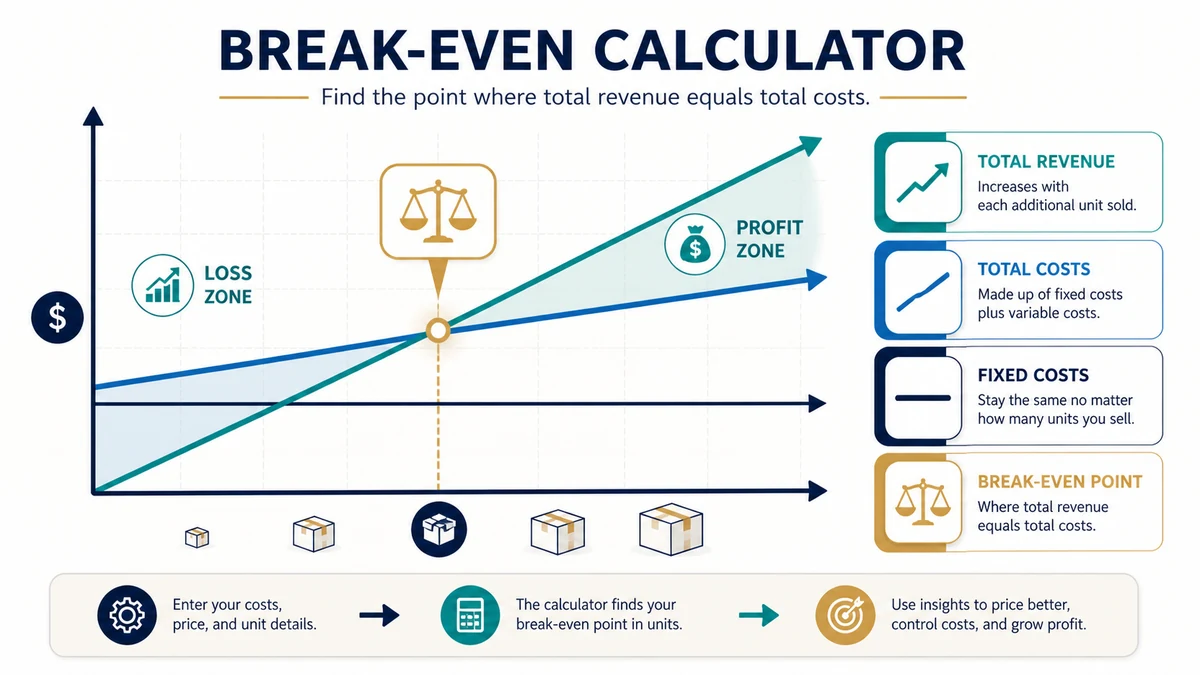
A Break-Even Calculator finds the sales volume where modeled revenue equals modeled cost. It starts with selling price, variable cost per unit, and fixed costs for one consistent period. Additional outputs can show contribution margin, break-even revenue, margin of safety, and units needed for a target profit.
Contribution margin pays fixed costs first
Contribution margin per unit = selling price − variable cost per unit
Each unit contributes this amount toward fixed costs. After fixed costs are covered, the same margin contributes to operating profit. If price is $40 and variable cost is $24, unit contribution margin is $16.
Find the break-even point in units and dollars
Break-even units = fixed costs ÷ contribution margin per unit
With monthly fixed costs of $12,000 and $16 contribution per unit, break-even volume is 750 units. Break-even revenue is 750 × $40 = $30,000. Round required units upward because a fraction of a sale may not be possible.
Add a profit target deliberately
Target-profit units = (fixed costs + target profit) ÷ contribution margin per unit
A $4,000 monthly target in the example requires 1,000 units. This is an operating model before financing costs, taxes, capacity constraints, and any cost not included in the inputs.
Classify costs by behavior, not by name
Fixed costs stay approximately unchanged within the modeled activity range and period. Variable costs change with each unit. A cost can be mixed or step-fixed: utilities may have a base charge plus usage, and staffing may jump after a production threshold. Split the components where practical.
Use margin of safety as a warning distance
Expected sales above break-even provide a margin of safety; sales below it imply a modeled loss. Compare units and revenue using the same price and mix. A multi-product business needs weighted contribution margins, so a single-product Break-Even Calculator may not be sufficient.
Stress-test price and variable cost
Run separate cases for discounts, supplier increases, returns, commission, packaging, and payment fees. A small reduction in contribution margin can raise required volume sharply. Also confirm that the required output fits equipment, labor, demand, and inventory capacity.
Related business calculations
Estimate sales-based pay with the Commission Calculator and place the planned costs into the Budget Calculator.
Break-Even Calculator FAQ
Is break-even the same as cash flow?
No. Timing of receipts, payments, inventory, debt, and noncash expenses can make cash flow different.
What if variable cost exceeds price?
Contribution margin is zero or negative, so greater volume cannot cover fixed costs under those inputs.
Should startup costs be included?
Allocate them to the modeled period only when that treatment fits the business analysis.
Authoritative formula
The U.S. Small Business Administration break-even calculator uses fixed costs ÷ (price − variable cost) for break-even units.
Capacity can make a mathematical target impossible
If break-even requires 1,200 units but equipment and labor can produce only 900, the current price-and-cost model is not feasible. Test price, variable cost, fixed cost, product mix, or capacity rather than treating the calculated volume as an instruction.
Use the same period everywhere
Monthly fixed costs require monthly target sales. Annual insurance or software should be allocated consistently when the analysis is monthly. Mixing annual fixed cost with monthly volume can inflate the Break-Even Calculator result by a factor of twelve.
After break-even, monitor actual contribution
Compare realized selling price and variable cost with the assumptions. Discounts, scrap, returns, shipping, card fees, and sales commission can reduce contribution. Recalculate when the product mix or supplier cost changes instead of keeping the original threshold indefinitely.
For a service business, define one “unit” clearly—an hour, engagement, seat, or transaction—and include variable labor that truly changes with delivery.