
Debt-to-Income Ratio Calculator
Calculate your monthly debt-to-income ratio using gross income, housing payment, and other monthly debt payments.
Other Monthly Debts
Add credit cards, student loans, auto loans, personal loans, and other recurring debt payments. Blank rows are ignored.
DTI Results
This calculator uses gross income before taxes and recurring debt payments. It is an estimate only. Lenders may calculate DTI differently depending on loan type, credit profile, taxes, insurance, HOA dues, alimony, child support, and underwriting rules.
The Debt-to-Income Ratio Calculator compares recurring monthly debt obligations with gross monthly income. Lenders use DTI as one measure of repayment capacity, but different products and lenders can count debts differently and apply different limits.
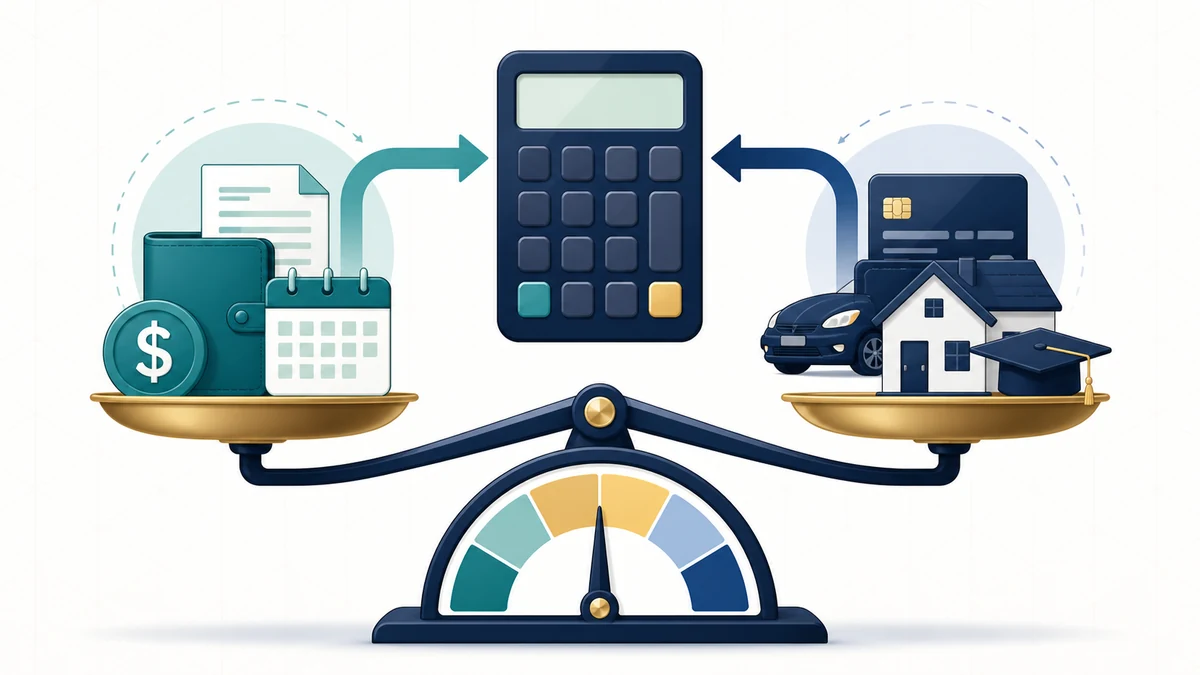
Gross income is the denominator
Use recurring income before tax and payroll deductions. Convert annual salary to monthly income by dividing by 12. For variable, commission, self-employment, or rental income, lender documentation and averaging rules may differ from a simple monthly estimate.
Front-end and back-end DTI answer different questions
Front-end DTI = monthly housing cost ÷ gross monthly income × 100
Back-end DTI = all counted monthly debts ÷ gross monthly income × 100
Housing cost may include principal, interest, property tax, homeowners insurance, mortgage insurance, and association dues. Back-end debt commonly adds required payments for credit cards, vehicle loans, student loans, personal loans, alimony, or other counted obligations.
A transparent example
With gross monthly income of $6,000, a $1,500 housing payment produces a 25% front-end ratio. Add $100 for an auto loan and $400 for other recurring debts: $2,000 ÷ $6,000 = 33.33% back-end DTI.
What usually does not belong in the debt list
Groceries, utilities, fuel, taxes, and ordinary living expenses are essential to affordability but are not normally debt payments in the basic DTI formula. They still belong in a household budget. Conversely, omitting a recurring legal or credit obligation can understate DTI.
Do not turn one ratio into an approval prediction
The Debt-to-Income Ratio Calculator does not evaluate credit history, assets, reserves, loan-to-value, interest-rate changes, or program eligibility. It also cannot determine the payment a lender will assign to student loans or revolving accounts. Use the lender’s current guidance for a specific application.
Improve the inputs before comparing results
- Use the prospective full housing payment, not only principal and interest.
- Use required monthly debt payments, not outstanding balances.
- Keep income and debt in the same monthly period.
- Run a second scenario for rate or payment changes.
Related affordability checks
Review living expenses with the Budget Calculator, explore debt reduction with the Debt Payoff Calculator, and compare housing paths with the Rent vs Buy Calculator.
DTI FAQ
Is lower DTI always better?
A lower ratio generally means less income is committed to debt, but it is only one financial measure.
Do lenders use net income?
The standard DTI definition uses gross income, though underwriting documentation rules vary.
Is there one universal maximum?
No. The CFPB notes that limits differ by lender and loan product.
Official definition
Consumer Financial Protection Bureau: debt-to-income ratio.
Future housing scenarios require the full payment
When testing a home purchase, include the proposed principal and interest plus estimated property tax, insurance, mortgage insurance, and association dues. Using only the advertised mortgage payment understates housing DTI. Update the scenario when a lender provides more accurate figures.
Income documentation can change the lender result
A self-calculated Debt-to-Income Ratio Calculator may accept any recurring income, while underwriting may require a history, specific documents, or exclusions. Bonuses, overtime, commissions, rental income, and self-employment income may be averaged or adjusted. Treat the result as preparation for a conversation, not a qualification certificate.
Recheck after a debt changes
If an account is paid off, confirm whether its remaining scheduled payments are excluded under the relevant program. If a new loan is opened or a deferred student loan enters repayment, update the monthly obligation. Also stress-test a higher housing payment if taxes or insurance could rise.
DTI complements a budget: the ratio uses gross income and selected debt obligations, while the budget tests whether all real living costs fit take-home cash. Recalculate with the Debt-to-Income Ratio Calculator whenever the required monthly payment or documented gross income changes.