Debt Payoff Calculator
Compare debt avalanche and debt snowball payoff methods side-by-side using balances, APRs, minimum payments, and extra monthly payment.
Debts
Enter each debt balance, APR, and minimum monthly payment. Blank rows are ignored.
Debt Payoff Comparison
—
Debt Avalanche
Targets the highest APR first to reduce interest cost.
Debt Snowball
Targets the smallest balance first for faster early wins.
This calculator provides an estimate only. Actual payoff results may differ because of statement dates, compounding rules, changing APRs, late fees, promotional rates, balance transfers, new purchases, payment timing, and lender-specific minimum payment rules.
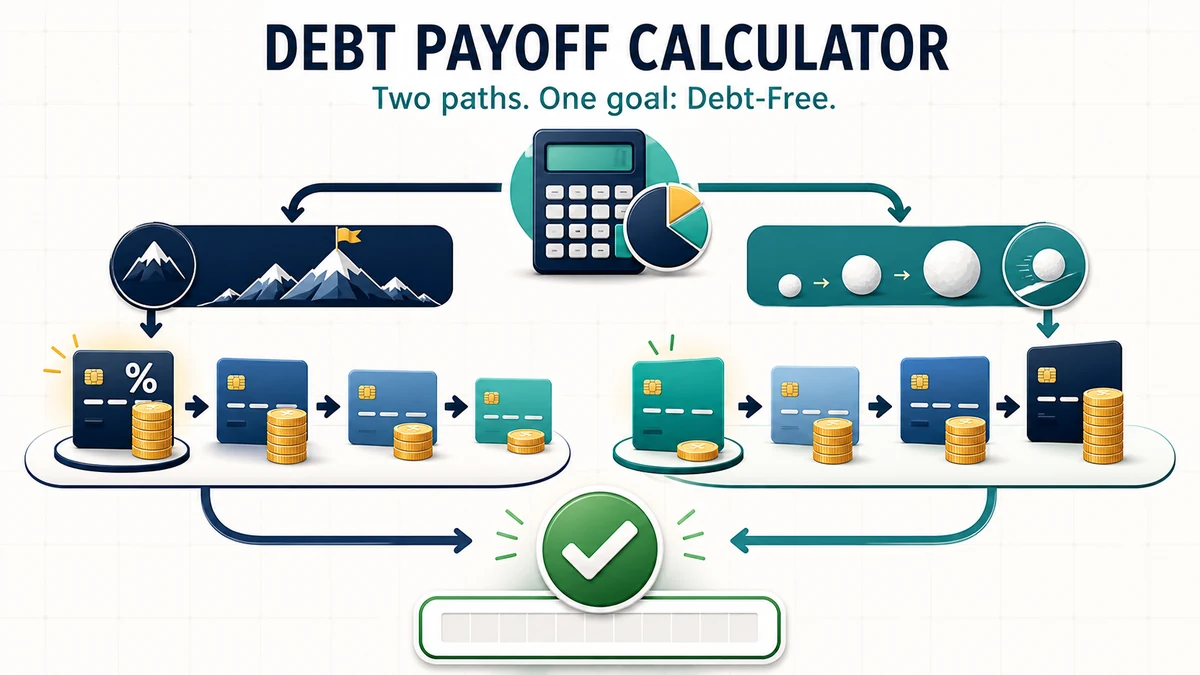
The Debt Payoff Calculator compares two ways to direct money above minimum payments. The avalanche method targets the highest interest rate; the snowball method targets the smallest balance. Both keep minimums current on the remaining accounts and roll a finished payment into the next debt.
Prepare a complete debt list
For every account, enter the current balance, annual percentage rate, and required minimum payment from the latest statement. Add the extra amount your budget can reliably sustain. Exclude debts with special rules unless the calculator models those rules correctly.
Avalanche: prioritize interest cost
After minimums, the avalanche sends extra money to the highest APR. This generally minimizes modeled interest when rates and payments remain constant. It can take longer to close the first account if that balance is large.
Snowball: prioritize early account closures
The snowball attacks the smallest balance first, regardless of APR. Early wins may make the plan easier to follow, though the mathematical interest cost can be higher.
Why payment rollover matters
Assume three debts require minimums of $40, $90, and $160, plus $100 extra. When the first account closes, its $40 does not disappear: the next target receives $140 extra. Keeping the total monthly debt budget constant is what accelerates the schedule.
Interest is estimated month by month
A simplified model uses monthly interest = balance × APR ÷ 12, then subtracts the payment. Real creditors may use daily periodic rates, changing minimum formulas, promotional periods, fees, or different payment allocation rules. Compare the estimate with statements.
Choose a plan you can maintain
Compare payoff month, total modeled interest, first debt closed, and required monthly cash. Keep an emergency buffer so an unexpected bill does not immediately return to a credit card. If minimums are unaffordable, contact creditors or a reputable nonprofit counselor rather than relying solely on an optimization result.
Coordinate with other numbers
Confirm the extra payment in the Budget Calculator, calculate recurring debt pressure with the Debt-to-Income Ratio Calculator, and compare refinancing offers with the Loan Comparison Calculator.
Debt Payoff Calculator FAQ
Which method is always best?
Avalanche often minimizes modeled interest; snowball may better support motivation. Affordability and account terms still matter.
Should I stop making minimum payments?
No. The strategies assume every required minimum remains current.
Will an extra payment always reduce principal?
Confirm the creditor’s allocation and prepayment terms.
Consumer resource
The CFPB Debt Action Plan describes highest-interest and smallest-debt repayment strategies.
Promotional rates need an expiration date
A zero or low introductory APR can change before the balance is gone. Run one scenario through the promotional period and another using the later rate. If a balance-transfer fee applies, include it in the starting balance or cost comparison as the tool instructs.
Do not drain the payment plan after a payoff
The Debt Payoff Calculator assumes the freed minimum rolls forward. If the household instead reduces its total monthly payment, the remaining payoff dates will be later than shown. Save the monthly debt budget beside the strategy so the rollover is deliberate.
Monthly review checklist
- confirm statement balances, APRs, minimums, and due dates;
- check that extra payments reached the intended account;
- record fees or rate changes;
- remove a closed account only after the final statement clears;
- rerun the schedule after any missed or additional payment.
When a settlement, consolidation, or hardship program is involved, seek reliable counseling and understand credit, tax, and legal consequences before replacing contractual terms with a calculator estimate.
Save both strategy results from the Debt Payoff Calculator and compare the interest difference with the date of the first expected account closure. The best usable plan is one the household can follow without missing required payments or essential expenses.