
Commission Calculator
Calculate commission earnings, total pay, effective commission rate, and the sales needed to reach a target commission.
Commission Results
This calculator uses a simple flat-rate commission formula. Actual commission pay may differ if your company uses tiered rates, quotas, clawbacks, taxes, deductions, caps, chargebacks, or different rules for gross sales versus net sales.
The Commission Calculator models a flat-rate plan: multiply eligible sales by the commission percentage, then add any entered base pay or bonus. It can also reverse the equation to estimate the sales needed for a target commission.
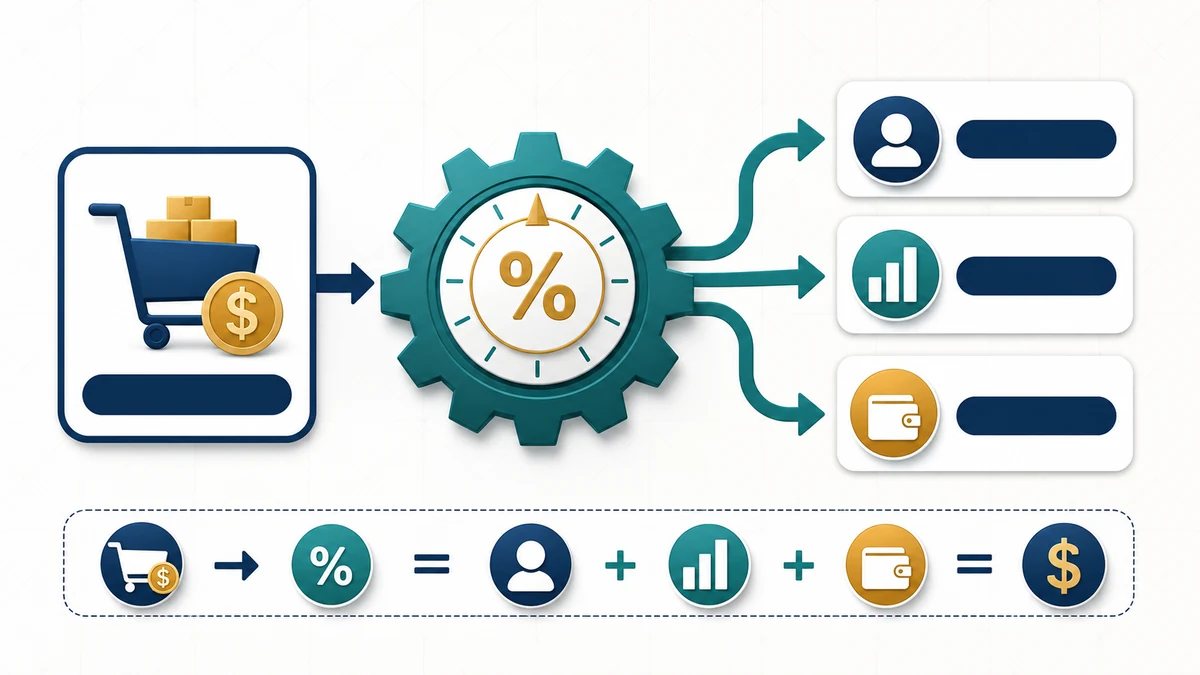
First identify commissionable sales
Gross revenue is not always commissionable revenue. Returns, discounts, tax, shipping, uncollected invoices, split credit, and excluded products may be removed under the compensation plan. Use the amount defined by the written agreement.
Flat-rate commission equations
Commission = eligible sales × commission rate ÷ 100
Total compensation = commission + base pay + bonus or adjustment
Required sales = target commission ÷ (commission rate ÷ 100)
At a 6% rate, $42,000 of eligible sales generates $2,520 commission. If the target commission is $3,600, required eligible sales are $60,000.
Timing can matter as much as the rate
Confirm whether commission is earned when a contract is signed, an invoice is issued, payment is collected, or a return period ends. A calculation can be correct while the expected pay date is wrong.
When the flat-rate result will not match payroll
The tool may not reproduce tiered rates, thresholds, draws, accelerators, caps, team splits, territory credit, chargebacks, or product-specific percentages. Calculate each tier separately only when the plan documents the breakpoint and rate. Do not average tier percentages without weighting them by eligible sales.
Gross earnings are not take-home pay
The Commission Calculator estimates compensation before any applicable withholding or deductions. In the United States, the IRS treats commissions as compensation and withholding depends on employment and tax circumstances. Do not subtract a guessed tax percentage and call it net pay.
Audit a commission statement
- Match eligible transactions to the correct period.
- Apply returns, splits, and exclusions from the plan.
- Check each rate or tier.
- Add documented bonuses and subtract authorized chargebacks.
- Compare the gross result with the statement before payroll deductions.
Connect sales earnings to planning
Use the Budget Calculator to build a cautious variable-income baseline. Businesses can compare margin and volume using the Break-Even Calculator.
Commission Calculator FAQ
Does the calculator support tiered commission?
The standard flat-rate result does not; calculate documented tiers separately.
Can I calculate the commission rate?
When sales and commission are known, rate = commission ÷ eligible sales × 100.
Are bonuses commissions?
They may be separate compensation components. Follow the plan and payroll classification.
Tax reference
IRS tax-withholding guidance includes commissions among pay subject to withholding.
Tiered plans require marginal calculations
Suppose the first $20,000 pays 4% and sales above $20,000 pay 7%. At $30,000, commission is $800 on the first tier plus $700 on the second, or $1,500—not 7% of all $30,000 unless the plan is retroactive. Identify whether rates are marginal or retroactive before using the Commission Calculator.
Chargebacks can cross pay periods
A canceled sale may reduce a later statement rather than the period in which the original commission appeared. Keep gross earned commission, chargebacks, bonuses, and prior draws as separate lines so the reconciliation remains understandable.
For managers planning a compensation plan
Test required sales, gross margin, maximum payout, and behavior around tier boundaries. A commission formula should be written clearly enough that a representative can reproduce it. Review employment, tax, and wage requirements with qualified professionals before implementation; this calculator supplies arithmetic, not legal compliance.
Reconcile the effective rate
Divide total commission by eligible sales to find the effective rate. Compare that figure with the plan only after tiers, splits, and exclusions are applied. Save the transaction list and period used in the Commission Calculator; without them, a correct total cannot be reproduced later.
When income varies sharply, build a household budget from a cautious baseline rather than the highest recent commission month.