Credit Card Interest Calculator

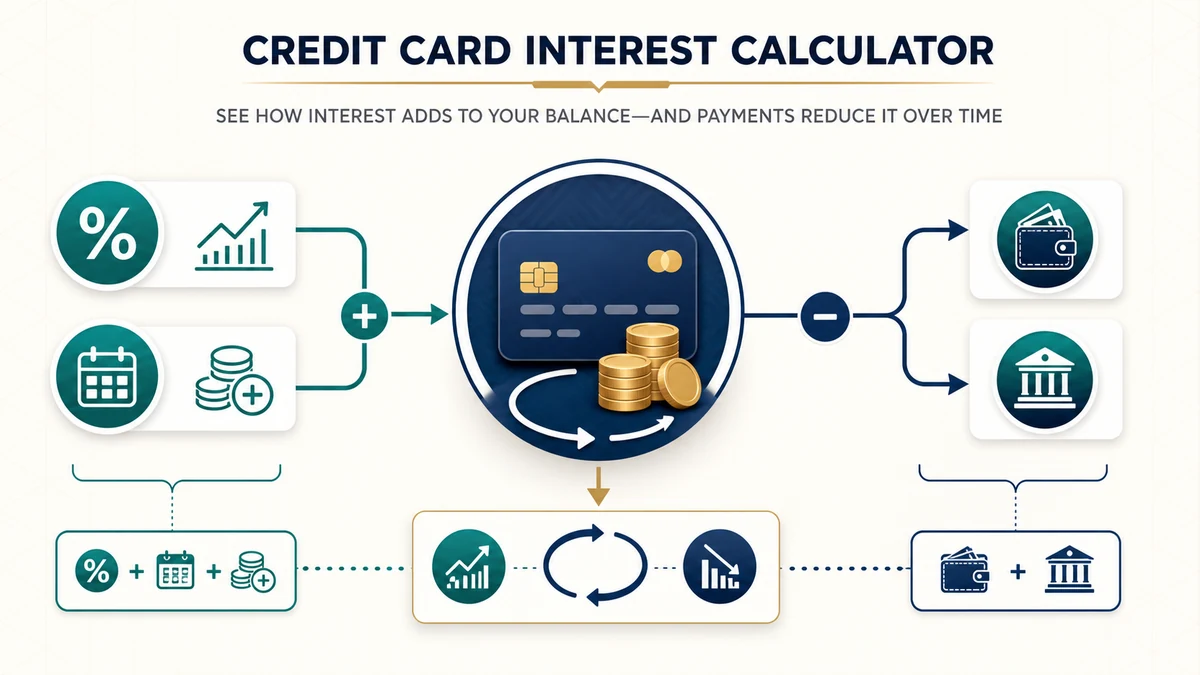
Estimate monthly interest using APR and average daily balance, plus projections.

Inputs
Projection (optional)
Results
Monthly interest estimate + projections.
Daily periodic rate
Monthly periodic rate (approx)
Estimated interest this cycle
Total interest over projection
Ending balance (projection)
Projection schedule
# Balance start Purchases Interest Payment Balance end
Run a calculation to see the schedule.
Note: This is an estimate. Real issuers may compute interest daily and apply payments on specific dates.

Important Note : credit card interest varies by issuer, transaction type, billing method, grace period, and payment timing. CFPB notes that a grace period may prevent interest on purchases when the full balance is paid by the due date, but credit card companies are not required to provide a grace period.

Use this Credit Card Interest Calculator to estimate how much interest a credit card balance may cost during a billing cycle. Enter your current balance, APR, number of days in the billing cycle, and optional average daily balance to estimate the interest charge. You can also add a monthly payment, new purchases, and projection length to see how the balance may change over time.

This calculator is useful when you want to understand how APR turns into daily interest, compare the cost of carrying a balance, estimate how payments affect future balances, or see why minimum-only payments can make credit card debt expensive over time.

Reviewed by: AjaxCalculators Editorial Team
Last updated: May 2, 2026
Method source: APR, daily periodic rate, average daily balance, billing-cycle interest, payment, purchase, and projection concepts based on standard credit card interest methods described by the Consumer Financial Protection Bureau and other official consumer-finance references
Editorial standards: AjaxCalculators Editorial Policy

What This Credit Card Interest Calculator Does

This calculator estimates the interest charged on a credit card balance using APR and billing-cycle assumptions. Depending on the values entered, it can calculate:

  • Daily periodic rate from the annual APR
  • Approximate billing-cycle interest
  • Estimated interest using average daily balance
  • Estimated ending balance after payments, new purchases, and interest
  • Total interest over a projection period
  • Month-by-month projection schedule
  • Warnings when the payment may be too low to reduce the balance meaningfully

The calculator is designed for education and planning. It does not reproduce every detail of a card issuer’s billing system.

How Credit Card Interest Works

Credit card APR stands for Annual Percentage Rate. Although APR is stated as a yearly rate, many credit card issuers calculate interest daily. To estimate daily interest, APR is converted into a daily periodic rate.

A common simplified structure is:

Daily periodic rate = APR ÷ 365

Estimated billing-cycle interest = Average daily balance × Daily periodic rate × Days in billing cycle

For example, if your credit card APR is 24.99%, the daily periodic rate is approximately:

24.99% ÷ 365 = 0.06847% per day

As a decimal, that is:

0.0006847 per day

If your average daily balance is $2,000 and the billing cycle has 30 days, estimated interest would be:

$2,000 × 0.0006847 × 30 = $41.08

APR vs Daily Periodic Rate

APR and daily periodic rate are related, but they are not the same thing.

Term Meaning Example at 24.99% APR
APR Annual percentage rate used to describe yearly borrowing cost 24.99% per year
Daily periodic rate Daily version of the APR used for daily interest calculations 24.99% ÷ 365 = about 0.06847% per day
Billing-cycle interest Interest estimated over the days in one billing cycle Average daily balance × daily rate × billing-cycle days

A higher APR creates a higher daily periodic rate, which can increase interest charges if you carry a balance.

Daily Periodic Rate Formula

This calculator estimates the daily periodic rate as:

Daily periodic rate = APR ÷ 100 ÷ 365

For an APR of 24.99%:

Daily periodic rate = 24.99 ÷ 100 ÷ 365

Daily periodic rate ≈ 0.0006847

As a percentage:

0.0006847 × 100 ≈ 0.06847% per day

Your cardholder agreement may describe the exact periodic rate and whether the issuer uses 365 days, 366 days, or another disclosed method. Use your statement or agreement for the official calculation method.

Average Daily Balance vs Current Balance

The current balance is the amount shown on your account at a specific time. The average daily balance is based on the balance across the days in the billing cycle.

If your balance changes during the month because of purchases, payments, refunds, interest, or fees, your average daily balance may be different from your current balance.

Balance Type Meaning Why It Matters
Current balance Balance shown at a specific moment Useful for a quick estimate
Statement balance Balance at the end of the billing cycle Often important for grace-period rules
Average daily balance Average of daily balances during the billing cycle Often closer to how many issuers calculate interest
Payoff amount Amount needed to satisfy the account at a specific time May include accrued interest not shown in a simple estimate

If the optional average daily balance field is blank, the calculator assumes the average daily balance equals the current balance. This is convenient, but it may not match your issuer’s actual interest calculation.

Compounding Method Caveat

Some credit card agreements describe daily balance methods where interest can accrue daily and may be included in later daily-balance calculations. This can create a compounding effect, depending on the card agreement and billing method.

This calculator uses a simplified billing-cycle estimate:

Interest = Average daily balance × Daily periodic rate × Billing-cycle days

That method is useful for planning, but it may not capture every issuer-specific detail, such as:

  • daily compounding rules
  • exact daily balances
  • payment posting dates
  • purchase posting dates
  • fees added during the cycle
  • different APR categories
  • promotional or penalty APR changes

For exact interest charges, use your card statement or cardholder agreement.

Credit Card Interest Formula Used

This calculator uses the following estimated method:

Daily periodic rate:
APR ÷ 100 ÷ 365

Estimated billing-cycle interest:
Average daily balance × daily periodic rate × billing-cycle days

Projection balance:
Starting balance + new purchases + interest − payment

The projection repeats this process month by month for the selected projection length.

Formula Summary

Calculation Formula Known Values Needed
Daily periodic rate APR ÷ 100 ÷ 365 APR
Billing-cycle interest Average daily balance × daily rate × days Average daily balance, daily rate, billing-cycle days
Ending balance Starting balance + purchases + interest − payment Balance, purchases, interest, payment
Principal reduction Payment − interest − new purchases Payment, interest, new purchases
Total projected interest Sum of monthly interest estimates Projection schedule

Worked Example: One Billing Cycle Interest

Suppose you have the following credit card details:

  • Current balance: $3,500
  • APR: 24.99%
  • Billing cycle: 30 days
  • Average daily balance: $3,500

Step 1: Convert APR to daily periodic rate
24.99% ÷ 365 = about 0.06847% per day

As a decimal:

0.06847% = 0.0006847

Step 2: Estimate billing-cycle interest
Interest = $3,500 × 0.0006847 × 30

Step 3: Calculate
Interest ≈ $71.89

Result: The estimated interest for this 30-day billing cycle is about $71.89.

Worked Example: Payment, Purchases, and Ending Balance

Now suppose the same account has:

  • Starting balance: $3,500
  • Estimated interest: $71.89
  • Monthly payment: $150
  • New purchases: $50

Step 1: Use the projection balance formula
Ending balance = starting balance + new purchases + interest − payment

Step 2: Substitute values
Ending balance = $3,500 + $50 + $71.89 − $150

Step 3: Calculate
Ending balance = $3,471.89

Result: Even after a $150 payment, the balance only falls by about $28.11 because $50 in new purchases and $71.89 in interest were added during the cycle.

Worked Example: Why Minimum Payments Can Be Risky

Suppose your balance is $3,500 at 24.99% APR, and a simplified minimum-payment rule produces a payment of $70.

From the previous example, estimated interest for the cycle is about $71.89.

Step 1: Compare payment with interest
Payment = $70
Estimated interest = $71.89

Step 2: Calculate balance change with no new purchases
Ending balance = $3,500 + $71.89 − $70

Step 3: Calculate
Ending balance = $3,501.89

Result: In this simplified example, the payment is not enough to cover the estimated interest, so the balance increases. Real issuer minimum-payment formulas may differ, but this shows why a low payment can make payoff slow or unrealistic.

Worked Payoff Example: $150 Payment vs $250 Payment

Using the same $3,500 balance, 24.99% APR, and a 30-day cycle, compare two payment choices with no new purchases.

Monthly Payment Estimated First-Cycle Interest Estimated Principal Reduction Estimated Ending Balance
$150 $71.89 $78.11 $3,421.89
$250 $71.89 $178.11 $3,321.89

Result: The $250 payment reduces principal by about $100 more in the first cycle. Because future interest is based on the remaining balance, larger payments can reduce interest faster over time.

Worked Projection Example: First 3 Months

This simplified projection uses:

  • Starting balance: $3,500
  • APR: 24.99%
  • Billing cycle: 30 days
  • Monthly payment: $150
  • New purchases: $0
Month Starting Balance Estimated Interest Payment Ending Balance
1 $3,500.00 $71.89 $150.00 $3,421.89
2 $3,421.89 $70.28 $150.00 $3,342.17
3 $3,342.17 $68.65 $150.00 $3,260.82

Result: Over the first three months, the balance falls from $3,500.00 to about $3,260.82 in this simplified model. Total estimated interest over those three months is about $210.82.

Grace-Period Caveat

A credit card grace period is the time between the end of a billing cycle and the payment due date, when eligible purchases may avoid interest if the full statement balance is paid by the due date.

Grace-period rules vary by issuer and transaction type. Important caveats include:

  • If you pay the full statement balance by the due date, eligible purchases may avoid interest.
  • If you carry a balance, you may lose the grace period for new purchases until the account is paid according to issuer rules.
  • Cash advances often do not receive a purchase grace period.
  • Balance transfers may have different interest and grace-period rules.
  • Promotional APR offers can have special terms and deadlines.
  • Late payments can trigger fees or penalty APRs, depending on the card agreement.

This calculator does not determine whether your account currently has a grace period. Check your statement and cardholder agreement for the official rule.

Minimum-Payment Warning

Minimum payments can keep an account current, but they are usually not designed to pay down debt quickly. If you pay only the minimum, a large share of your payment may go to interest, especially when the APR is high.

Payment Pattern Possible Result Why It Matters
Payment is less than estimated interest Balance may increase Debt can grow even while payments are made
Payment barely exceeds interest Balance falls slowly Payoff can take a long time
Payment is well above interest Principal falls faster Total interest may decrease over time
New purchases continue Progress may slow or reverse The balance may not decline as expected

For payoff planning, compare your minimum payment with the estimated interest and new purchases. If the payment is not much higher than those additions, the balance may decline slowly.

How to Use the Credit Card Interest Calculator

  1. Enter your current credit card balance.
  2. Enter your card’s APR as a percentage.
  3. Enter the number of days in your billing cycle. Many cycles are around 28 to 31 days.
  4. Optionally enter your average daily balance. Leave it blank if you want the calculator to use your current balance.
  5. For projections, enter a monthly payment, expected new purchases per month, and projection length.
  6. Click Calculate if the tool requires it.
  7. Review estimated interest, daily periodic rate, ending balance, and projection schedule.
  8. Compare the estimate with your official statement before making financial decisions.

How to Interpret the Results

The result labeled Estimated interest this cycle shows the approximate finance charge for one billing cycle based on the inputs you entered.

Result Meaning How to Use It
Daily periodic rate Daily version of the APR Helps explain how annual APR becomes daily interest
Estimated cycle interest Approximate interest for one billing cycle Shows the cost of carrying the balance for that cycle
Total interest over projection Estimated interest across multiple months Helps compare payment and purchase strategies
Ending balance Balance after purchases, interest, and payments Shows whether the balance is rising or falling
Projection schedule Month-by-month estimate Helps identify slow payoff or high interest cost

If the ending balance goes down slowly, your payment may not be much higher than the interest and new purchases added each month.

Why Your Actual Credit Card Interest May Be Different

Your real credit card interest may differ from this calculator because issuers can apply specific rules from your card agreement.

  • Daily balance or average daily balance calculations
  • Daily compounding rules
  • Exact purchase dates and payment posting dates
  • Grace-period eligibility
  • Different APRs for purchases, balance transfers, and cash advances
  • Promotional APRs, deferred-interest offers, or penalty APRs
  • Fees added to the balance
  • Payment allocation rules across different APR categories
  • Statement closing date and due date timing
  • Leap-year or issuer-specific daily-rate rules

This calculator is best used as an estimate and comparison tool. For exact interest, use your issuer’s statement, online account, payoff quote, or card agreement.

Tips to Reduce Credit Card Interest

  • Pay more than the minimum payment when possible.
  • Stop or reduce new purchases while paying down the balance.
  • Pay earlier in the billing cycle if your issuer calculates interest daily.
  • Review your APR categories for purchases, transfers, and cash advances.
  • Pay the full statement balance by the due date to preserve a grace period when available.
  • Ask your issuer about hardship options if you are struggling to make payments.
  • Consider nonprofit credit counseling if debt payoff feels unmanageable.

When This Calculator Is Useful

This calculator can help you:

  • Estimate the cost of carrying a credit card balance
  • Understand how APR affects daily and monthly interest
  • Compare payoff strategies
  • Estimate how new purchases affect your balance
  • Plan a larger monthly payment
  • See why high-interest credit card debt can grow quickly
  • Compare current balance and average daily balance estimates
  • Review how a grace period may affect purchase-interest planning

When You May Need More Than This Calculator

A simple calculator may not be enough when your credit card account has complex terms or when the financial decision is important.

Use your issuer’s official information or qualified guidance when working with:

  • cash advances
  • balance transfers
  • deferred-interest offers
  • 0% promotional APR deadlines
  • penalty APRs
  • late fees or annual fees
  • multiple APR categories
  • payment allocation questions
  • hardship plans
  • collections or debt settlement
  • bankruptcy or legal debt questions

Common Mistakes to Avoid

  • Confusing APR with daily interest: APR is annual; daily interest uses a periodic rate.
  • Assuming current balance equals average daily balance: payments and purchases can change the average.
  • Ignoring grace-period rules: carrying a balance may affect whether new purchases avoid interest.
  • Assuming cash advances work like purchases: cash advances often have different APRs and may not have the same grace period.
  • Paying only the minimum without checking interest: payoff can take much longer and cost much more.
  • Ignoring new purchases: new charges can cancel out progress from payments.
  • Forgetting fees: fees can increase the balance and interest cost.
  • Using the calculator as an official statement: only your issuer can provide exact account-specific calculations.

Assumptions and Limitations

  • The calculator uses APR divided by 365 for the daily periodic rate.
  • It assumes the average daily balance equals the current balance when the average daily balance field is left blank.
  • The projection uses the same payment and new purchase amount each month.
  • It uses a simplified interest model for planning and may not capture every issuer-specific compounding rule.
  • It does not separately model different APR categories such as cash advances, promotional balances, or balance transfers.
  • It does not guarantee your issuer’s exact finance charge.
  • It does not include late fees, annual fees, penalty APRs, returned-payment fees, or other account charges unless you manually account for them.
  • It does not determine your grace-period eligibility.
  • It does not provide financial, legal, credit, or debt-management advice.

Credit Card Interest Calculator Example Table

Input Example Value
Balance $3,500
APR 24.99%
Daily periodic rate About 0.06847% per day
Billing cycle 30 days
Average daily balance $3,500
Estimated interest About $71.89

Official References

  1. Consumer Financial Protection Bureau: How credit card companies calculate interest
  2. Consumer Financial Protection Bureau: Credit card contract definitions
  3. Consumer Financial Protection Bureau: Daily periodic rate
  4. Consumer Financial Protection Bureau: Credit card grace period
  5. Consumer Financial Protection Bureau: Credit card payoff disclosure and minimum-payment guidance
  6. Federal Trade Commission: Using credit cards and disputing charges
  7. Federal Trade Commission: How to get out of debt

Related Calculators

Frequently Asked Questions

How do I calculate credit card interest from APR?

Divide the APR by 365 to estimate the daily periodic rate, then multiply that rate by the average daily balance and the number of days in the billing cycle.

What is the daily periodic rate on a credit card?

The daily periodic rate is the daily version of your APR. A common estimate is APR divided by 365, although your card agreement controls the exact method.

Is APR the same as monthly interest?

No. APR is annual. Monthly or billing-cycle interest is estimated by converting APR into a periodic rate and applying it to the balance for the days in the billing cycle.

What is average daily balance?

Average daily balance is the average of your balance across the days in a billing cycle. It can change when you make purchases, payments, refunds, transfers, interest charges, or fees during the cycle.

Does credit card interest compound daily?

Some card agreements can create a daily compounding effect depending on how daily balances and interest are calculated. This calculator uses a simplified billing-cycle estimate and may not match every issuer’s compounding method.

Why is my actual credit card interest different from this calculator?

Your actual interest can differ because card issuers may use exact daily balances, payment posting dates, compounding, grace periods, promotional APRs, cash advance APRs, fees, and other account-specific rules.

What is a credit card grace period?

A grace period is the time between the end of the billing cycle and the payment due date when eligible purchases may avoid interest if you pay the full statement balance by the due date.

Can I avoid credit card interest?

You may be able to avoid purchase interest if your card has a grace period and you pay the full statement balance by the due date. Cash advances, balance transfers, promotional balances, or accounts carrying balances may follow different rules.

Does making a payment early reduce interest?

It can. If your issuer calculates interest daily, paying earlier may lower daily balances and reduce interest compared with waiting until the due date.

Why are minimum payments risky?

Minimum payments can keep an account current, but they may reduce the balance very slowly. If the payment is close to the interest charged, payoff can take a long time and cost much more.

What happens if my payment is less than the interest?

In a simplified model, the balance can increase if the payment is less than the interest added. Real issuer minimum-payment formulas may differ, but very low payments can still make payoff slow.

Does this calculator include new purchases?

Yes, if you enter a new-purchases amount for the projection. New purchases can increase the balance and may reduce or reverse payoff progress.

Does this calculator include fees?

No. Unless you manually add them to the balance, this calculator does not include late fees, annual fees, balance transfer fees, cash advance fees, returned-payment fees, or penalty charges.

Can this calculator replace my credit card statement?

No. It provides an estimate only. Your credit card statement and cardholder agreement are the official sources for APR, balance calculation method, grace-period rules, fees, and payment terms.

Can this calculator give financial advice?

No. It is an educational planning tool. For debt-management decisions, hardship options, credit counseling, settlement, or legal questions, use qualified financial or nonprofit credit counseling guidance.

Finance Disclaimer

This Credit Card Interest Calculator provides educational estimates only. It does not provide financial, legal, credit, tax, or debt-management advice. Actual credit card interest, finance charges, grace-period eligibility, payment allocation, fees, and payoff amounts depend on your issuer’s cardholder agreement and account activity. Review your monthly statement, card agreement, and issuer disclosures for official terms. If you are having trouble making payments or managing credit card debt, consider contacting your card issuer or a qualified nonprofit credit counselor.

Quick Info: This Credit Card Interest Calculator provides educational estimates using APR, daily periodic rate, average daily balance, billing-cycle days, payments, new purchases, and projection assumptions. Actual credit card interest may differ because issuers can use daily balance or average daily balance methods, daily compounding, exact transaction dates, payment posting dates, grace-period rules, multiple APR categories, promotional APRs, penalty APRs, balance transfer terms, cash advance rules, fees, and cardholder agreement details. If you pay the full statement balance by the due date and your card has a purchase grace period, eligible purchases may avoid interest; however, grace periods may not apply to cash advances, some balance transfers, promotional balances, or accounts already carrying a balance. Minimum payments can keep an account current but may reduce the balance slowly and can lead to much higher total interest. This calculator is not financial advice and does not replace your issuer’s statement, card agreement, official payoff quote, or credit counseling guidance. For exact finance charges, APR categories, payment allocation, grace-period eligibility, and payoff terms, review your statement or contact your card issuer.

More of our calculators...

Mortgage Calculator

Calculate monthly mortgage payment, total interest, payoff date, and amortization. Add down payment, taxes, insurance, PMI, and extra payments.

Mortgage Interest Calculator

Estimate total mortgage interest and monthly interest over the loan term. Compare rates and terms quickly.

Mortgage Calculator with Taxes and Insurance

Estimate monthly mortgage payment with principal, interest, taxes, insurance, HOA, PMI, closing costs, loan amount, and amortization preview.

Amortization Calculator

Generate a loan amortization schedule with monthly payment, principal, interest, balance, payoff date, total interest, and optional extra payments.

Refinance Calculator

Compare your current mortgage with our Refinance calculator. Estimate new payment, monthly savings, closing costs, break-even time, interest, and payoff dates.

Balance Transfer Calculator

Compare keeping your current credit card balance vs transferring it to a promo APR card. Estimate interest, transfer fees, savings, and payoff time.

Interest Rate Calculator

Calculate the interest rate needed to grow a present value into a future value. Supports annual, monthly, daily, and continuous compounding.

Inflation Calculator

Calculate how inflation changes money value over time. Estimate future value, today’s purchasing power, cumulative inflation, and monthly inflation schedule.

Salary calculator

Convert hourly, weekly, biweekly, semi-monthly, monthly, and annual pay. Estimate gross salary from hours per week and paid weeks per year.