Credit Card Payoff Calculator
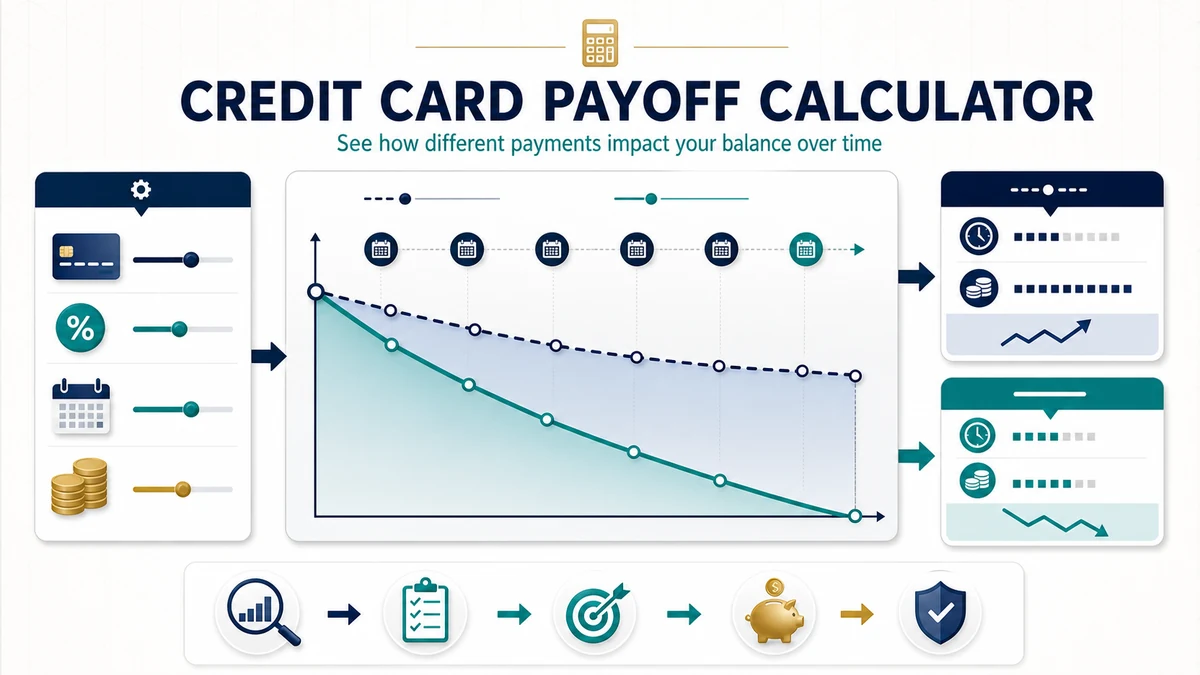
Estimate payoff time and interest for fixed payments or minimum payments.
| # | Date | Payment | Interest | Principal | Balance |
|---|---|---|---|---|---|
| Run a calculation to see the schedule. | |||||
Important Note : Estimate only. Actual card payoff may differ because issuers often use daily interest, statement-cycle timing, different APR categories, fees, and new purchases.
Use this Credit Card Payoff Calculator to estimate how long it may take to pay off your balance, how much interest you may pay, and what your payoff month could look like. It works with either a fixed monthly payment or a minimum-payment-style plan, making it useful for budgeting, debt payoff planning, and comparing payment strategies.
Reviewed by: AjaxCalculators Editorial Team
Last updated: May 2, 2026
Method source: Simplified credit card payoff model using current balance, APR, and either a fixed payment or a minimum-payment rule
Editorial standards: AjaxCalculators Editorial Policy
What This Credit Card Payoff Calculator Calculates
This calculator estimates how a credit card balance may decline over time under the payment settings you enter. It can calculate:
- Payoff time: estimated number of months needed to pay the balance to zero
- Estimated payoff month: a rough calendar month when the balance may be paid off
- Total interest paid: estimated interest cost over the payoff period
- Total amount paid: estimated principal plus interest paid
- Average monthly payment: especially useful when minimum payments change over time
- Monthly payoff schedule: a month-by-month estimate of interest, payment, and remaining balance
The calculator supports two common payoff styles:
- Fixed monthly payment: you pay the same amount each month until the balance is gone
- Minimum payment method: the calculator estimates payment using a minimum-payment percentage and minimum-payment floor
This makes it useful for comparing payoff strategies, checking whether a payment is large enough, and seeing how extra payments can reduce interest cost.
What Credit Card Payoff Means
Credit card payoff means reducing a revolving balance to zero. When you carry a balance from month to month, interest may be charged based on the card’s APR and the issuer’s interest calculation method.
A credit card payoff estimate usually depends on three major inputs:
- Balance: the amount you currently owe
- APR: the annual percentage rate charged on the balance
- Payment: how much you pay toward the balance each month
Higher APRs and lower payments usually increase the payoff time and total interest. Larger payments usually shorten the payoff timeline and reduce total interest.
How the Credit Card Payoff Calculator Works
This calculator starts with your current balance and APR, then estimates interest and payment progress over time.
1) Fixed Payment Method
In fixed-payment mode, the calculator assumes you pay the same amount each month until the balance reaches zero.
A simplified monthly model works like this:
Monthly interest ≈ current balance × monthly rate
New balance = current balance + interest − payment
Where:
- monthly rate ≈ APR ÷ 12
- payment is the fixed monthly amount you choose
As the balance gets smaller, the interest portion usually gets smaller too. That means more of each fixed payment may go toward principal over time.
2) Minimum Payment Method
In minimum-payment mode, the calculator estimates each month’s payment using a rule such as:
Minimum payment = greater of:
- balance × minimum payment percent
- minimum payment floor
If you enter an extra payment amount, that extra amount is added on top of the estimated minimum payment.
Minimum-payment plans often start with larger payments when the balance is high, then payments may shrink as the balance falls. This can make the payoff timeline much longer than a steady fixed-payment plan.
Formula Summary
| Calculation | Formula | Known Values Needed |
|---|---|---|
| Monthly interest rate | Monthly rate = APR ÷ 12 | APR |
| Monthly interest estimate | Interest ≈ balance × monthly rate | Balance and monthly rate |
| New balance | New balance = balance + interest − payment | Balance, interest, and payment |
| Minimum payment estimate | Greater of balance × minimum percent or minimum floor | Balance, percent, and floor |
| Total amount paid | Total paid = principal + total interest | Original balance and accumulated interest |
APR, Monthly Rate, and Daily Interest
APR stands for annual percentage rate. It is the yearly rate used to describe the cost of borrowing on a credit card.
This calculator uses a simplified monthly approach by dividing APR by 12. However, many credit card issuers calculate interest daily, often using an average daily balance method. That means a calculator estimate may differ from your actual statement interest.
| Interest Concept | Meaning | Why It Matters |
|---|---|---|
| APR | Annual percentage rate | Used to describe yearly borrowing cost |
| Monthly rate | APR divided by 12 | Useful for a simplified monthly payoff estimate |
| Daily periodic rate | APR divided by days in the year | Common in actual card interest calculations |
| Average daily balance | Average of daily balances during the billing cycle | Often used by issuers to calculate interest charges |
Use this calculator as a planning tool, then compare with your credit card statement for issuer-specific billing details.
Fixed Payment vs Minimum Payment
The payment method can greatly change payoff time and total interest.
| Payment Strategy | How It Works | Typical Result |
|---|---|---|
| Fixed monthly payment | You pay the same amount each month | Usually easier to plan and may pay off faster |
| Minimum payment only | Payment may shrink as the balance shrinks | Often takes longer and costs more interest |
| Minimum plus extra payment | You pay the estimated minimum plus an added amount | Can reduce payoff time and interest cost |
| Larger fixed payment | You commit more money each month | Usually lowers total interest and speeds payoff |
When comparing strategies, total interest paid is often the most important number because it shows the estimated borrowing cost over the payoff period.
Worked Example: Fixed Monthly Payment
Suppose you have:
- Current balance: $5,000
- APR: 24%
- Fixed monthly payment: $200
Step 1: Estimate the monthly rate
24% ÷ 12 = 2% per month
Step 2: Estimate first-month interest
$5,000 × 0.02 = $100
Step 3: Estimate principal paid in month 1
$200 payment − $100 interest = $100 principal
Step 4: Estimate new balance after month 1
$5,000 + $100 − $200 = $4,900
Result: In this simplified example, half of the first month’s $200 payment goes to interest. As the balance falls, less interest is charged and more of the payment can reduce principal.
Worked Example: Why a Higher Payment Helps
Using the same $5,000 balance and 24% APR, compare first-month principal reduction at different payment amounts.
| Monthly Payment | First-Month Interest | First-Month Principal Reduction | New Balance |
|---|---|---|---|
| $150 | $100 | $50 | $4,950 |
| $200 | $100 | $100 | $4,900 |
| $300 | $100 | $200 | $4,800 |
| $500 | $100 | $400 | $4,600 |
Result: A higher payment reduces principal faster, which can also reduce future interest because interest is usually based on the remaining balance.
Worked Example: Minimum Payment Estimate
Suppose you have:
- Current balance: $3,000
- Minimum payment percent: 2%
- Minimum payment floor: $35
Step 1: Calculate percentage-based minimum
$3,000 × 0.02 = $60
Step 2: Compare with the minimum floor
Percentage amount = $60
Minimum floor = $35
Step 3: Use the greater amount
Estimated minimum payment = $60
Result: In this example, the estimated minimum payment is $60 because it is greater than the $35 floor.
Worked Example: Minimum Payment Floor
Suppose the balance later falls to $1,000, with the same 2% minimum rule and $35 floor.
Step 1: Calculate percentage-based minimum
$1,000 × 0.02 = $20
Step 2: Compare with the minimum floor
Percentage amount = $20
Minimum floor = $35
Step 3: Use the greater amount
Estimated minimum payment = $35
Result: In this example, the floor controls the payment because $35 is greater than $20.
Worked Example: Adding an Extra Payment
Suppose your estimated minimum payment is $80, and you add an extra $50 each month.
Step 1: Add the extra payment
Total payment = minimum payment + extra payment
Step 2: Substitute the values
Total payment = $80 + $50
Step 3: Calculate
Total payment = $130
Result: Paying extra can reduce the balance faster and may lower total interest compared with paying only the minimum.
When a Payment May Be Too Low
A payment must be high enough to cover interest and reduce principal. If the payment barely covers interest, payoff can be extremely slow. If it does not cover interest, the balance may grow instead of shrink.
| Payment Pattern | What It Means | Possible Outcome |
|---|---|---|
| Payment is greater than interest | Some money reduces principal | Balance can decline over time |
| Payment is close to interest | Very little reduces principal | Payoff can take a long time |
| Payment is less than interest | Interest exceeds payment | Balance may increase |
| New purchases continue | More principal is added | Payoff date may move farther away |
If the calculator shows that payoff is not realistic, increase the payment, reduce new charges, or consider professional debt-help options.
How to Use This Credit Card Payoff Calculator
- Enter your current credit card balance.
- Enter the card’s APR.
- Choose a payment plan: fixed monthly payment or minimum payment.
- If using fixed payment, enter the monthly amount you plan to pay.
- If using minimum payment, enter the minimum payment percent and minimum payment floor.
- Add an optional extra payment if you want to accelerate payoff.
- Choose how much of the schedule to display if the calculator provides that option.
- Click Calculate if the tool requires it.
- Review payoff time, estimated payoff month, interest, total paid, and the schedule.
- Compare the estimate with your card statement and actual budget.
How to Interpret the Result
The calculator output helps you understand how your payment strategy may affect payoff time and interest cost.
| Result | Meaning | How to Use It |
|---|---|---|
| Payoff time | Estimated months needed to clear the balance | Use it to set a debt-free target |
| Estimated payoff month | Approximate calendar payoff date | Use it as a rough planning timeline |
| Total interest paid | Estimated borrowing cost over the payoff period | Use it to compare payment strategies |
| Total amount paid | Principal plus estimated interest | Shows the full estimated cost of payoff |
| Average monthly payment | Average payment across the payoff schedule | Useful when minimum payments change over time |
| Payoff schedule | Month-by-month balance estimate | Shows how interest and principal change over time |
If a slightly higher payment creates a much shorter payoff period and much lower total interest, your balance is very interest-sensitive and may be worth prioritizing faster if your budget allows.
Why Minimum Payments Can Be Expensive
Minimum payments are usually designed to keep the account current, not necessarily to pay the debt off quickly. When you pay only the minimum, a large portion of each payment may go to interest, especially at high APRs.
| Payment Choice | Typical Effect on Payoff Time | Typical Effect on Interest |
|---|---|---|
| Minimum only | Longest payoff time | Usually highest interest |
| Minimum plus extra | Shorter payoff time | Lower interest than minimum only |
| Fixed payment above minimum | More predictable payoff timeline | Often much lower interest |
| Large one-time payment | Can reduce balance immediately | Can reduce future interest if applied to principal |
Even a modest extra monthly payment can make a meaningful difference over time when APR is high.
Credit Card Payoff and New Purchases
This calculator usually assumes no new purchases unless your tool has a separate new-purchase input. Adding new charges can change the payoff schedule significantly.
| Scenario | Effect on Payoff Estimate |
|---|---|
| No new purchases | Calculator payoff estimate is easier to follow |
| Occasional new purchases | Payoff may take longer than estimated |
| New purchases every month | Balance may decline slowly or not at all |
| New purchases plus high APR | Total interest may rise quickly |
For a clean payoff plan, avoid adding new charges to the payoff balance when possible.
Statement Balance, Current Balance, and Payoff Balance
Credit card balances can be confusing because your account may show several different numbers.
| Balance Type | Meaning | Why It Matters |
|---|---|---|
| Statement balance | Balance shown at the end of the billing cycle | Paying this by the due date may help avoid purchase interest on many cards |
| Current balance | Balance including recent activity | May include transactions after the statement closed |
| Minimum payment | Smallest required payment for that statement | Keeps account current but may not pay debt quickly |
| Payoff amount | Amount needed to fully satisfy the balance at a given time | May include accrued interest not shown in a simple calculator |
For an official payoff number, use your card issuer’s statement, online account, or customer service.
Why Your Statement May Differ From This Calculator
Your actual credit card statement can differ from a simplified payoff calculator because issuer billing systems are more detailed.
| Reason | How It Can Change the Result |
|---|---|
| Daily interest calculation | Interest may be based on daily balances, not a simple monthly rate |
| Average daily balance method | Payment timing and transaction timing can affect interest |
| Multiple APR categories | Purchases, cash advances, and balance transfers may have different rates |
| Fees | Late fees, annual fees, balance transfer fees, or cash advance fees can increase balance |
| Promotional APR | 0% or reduced-rate periods can change payoff strategy |
| Penalty APR | Late payments may increase interest rate under issuer rules |
| Grace period rules | Interest treatment can differ if you pay in full versus carry a balance |
| New transactions | New purchases can delay payoff and increase interest |
| Payment allocation | Payments may be applied differently across APR categories |
Use this calculator for planning and comparison, not as a replacement for your card issuer’s official billing calculation.
Strategies to Pay Off Credit Card Debt Faster
The best strategy depends on your budget, APR, number of cards, and financial situation. Common approaches include:
- Pay more than the minimum: even a small extra amount can reduce interest and payoff time.
- Use a fixed payment: keeping the payment steady can pay debt faster than a shrinking minimum payment.
- Avoid new charges: adding purchases can delay payoff.
- Target high-APR balances: the debt avalanche method focuses extra money on the highest interest rate first.
- Use small wins if needed: the debt snowball method focuses extra money on the smallest balance first for motivation.
- Ask about hardship options: if payments are difficult, contact the issuer before missing payments.
- Consider nonprofit credit counseling: a qualified counselor may help with budgeting and debt-management options.
Be cautious with companies that promise guaranteed debt relief or special shortcuts for a fee. Verify any debt-help provider carefully before sharing personal information or making payments.
Debt Avalanche vs Debt Snowball
If you have more than one credit card, payoff order can matter.
| Method | How It Works | Potential Advantage | Potential Limitation |
|---|---|---|---|
| Debt avalanche | Pay extra toward the highest APR balance first | Can save the most interest mathematically | May take longer to feel progress if the high-APR balance is large |
| Debt snowball | Pay extra toward the smallest balance first | Can create faster motivational wins | May cost more interest if higher-APR debts wait |
This calculator focuses on one balance at a time, but you can run separate estimates for multiple cards to compare payoff strategies.
When This Calculator Is Useful
This calculator is useful when you need a quick payoff estimate for a credit card balance.
- Compare fixed payment versus minimum payment strategies
- Estimate how much interest you could save by paying extra
- Set a realistic debt payoff target date
- Understand how APR affects total borrowing cost
- Check whether your current payment plan is too slow
- Estimate how extra monthly payments may change the timeline
- Review a simplified month-by-month payoff schedule
- Plan a budget around a debt-free target month
When You May Need More Than This Calculator
A simple credit card payoff calculator may not be enough when your account or debt situation is complicated.
Use issuer information or qualified guidance when dealing with:
- multiple APR categories on one card
- cash advances or balance transfers
- promotional APR periods
- deferred interest offers
- late fees or penalty APRs
- new purchases during payoff
- hardship plans or negotiated repayment programs
- accounts in collections
- settlement offers
- bankruptcy questions
- credit counseling or debt-management plans
Common Mistakes to Avoid
- Assuming APR divided by 12 exactly matches your statement: many issuers calculate interest daily.
- Ignoring new purchases: new charges can delay payoff and increase interest.
- Paying only the minimum without checking the timeline: minimum payments can take years and cost much more interest.
- Using a payment that barely covers interest: principal may decline very slowly.
- Forgetting fees: late fees, annual fees, cash advance fees, and balance transfer fees can affect payoff.
- Ignoring promotional APR deadlines: payoff strategy may change when a promotional period ends.
- Comparing cards without checking APR categories: purchases, transfers, and cash advances may have different rates.
- Assuming the calculator is an official payoff quote: only your issuer can provide exact account-specific numbers.
- Waiting until after a missed payment to ask for help: contact the issuer or a nonprofit credit counselor early if payments are difficult.
Important Assumptions and Limitations
- This calculator is a simplified payoff estimate, not an exact reproduction of a card issuer’s billing system.
- The calculator may use a monthly interest model, while many card issuers calculate interest daily.
- The estimate assumes the APR entered stays the same unless the calculator has a separate APR-change input.
- The estimate assumes no major new charges unless new purchases are included separately.
- The calculator may not model grace periods, payment allocation rules, penalty APRs, fees, deferred interest, or promotional APR periods.
- Fixed-payment mode assumes you keep making the same payment until payoff.
- Minimum-payment mode depends on the minimum percent and floor you enter.
- If the payment is too low to reduce principal, payoff may not happen in a realistic timeframe.
- This calculator does not replace your credit card statement, account agreement, payoff quote, credit counseling, or financial advice.
Practical Uses of a Credit Card Payoff Calculator
- Estimate months needed to pay off a balance
- Estimate total interest paid
- Compare minimum payment and fixed payment strategies
- Test the impact of extra monthly payments
- Estimate a debt-free target month
- Understand how high APR affects payoff cost
- Build a payoff plan for one credit card balance
- Decide whether a larger payment fits your budget
References
- Consumer Financial Protection Bureau: What Is a Credit Card Interest Rate? What Does APR Mean?
- Consumer Financial Protection Bureau: How Credit Card Interest Is Calculated
- Consumer Financial Protection Bureau: Three-Year Payoff Disclosure
- Federal Trade Commission: Using Credit Cards and Disputing Charges
- Federal Trade Commission: How To Get Out of Debt
- Federal Trade Commission: Paying Off Credit Card Debt
Related Calculators
- Credit Card Interest Calculator
- Balance Transfer Calculator
- Mortgage/Loan Amortization Calculator
- Interest Rate Calculator
- APR Calculator
- Loan Calculator
Frequently Asked Questions
What does this Credit Card Payoff Calculator estimate?
It estimates payoff time, estimated payoff month, total interest paid, total amount paid, average monthly payment, and a simplified monthly payoff schedule.
What formula does the calculator use?
The simplified monthly model estimates interest as balance × monthly rate, then updates the balance using new balance = balance + interest − payment.
How is the monthly interest rate estimated?
The simplified monthly rate is estimated by dividing APR by 12. Actual credit card issuers may calculate interest daily instead.
Is this calculator the same as my credit card statement?
No. Your statement may use daily interest, average daily balance, fees, promotional APRs, payment allocation rules, grace periods, and issuer-specific billing rules.
Why does paying only the minimum take so long?
Minimum payments are often small relative to the balance and interest. As the balance falls, the minimum payment may also fall, which can stretch the payoff timeline.
What is a fixed monthly payment?
A fixed monthly payment means you pay the same amount every month until the balance is paid off. This can make payoff planning more predictable.
What is a minimum payment floor?
A minimum payment floor is the smallest payment amount used by the minimum-payment rule. For example, the payment may be the greater of a balance percentage or $35.
What happens if my payment is too low?
If your payment does not reduce principal enough, payoff may be extremely slow. If your payment is less than the interest charged, the balance may grow.
Does the calculator include new purchases?
Only if the calculator has a specific input for new purchases. Otherwise, the estimate usually assumes no new charges are added during payoff.
Does the calculator include late fees or annual fees?
Not unless those are entered separately. Fees can increase the balance and change the payoff timeline.
Can extra payments reduce interest?
Yes. Extra payments can reduce the balance faster, which may reduce future interest and shorten the payoff period.
Should I use debt avalanche or debt snowball?
The debt avalanche method targets the highest APR first and may save the most interest. The debt snowball method targets the smallest balance first and may provide faster motivational wins.
Can this calculator replace financial advice?
No. It is an educational planning tool. For hardship, collections, settlement, credit counseling, or major debt decisions, consider qualified financial or nonprofit credit counseling guidance.
Where can I find my exact payoff amount?
Your card issuer can provide account-specific information through your statement, online account, mobile app, or customer service.
Disclaimer: This Credit Card Payoff Calculator provides educational debt-payoff estimates using a simplified monthly model based on your current balance, APR, and selected payment strategy. Actual credit card payoff timing and interest charges may differ because many issuers calculate interest daily using an average daily balance method, and your statement may include fees, new purchases, balance transfers, cash advances, promotional APRs, penalty APRs, grace-period rules, different APR categories, payment allocation rules, and changing minimum-payment requirements. Fixed-payment results assume you keep paying the same amount and do not add new charges. Minimum-payment results can take much longer and may cost substantially more in interest. If your payment is too low to reduce principal, the balance may not pay off in a realistic timeframe. This calculator does not replace your card issuer’s statement, account agreement, payoff quote, credit counseling, or financial advice. For official payoff amounts, billing rules, hardship options, or debt-management decisions, review your statement, contact your card issuer, or speak with a qualified nonprofit credit counselor or financial professional.