VO₂ Max Calculator

Rockport 1-Mile Walk Test

Inputs

Age in years.
Used by the Rockport equation.
Conversion is round-trip safe (no float tails).
Min
Sec
Time to walk 1 mile (1.609 km) as fast as possible.
Heart rate immediately after finishing (bpm).
Quick summary
Enter the Rockport inputs to estimate VO₂ max.

Results

Estimated VO₂ max
ml/kg/min
Inputs used
Updating…

Action

Hard reset: cancels pending updates and clears everything on the first click.

Use this VO₂ Max Calculator to estimate your cardio fitness score with the Rockport 1-mile walk test. It uses age, sex, body weight, 1-mile walk time, and your heart rate immediately after finishing to estimate aerobic capacity in ml/kg/min.

Reviewed by: AjaxCalculators Editorial Team
Last updated: May 2, 2026
Method source: Rockport 1-mile walk test equation for estimated VO₂ max
Editorial standards: AjaxCalculators Editorial Policy

What This VO₂ Max Calculator Calculates

This calculator estimates your VO₂ max, which is a common measure of aerobic fitness and cardiorespiratory endurance. VO₂ max is usually expressed as the amount of oxygen your body can use per kilogram of body weight per minute.

The result is shown in:

  • ml/kg/min: milliliters of oxygen per kilogram of body weight per minute

This calculator uses the Rockport 1-mile walk test, which is a field-test estimate. It is not the same as a direct VO₂ max test performed with laboratory gas-analysis equipment.

What VO₂ Max Means

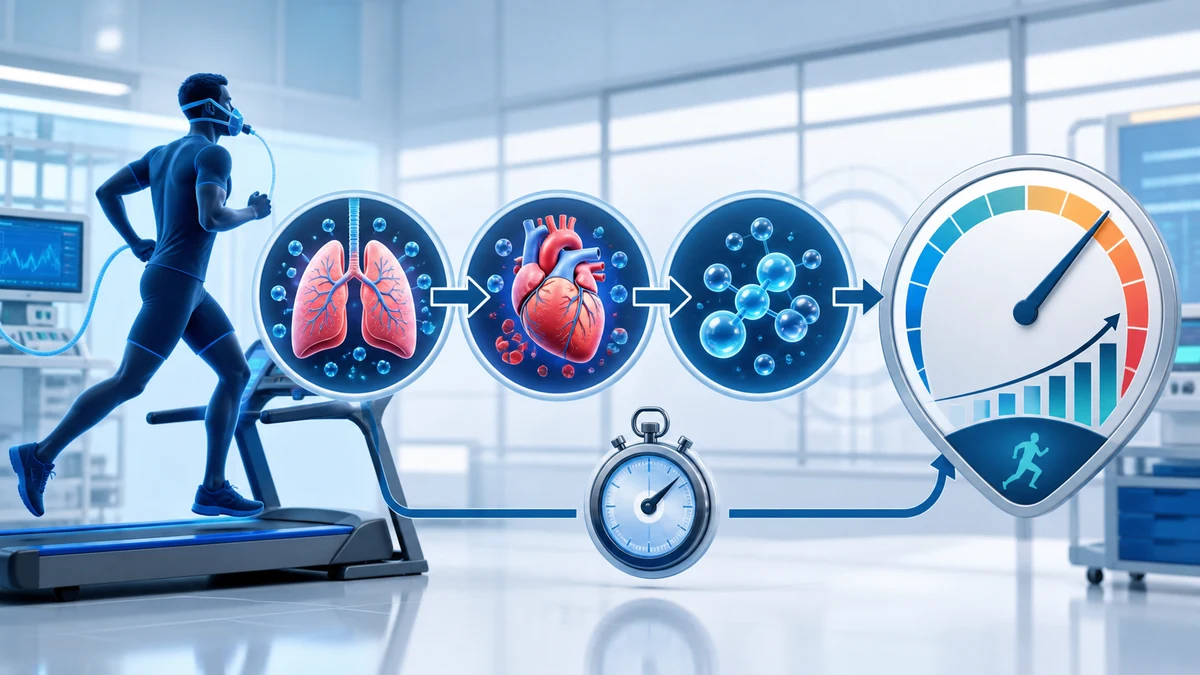
VO₂ max is an estimate of maximal oxygen uptake. It reflects how well your heart, lungs, blood, and muscles work together during sustained aerobic exercise.

In general:

  • A higher VO₂ max usually suggests stronger aerobic fitness.
  • A lower VO₂ max usually suggests lower cardiorespiratory fitness.
  • VO₂ max can improve with consistent aerobic training.
  • VO₂ max can vary by age, sex, body size, genetics, training history, health status, and test method.

Because this calculator uses a walking field test, the result is best interpreted as a practical estimate for tracking your own progress over time under similar testing conditions.

How the VO₂ Max Calculator Works

This calculator uses the Rockport 1-mile walk test equation:

VO₂ max = 132.853 − (0.0769 × weight in lb) − (0.3877 × age) + (6.315 × sex) − (3.2649 × walk time in minutes) − (0.1565 × post-walk heart rate)

For this equation:

  • weight is body weight in pounds
  • age is age in years
  • sex = 1 for male
  • sex = 0 for female
  • walk time is the 1-mile walk time in decimal minutes
  • post-walk heart rate is beats per minute immediately after finishing

The calculator converts units as needed, converts minutes and seconds into decimal minutes, and then applies the Rockport formula.

Formula Summary

Input or Result How It Is Used Important Note
Age Included directly in the Rockport equation Older age lowers the estimate in this equation
Sex Male = 1, female = 0 The equation includes a sex coefficient
Weight Converted to pounds VO₂ max is reported relative to body weight
Walk time Converted to decimal minutes Faster walk time generally raises the estimate
Post-walk heart rate Entered in beats per minute Lower heart rate for the same pace often raises the estimate
VO₂ max Calculated from the Rockport equation Reported in ml/kg/min

What the Rockport 1-Mile Walk Test Requires

The Rockport test is meant to be performed as a 1-mile walk, not a run. The goal is to walk the mile as fast as possible while still walking.

Test Requirement Why It Matters
Walk exactly 1 mile An inaccurate distance changes the calculated fitness estimate
Walk as fast as possible without running The formula is based on a walking test, not a running test
Record total time accurately Walk time is one of the largest drivers of the result
Measure heart rate immediately after finishing Delayed heart-rate measurement can make the estimate less useful
Use a flat and safe course Hills, stops, traffic, and uneven terrain can distort the result

Time Conversion for the Rockport Equation

The Rockport formula uses walk time in decimal minutes. If your time includes seconds, convert the seconds into a fraction of a minute.

Decimal minutes = minutes + (seconds ÷ 60)

Walk Time Decimal Minutes Calculation
12 minutes 15 seconds 12.25 minutes 12 + 15 ÷ 60
14 minutes 30 seconds 14.5 minutes 14 + 30 ÷ 60
16 minutes 45 seconds 16.75 minutes 16 + 45 ÷ 60

Entering the time correctly is important because even small time differences can change the VO₂ max estimate.

Worked Example: Rockport VO₂ Max Estimate

Suppose a person enters:

  • Age: 30 years
  • Sex: Male
  • Weight: 180 lb
  • 1-mile walk time: 12 minutes 15 seconds
  • Post-walk heart rate: 165 bpm

Step 1: Convert walk time to decimal minutes
12 minutes 15 seconds = 12 + 15 ÷ 60 = 12.25 minutes

Step 2: Set the sex value
Male = 1

Step 3: Use the Rockport equation
VO₂ max = 132.853 − (0.0769 × 180) − (0.3877 × 30) + (6.315 × 1) − (3.2649 × 12.25) − (0.1565 × 165)

Step 4: Calculate each part

  • 0.0769 × 180 = 13.842
  • 0.3877 × 30 = 11.631
  • 6.315 × 1 = 6.315
  • 3.2649 × 12.25 = 39.995
  • 0.1565 × 165 = 25.823

Step 5: Finish the calculation
VO₂ max ≈ 132.853 − 13.842 − 11.631 + 6.315 − 39.995 − 25.823

Result: VO₂ max ≈ 47.88 ml/kg/min

So this walk result gives an estimated VO₂ max of about 47.9 ml/kg/min.

Worked Example: Effect of Walk Time

Using the same age, sex, weight, and post-walk heart rate, a faster walk time increases the estimated VO₂ max.

Walk Time Decimal Minutes General Effect
13:30 13.5 Lower estimate than a faster walk
12:15 12.25 Middle estimate in this comparison
11:30 11.5 Higher estimate than a slower walk

The formula subtracts a value based on walk time, so a shorter time usually raises the estimated VO₂ max.

Worked Example: Effect of Post-Walk Heart Rate

For the same walk time and body weight, a lower immediate post-walk heart rate usually increases the estimate.

Post-Walk Heart Rate General Interpretation Effect in the Formula
150 bpm Lower heart rate for the same walk result Higher VO₂ max estimate
165 bpm Moderate comparison point Middle estimate
180 bpm Higher heart rate for the same walk result Lower VO₂ max estimate

Heart-rate timing matters. If you wait too long after finishing, your heart rate may fall and the estimate may be distorted.

How to Use This VO₂ Max Calculator

  1. Enter your age in years.
  2. Select your sex.
  3. Enter your body weight and choose the correct unit.
  4. Walk exactly 1 mile as fast as possible without running.
  5. Enter your 1-mile walk time in minutes and seconds.
  6. Measure your heart rate immediately after finishing the walk.
  7. Enter the post-walk heart rate in beats per minute.
  8. Click Calculate if the tool requires it.
  9. Review your estimated VO₂ max in ml/kg/min.
  10. Repeat the test under similar conditions if you want to track progress over time.

How to Interpret the Result

Your VO₂ max estimate gives a rough picture of aerobic fitness. In general, a higher value suggests stronger cardiorespiratory fitness, while a lower value suggests lower aerobic capacity.

Result Pattern Possible Meaning Important Reminder
Higher estimated VO₂ max Stronger aerobic capacity under this field equation Still not a direct lab measurement
Lower estimated VO₂ max Lower estimated aerobic capacity May reflect fitness, pacing, test conditions, or measurement error
Improves over time Possible improvement in aerobic fitness Retest under similar conditions for fair comparison
Changes unexpectedly Could reflect illness, fatigue, heat, stress, or heart-rate error Review conditions before drawing conclusions

This result is most useful for comparing your own results over time, rather than making a single absolute judgment from one test.

VO₂ Max Estimate vs Lab-Measured VO₂ Max

The Rockport test gives an estimated VO₂ max. A lab test measures oxygen uptake more directly during controlled exercise.

Method How It Works Strength Limitation
Rockport 1-mile walk estimate Uses age, sex, weight, walk time, and post-walk heart rate Low-cost and practical Less precise than direct lab testing
Fitness watch estimate Uses device sensors and algorithms Convenient and repeated often Depends on sensor accuracy and proprietary assumptions
Lab VO₂ max test Measures oxygen uptake during graded exercise More direct and controlled Requires equipment, supervision, and sometimes medical screening

If you need a precise value for clinical, competitive, or research purposes, use supervised testing rather than relying only on a field-test calculator.

Factors That Can Affect Your Result

Your estimated VO₂ max can change because of more than fitness alone.

Factor How It Can Affect the Estimate
Distance accuracy A course longer or shorter than 1 mile changes the walk time meaning
Terrain Hills, uneven paths, and turns can slow the walk
Weather Heat, humidity, wind, or cold can change heart rate and pace
Heart-rate timing Delayed measurement can lower the recorded heart rate
Sensor accuracy Wrist monitors may misread heart rate during movement
Fatigue or illness Can worsen performance or raise heart rate
Caffeine or medication Can affect heart-rate response
Walking technique Running or jogging invalidates the walking-test assumption

For better tracking, use the same course, similar weather, similar footwear, and the same heart-rate measurement method each time.

VO₂ Max and Exercise Intensity

VO₂ max is one way to estimate aerobic fitness, but exercise intensity can also be monitored with heart rate, breathing, pace, and perceived effort.

Intensity Check What It Tells You Practical Use
Heart rate How hard your cardiovascular system is working Useful for target zones and training plans
Talk test Whether you can talk or sing during exercise Simple check for moderate or vigorous intensity
Pace or speed How fast you are moving Useful for running, walking, and cycling comparisons
Perceived effort How hard the workout feels Helpful when heart rate is affected by heat, stress, or medication

Use VO₂ max as one fitness marker, not the only measure of health or training progress.

When This Calculator Is Useful

This calculator is useful when you want a practical field estimate of aerobic fitness.

  • Estimate cardio fitness from a simple 1-mile walk
  • Track aerobic fitness progress over time
  • Use a low-cost field test instead of a lab test
  • Compare fitness changes after training blocks
  • Support general exercise planning with an estimated fitness score
  • Check how walking time and heart rate influence the estimate
  • Record a baseline before starting a cardio training program
  • Compare repeated tests under similar conditions

When You May Need More Than This Calculator

A field-test VO₂ max estimate may not be enough when exercise safety, diagnosis, or performance precision matters.

Use qualified guidance or supervised testing when working with:

  • heart disease or cardiovascular risk
  • chest pain, dizziness, fainting, or unusual shortness of breath
  • known rhythm problems or palpitations
  • high blood pressure or heart-related medication
  • diabetes or blood-sugar management
  • pregnancy or postpartum exercise
  • chronic illness, injury, or recent surgery
  • clinical rehabilitation or medically supervised exercise
  • high-performance athletic testing
  • research or occupational fitness testing

Common Mistakes to Avoid

  • Running instead of walking: the Rockport equation is designed for a walking test.
  • Using the wrong distance: the test requires exactly 1 mile.
  • Entering time incorrectly: seconds must be converted correctly into decimal minutes by the calculator.
  • Measuring heart rate too late: heart rate should be taken immediately after finishing.
  • Using a hilly or interrupted course: terrain, traffic, and stops can distort the result.
  • Comparing tests done in very different conditions: heat, wind, fatigue, and footwear can affect performance.
  • Treating the result as a diagnosis: VO₂ max estimates do not diagnose health status.
  • Ignoring symptoms: chest pain, dizziness, fainting, or unusual shortness of breath should not be ignored.
  • Assuming one result is permanent: fitness estimates can change with training, illness, rest, and testing accuracy.

Important Assumptions and Limitations

  • This calculator gives an estimate, not a direct laboratory measurement of VO₂ max.
  • The Rockport test assumes you walk 1 mile as fast as possible without running.
  • Your heart rate should be taken immediately after finishing for the estimate to be more useful.
  • The result is affected by pacing, terrain, distance accuracy, weather, measurement timing, and heart-rate accuracy.
  • The equation may be less accurate outside the populations used to develop or validate the test.
  • Medications, illness, fatigue, caffeine, stress, and heat can affect heart rate and test performance.
  • The calculator does not determine whether exercise testing is safe for you.
  • The calculator does not replace medical advice, supervised exercise testing, or direct VO₂ max testing in a clinical or sports-performance setting.

Practical Uses of a VO₂ Max Calculator

  • Estimate aerobic fitness from a 1-mile walk
  • Track cardio progress over time
  • Compare repeated walk-test results
  • Record a baseline before a training program
  • Support general fitness planning
  • Understand how pace and heart rate affect VO₂ max estimates
  • Use a practical field estimate when lab testing is not available
  • Pair with heart-rate-zone and pace calculators for training planning

References

  1. Kline et al.: Estimation of VO₂ max from a One-Mile Track Walk
  2. Weiglein et al.: The 1-Mile Walk Test as a Predictor of VO₂ Max
  3. Rockport 1-Mile Walking Test and Cardiopulmonary Function Study
  4. CDC: Measuring Physical Activity Intensity
  5. American Heart Association: Target Heart Rates Chart

Related Calculators

Frequently Asked Questions

What does this VO₂ Max Calculator estimate?

It estimates VO₂ max in ml/kg/min using the Rockport 1-mile walk test equation.

What is VO₂ max?

VO₂ max is an estimate of maximal oxygen uptake. It is commonly used as a measure of aerobic fitness and cardiorespiratory endurance.

What formula does this calculator use?

It uses the Rockport 1-mile walk test equation with age, sex, weight in pounds, 1-mile walk time in decimal minutes, and post-walk heart rate.

What does ml/kg/min mean?

It means milliliters of oxygen per kilogram of body weight per minute. This allows aerobic capacity to be compared relative to body weight.

Do I need to run for the Rockport test?

No. The Rockport test is a walking test. You should walk 1 mile as fast as possible without running.

When should I measure heart rate?

Measure your heart rate immediately after finishing the 1-mile walk. Waiting too long can lower the recorded heart rate and affect the estimate.

Can I use kilometers instead of miles?

The Rockport test is based on 1 mile. If using a metric course, use an accurately measured distance equal to 1 mile, which is about 1.609 kilometers.

Is this result the same as a lab VO₂ max test?

No. This calculator gives a field estimate. A lab VO₂ max test measures oxygen uptake more directly under controlled conditions.

Why did my VO₂ max estimate change?

It may change because of fitness, pacing, heart-rate measurement, terrain, weather, fatigue, illness, caffeine, medication, or distance accuracy.

Is a higher VO₂ max better?

In general, a higher VO₂ max suggests stronger aerobic fitness, but it should be interpreted with age, sex, health status, and test method in mind.

Can this calculator diagnose my heart health?

No. It estimates aerobic fitness from a walking test. It does not diagnose cardiovascular health or determine whether exercise is safe.

Can medication affect the result?

Yes. Some medications can change heart-rate response during exercise, which can affect the Rockport estimate.

How often should I retest?

For progress tracking, retest under similar conditions after a training block, such as every few weeks or months. Avoid retesting too frequently if it encourages overexertion.

What should I do if I feel chest pain or dizziness during the test?

Stop the test. Symptoms such as chest pain, dizziness, fainting, or unusual shortness of breath should be taken seriously and may require medical guidance.

Can this calculator replace a trainer or doctor?

No. It is for educational and fitness-planning use only. Use professional guidance for medical concerns, performance testing, rehabilitation, or high-intensity exercise planning.

Disclaimer: This VO₂ Max Calculator provides an educational fitness estimate using the Rockport 1-mile walk test equation. Results depend on the age, sex, body weight, 1-mile walk time, post-walk heart rate, unit selections, pacing, terrain, weather, footwear, walking effort, and heart-rate measurement accuracy entered. The result is an estimated VO₂ max in ml/kg/min, not a direct laboratory measurement of oxygen uptake. The Rockport test assumes you walk exactly 1 mile as fast as possible without running and record your heart rate immediately after finishing. Results may be less reliable if the distance is inaccurate, the course is hilly, the pace is uneven, the heart rate is delayed or misread, or the user is outside the population for which the equation is appropriate. This calculator does not diagnose cardiovascular health, determine exercise safety, or replace supervised fitness testing. If you have heart disease, chest pain, dizziness, fainting, unusual shortness of breath, rhythm problems, high blood pressure, diabetes, pregnancy, chronic illness, injury, or take medication that affects heart rate, ask a healthcare professional before performing a fitness test or using the result for training decisions.

More of our calculators...

Heart Rate Zone Calculator

Use our Heart Rate Zone Calculator to find 5 training zones by % max heart rate or Karvonen HRR. Get personalized target BPM ranges for cardio workouts.

Target Heart Rate Calculator

Use our Target Heart Rate Calculator to find workout BPM targets by intensity using % max heart rate or Karvonen heart rate reserve.

Max Heart Rate Calculator

Use our Max Heart Rate Calculator to estimate HRmax by age with Fox, Tanaka, Gellish, and Nes formulas. Compare max heart rate estimates in bpm fast.

Pace Calculator

Use our Pace Calculator to find running pace, finish time, or distance in min/km or min/mile. Great for 5K, 10K, half marathon, and marathon planning.

Winning Percentage Calculator

Use our Winning Percentage Calculator to find win percentage from wins, losses, and optional ties. Supports standard and tie-aware formulas for sports records.

Calories Burned Calculator

Use our Calories Burned Calculator to estimate exercise calories from activity, weight, time, and MET value. Supports common workouts and custom MET input.

Running Split Calculator

Use our Running Split Calculator to find even pace splits by mile or kilometer from total distance and finish time. Great for race pacing and training plans.

Marathon Pace Calculator

Use our Marathon Pace Calculator to convert marathon finish time to pace per mile, pace per km, and speed, or estimate finish time from your target pace.

Bench Press 1RM Calculator

Use our Bench Press 1RM Calculator to estimate your one-rep max with Epley, Brzycki, Lombardi, and O’Conner formulas in kg or lb.