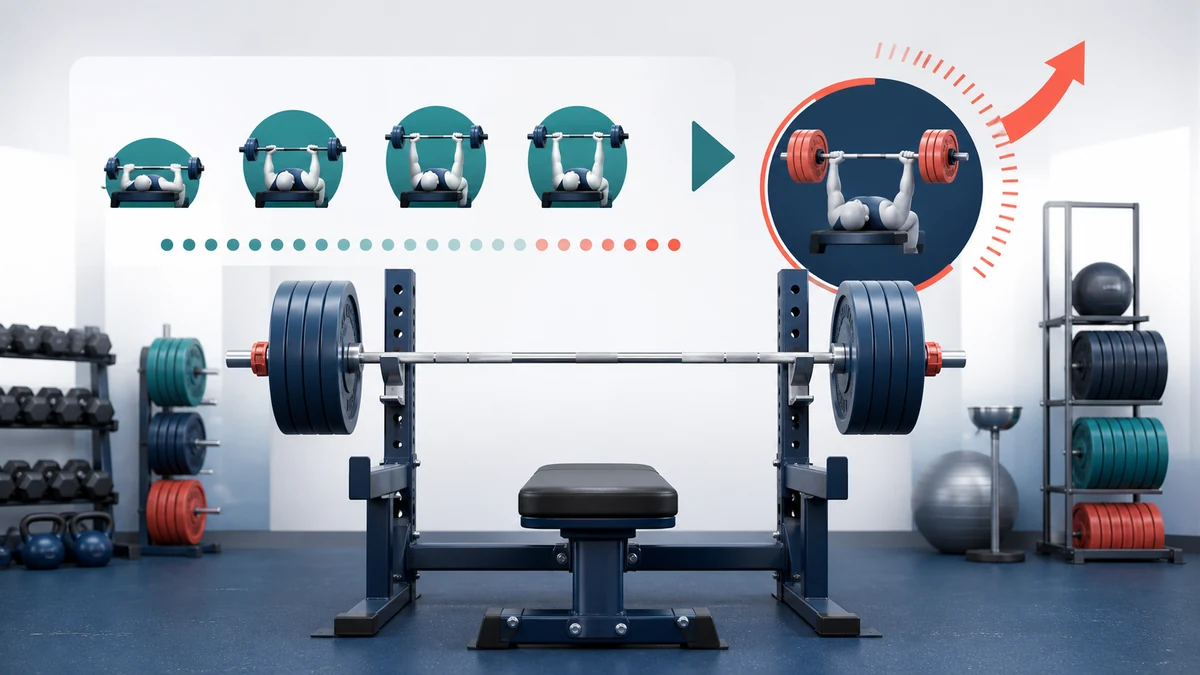
Bench Press 1RM Calculator

4 formulas • kg/lb •Best used for hard sets of about 1–10 reps; estimates get less reliable as reps rise.
Live

Inputs

Enter the weight you lifted for a set. Then enter reps.
Most formulas are reliable for 1–10 reps (some up to ~12).
Quick summary
Enter weight and reps to estimate your 1RM.

Results

Epley
Brzycki
Lombardi
O’Conner
Average estimate
Average of all formulas (use as a practical single number).
Updating…

Prediction only — best used for hard sets around 1–10 reps.

Action

Hard reset: cancels pending updates and clears everything on the first click.

Use this Bench Press 1RM Calculator to estimate your one-rep max from a submaximal bench press set. It compares four popular 1RM formulas and gives you a practical average estimate, making it useful for strength tracking, training planning, percentage-based programming, and checking progress without attempting a true max single.

Reviewed by: AjaxCalculators Editorial Team
Last updated: May 2, 2026
Method source: Submaximal one-repetition-maximum prediction equations using lifted weight and reps completed
Editorial standards: AjaxCalculators Editorial Policy

What This Bench Press 1RM Calculator Calculates

This calculator estimates your bench press one-repetition maximum (1RM) from a weight-and-reps set.

It shows separate predictions from four commonly used formulas:

  • Epley
  • Brzycki
  • Lombardi
  • O’Conner

It also gives an average estimate so you can use one practical summary number for training decisions.

What 1RM Means

1RM means one-repetition maximum. It is the maximum amount of weight you can lift for one complete repetition with proper technique.

For bench press, a true 1RM generally means the heaviest load you can press for one controlled rep under the lifting standards you are using. That may include a touch-and-go bench press, paused bench press, powerlifting-style bench press, or another consistent technique standard.

This calculator estimates 1RM from a submaximal set. It does not directly test your true maximum.

How the Bench Press 1RM Calculator Works

This calculator estimates your 1RM from the amount of weight lifted and the number of reps completed in one hard set.

The four formulas commonly used on this page are:

Epley:
1RM = weight × (1 + reps / 30)

Brzycki:
1RM = weight × 36 / (37 − reps)

Lombardi:
1RM = weight × reps0.10

O’Conner:
1RM = weight × (1 + 0.025 × reps)

Because each formula models fatigue a little differently, the resulting estimates are often close but not identical. That is why the calculator also shows an average estimate.

Bench Press 1RM Formula Summary

Formula Equation How It Behaves
Epley 1RM = weight × (1 + reps / 30) Often gives a practical estimate for lower-to-moderate reps
Brzycki 1RM = weight × 36 / (37 − reps) Can be conservative for some lifters and rep ranges
Lombardi 1RM = weight × reps0.10 Uses a power-style relationship between reps and load
O’Conner 1RM = weight × (1 + 0.025 × reps) Uses a smaller per-rep increase than Epley
Average estimate Mean of selected formula estimates Useful as a practical training number, not a true max guarantee

Why Different 1RM Formulas Give Different Results

One-rep-max prediction formulas are estimates. They use a lifter’s submaximal performance to infer a possible max single, but they do not know the lifter’s exact fatigue profile, technique, strength endurance, or readiness on that day.

Reason Results Differ How It Affects the Estimate
Different fatigue assumptions Each equation estimates how reps relate to maximum strength differently
Higher rep counts Formula spread usually increases as reps get higher
Training background Strength-focused lifters and endurance-oriented lifters may fatigue differently
Bench press style Paused, touch-and-go, close-grip, and competition-style reps can differ
Rep quality Partial reps, bouncing, or uneven range of motion can inflate estimates
Set effort A set stopped far from failure may underestimate true 1RM

For best tracking, use the same formula, technique, rep range, and testing conditions each time.

Worked Example: 100 kg for 5 Reps

Suppose you bench press 100 kg for 5 reps.

Epley:
1RM = 100 × (1 + 5 / 30)

1RM = 100 × 1.1667 ≈ 116.7 kg

Brzycki:
1RM = 100 × 36 / (37 − 5)

1RM = 3600 / 32 = 112.5 kg

Lombardi:
1RM = 100 × 50.10

1RM ≈ 117.5 kg

O’Conner:
1RM = 100 × (1 + 0.025 × 5)

1RM = 100 × 1.125 = 112.5 kg

Average estimate:
Average = (116.7 + 112.5 + 117.5 + 112.5) ÷ 4

Average ≈ 114.8 kg

Result: A set of 100 kg for 5 reps suggests a bench press 1RM somewhere around 113 to 118 kg, with an average estimate of about 115 kg.

Worked Example: 225 lb for 8 Reps

Suppose you bench press 225 lb for 8 reps.

Epley:
1RM = 225 × (1 + 8 / 30)

1RM = 225 × 1.2667 ≈ 285.0 lb

Brzycki:
1RM = 225 × 36 / (37 − 8)

1RM = 8100 / 29 ≈ 279.3 lb

Lombardi:
1RM = 225 × 80.10

1RM ≈ 277.0 lb

O’Conner:
1RM = 225 × (1 + 0.025 × 8)

1RM = 225 × 1.20 = 270.0 lb

Average estimate:
Average = (285.0 + 279.3 + 277.0 + 270.0) ÷ 4

Average ≈ 277.8 lb

Result: A set of 225 lb for 8 reps suggests an estimated bench press 1RM of about 278 lb using the four-formula average.

Worked Example: Formula Spread at Higher Reps

Suppose two lifters both bench press the same weight, but one set is 5 reps and the other is 12 reps. Formula spread often becomes more noticeable as reps increase.

Example Set What Usually Happens Practical Interpretation
100 kg × 3 reps Formulas usually cluster more closely Often more useful for max-strength estimation
100 kg × 5 reps Formulas are still usually practical Good range for many training estimates
100 kg × 10 reps Formula differences become more noticeable Still useful, but less precise for true max prediction
100 kg × 15 reps Formula spread may be large Better treated as a rough strength-endurance estimate

Most lifters should treat high-rep predictions as rougher estimates, especially when reps exceed about 10.

Estimated 1RM and Training Percentages

One practical use of an estimated 1RM is to calculate training loads. For example, many strength programs prescribe sets based on a percentage of 1RM.

If your estimated bench press 1RM is 115 kg, approximate training loads would be:

Percent of Estimated 1RM Approx. Load Common Training Use
60% 69 kg Technique, speed, warm-up, lighter volume
70% 80.5 kg Moderate volume and practice work
75% 86.25 kg Hypertrophy or strength-volume work
80% 92 kg Strength-focused work for many programs
85% 97.75 kg Heavier strength sets
90% 103.5 kg Heavy singles, doubles, or triples for experienced lifters

Because the 1RM is estimated, percentage loads should also be treated as estimates. Adjust based on form, bar speed, fatigue, and coaching guidance.

Estimated Reps at Percent of 1RM

Many lifters use rough percentage ranges to plan bench press training. These ranges vary by person, but the table below gives a general planning reference.

Approx. Percent of 1RM Typical Rep Range Important Note
90%+ 1 to 3 reps High intensity; usually requires careful setup and spotting
85% 3 to 5 reps Heavy strength work
80% 5 to 8 reps Common strength and volume range
70% to 75% 8 to 12 reps Often used for hypertrophy and technical volume
60% to 65% 12+ reps Lighter volume, technique, or muscular endurance

Individual differences matter. Some lifters can perform more reps at a given percentage, while others fatigue faster.

How to Use This Bench Press 1RM Calculator

  1. Enter the weight you lifted.
  2. Choose the weight unit: kg or lb.
  3. Enter the number of reps completed in the set.
  4. Use a set that was challenging and technically consistent.
  5. Click Calculate if the tool requires it.
  6. Review the Epley, Brzycki, Lombardi, and O’Conner estimates.
  7. Use the average estimate or your preferred formula to guide training loads.

How to Interpret the Result

Each formula gives an estimate of what you might be able to lift for one strict rep under fresh conditions.

Result Pattern Possible Meaning How to Use It
Formula estimates are close together The estimate is relatively stable across formulas Average estimate may be useful for programming
Formula estimates are far apart Formula choice matters more for that rep range Treat the result as a wider estimate range
Estimate jumps after a high-rep set Strength endurance may be influencing the result Use lower-rep sets for more max-strength-focused estimates
Estimate drops suddenly Fatigue, technique, illness, or poor recovery may be involved Retest under similar conditions before changing your plan

The average estimate is useful as a practical training number, but it is still an estimate. Your real 1RM could be higher or lower depending on technique, fatigue, confidence, pause style, equipment, and day-to-day readiness.

Best Rep Range for 1RM Estimation

Submaximal 1RM prediction is usually more useful when the set is close enough to max strength to reflect true pressing ability, but not so heavy that it creates unnecessary risk.

Rep Range Usefulness for 1RM Estimate Comment
1 to 3 reps Very close to max strength Can be useful but requires heavier loading and more safety attention
4 to 6 reps Often practical Good balance between heavy loading and reduced need for a true max attempt
7 to 10 reps Useful but less precise Formula differences and strength endurance matter more
11+ reps Rough estimate only More influenced by muscular endurance, pacing, and fatigue tolerance

For progress tracking, using a similar rep range each time often gives more meaningful comparisons.

Touch-and-Go vs Paused Bench Press

Bench press technique can change your result. A touch-and-go set and a paused set may not produce the same estimated 1RM.

Bench Style Description Effect on Estimate
Touch-and-go The bar touches the chest and is pressed without a long pause May allow slightly more reps or load for some lifters
Paused bench The bar pauses on the chest before pressing Often more strict and may produce a lower estimate
Partial range The bar does not complete the same full range of motion Can inflate estimates and reduce comparison quality
Competition-style bench Uses consistent setup and standards, often with a pause Most useful if you are tracking powerlifting-style bench strength

Use the same bench press style each time if your goal is accurate progress tracking.

Why Estimated 1RM Can Be Useful

Testing a true one-rep max can be useful for some lifters, but it is not always necessary. A submaximal estimate can reduce the need for frequent maximal attempts.

  • It helps set training loads without testing a true max.
  • It gives a repeatable way to track progress.
  • It can support percentage-based strength programs.
  • It can help compare formulas and estimate a reasonable max range.
  • It can guide conservative load jumps during training blocks.

Safety Notes for Bench Press Testing

Bench pressing heavy loads can carry risk, especially when attempting maximal or near-maximal weights. A calculator result should not be treated as permission to attempt that weight.

  • Use a competent spotter or appropriate safety equipment for heavy bench press sets.
  • Warm up gradually before heavy attempts.
  • Do not test heavy loads when injured, ill, overly fatigued, or unfamiliar with the movement.
  • Use consistent technique and a controlled range of motion.
  • Avoid bouncing the bar off the chest or losing control of the bar path.
  • Stop the set if technique breaks down.
  • Consider coaching support before attempting true max singles.

When This Calculator Is Useful

This calculator is useful for lifters who want a practical strength estimate without directly testing a true 1RM.

  • Estimate bench press max without testing a true 1RM
  • Set training percentages for strength programs
  • Track progress over time from repeated submaximal sets
  • Compare how different formulas estimate the same set
  • Plan safer strength testing when a true max attempt is unnecessary
  • Estimate working weights for hypertrophy or strength blocks
  • Compare kg and lb training numbers
  • Review whether a recent rep PR suggests progress

When You May Need More Than This Calculator

A 1RM calculator is useful, but it does not replace coaching, direct testing, or medical judgment when the situation calls for it.

Use more personalized guidance when:

  • you are preparing for a powerlifting meet
  • you need a competition-standard paused bench press max
  • you are new to bench pressing
  • you have shoulder, chest, elbow, wrist, back, or neck pain
  • you have high blood pressure, heart disease, or medical restrictions
  • you are returning from injury or surgery
  • you are attempting maximal loads without an experienced spotter
  • your reps are above the practical prediction range

Common Mistakes to Avoid

  • Treating an estimate as guaranteed: a predicted 1RM is not the same as a tested 1RM.
  • Using very high-rep sets: high reps make the result more influenced by endurance and formula choice.
  • Changing technique between tests: touch-and-go, paused, partial reps, and different grips can change results.
  • Testing while fatigued: poor recovery can make the estimate look lower than your actual strength.
  • Using sloppy reps: bouncing or partial range of motion can inflate the estimate.
  • Ignoring safety: heavy bench press attempts should use proper setup, spotters, or safety equipment.
  • Changing formulas every time: use the same formula or average method for better progress tracking.
  • Loading exact percentages too aggressively: adjust based on bar speed, form, and daily readiness.

Assumptions and Important Notes

  • This calculator gives a predicted 1RM, not a directly tested true max.
  • Prediction accuracy is usually better at lower rep counts than at high reps.
  • Most practical 1RM formulas are best used with hard sets in roughly the 1 to 10 rep range.
  • Different formulas can give different answers for the same set, especially when reps get higher.
  • Bench press prediction accuracy can vary by training background, exercise style, body size, and population.
  • The result assumes the entered reps were completed with consistent technique and comparable range of motion.
  • The result does not account for fatigue, illness, injury, warm-up quality, spotter assistance, equipment, or confidence under heavy loads.
  • The calculator is most useful for programming and progress tracking, not for replacing proper lifting technique or safety judgment.

Practical Uses of a Bench Press 1RM Calculator

  • Estimate one-rep max from a submaximal set
  • Compare Epley, Brzycki, Lombardi, and O’Conner estimates
  • Set percentage-based bench press training loads
  • Track strength progress without frequent max testing
  • Estimate kg or lb training targets
  • Plan conservative load progression
  • Check whether a rep PR suggests a higher max
  • Support training-block planning for strength or hypertrophy

References

  1. Reynolds, Gordon, and Robergs: Prediction of 1RM Strength from Multiple Repetition Maximum Testing
  2. Whisenant et al.: Validation of Submaximal Prediction Equations for the 1RM Bench Press Test
  3. Spinal Cord: Validity of 1RM Predictive Equations in Individuals with Spinal Cord Injury
  4. American College of Sports Medicine: Resistance Training Guidelines Update
  5. American Council on Exercise: Bench Press Assessment Protocol

Related Calculators

Frequently Asked Questions

What does this Bench Press 1RM Calculator estimate?

It estimates your bench press one-rep max from the weight lifted and the number of reps completed in a submaximal set.

What is a one-rep max?

A one-rep max, or 1RM, is the maximum weight you can lift for one complete repetition with proper technique.

Which formulas does this calculator use?

It uses the Epley, Brzycki, Lombardi, and O’Conner formulas, then shows an average estimate.

Is estimated 1RM the same as tested 1RM?

No. Estimated 1RM is predicted from a rep set. Tested 1RM is directly measured by attempting a true max single.

Which 1RM formula is best?

No formula is always best for every lifter. Formula accuracy can vary by exercise, rep range, training level, body size, and fatigue profile.

What rep range works best for 1RM prediction?

Lower-to-moderate rep ranges are usually more useful. Many lifters use hard sets between about 1 and 10 reps for practical 1RM estimation.

Are high-rep 1RM estimates accurate?

High-rep estimates are usually less precise because they depend more on muscular endurance, pacing, and fatigue tolerance.

Should I use touch-and-go or paused bench press?

Use the style that matches your training goal. For tracking, keep the same style each time so results are comparable.

Can I use estimated 1RM for training percentages?

Yes. Estimated 1RM can help set percentage-based training loads, but adjust loads based on form, recovery, bar speed, and coaching guidance.

Can this calculator tell me what weight to attempt for a max?

It can provide an estimate, but it cannot guarantee that a max attempt is safe or successful. Use conservative jumps, proper setup, and a spotter when testing heavy loads.

Why did my estimated 1RM change?

It may change because of strength progress, fatigue, sleep, warm-up quality, technique, rep range, illness, injury, or different effort levels.

Can beginners use this calculator?

Beginners can use it for rough tracking, but technique consistency matters. New lifters should prioritize form, coaching, and safe progression over max estimates.

Do I need a spotter for bench press testing?

For heavy or near-maximal bench press sets, a competent spotter or appropriate safety setup is strongly recommended.

Can this calculator prevent injury?

No. It only estimates strength. Safe lifting depends on technique, load selection, warm-up, equipment setup, spotting, recovery, and individual health status.

Can this calculator replace a coach?

No. It is a training-planning tool. A coach can evaluate technique, choose appropriate loads, and help manage risk during heavy bench press training.

Disclaimer: This Bench Press 1RM Calculator provides educational strength-training estimates from a submaximal bench press set using common one-repetition-maximum prediction equations. Results depend on the weight lifted, reps completed, unit selection, formula used, lifting technique, range of motion, pause style, fatigue level, rep quality, training background, and how close the set was to true failure. Predicted 1RM is not the same as a directly tested one-rep max, and formula accuracy is usually better with lower-rep hard sets than with high-rep sets. Different formulas may give different estimates, especially as reps increase. The result should be used for training planning and progress tracking, not as a guarantee that you can safely attempt that weight. Bench pressing heavy loads can involve injury risk, especially without proper technique, warm-up, equipment setup, and a competent spotter. If you have chest, shoulder, elbow, wrist, back, blood-pressure, heart, or medical concerns, or you are new to heavy lifting, use qualified coaching or medical guidance before attempting maximal or near-maximal bench press loads.

More of our calculators...

Heart Rate Zone Calculator

Use our Heart Rate Zone Calculator to find 5 training zones by % max heart rate or Karvonen HRR. Get personalized target BPM ranges for cardio workouts.

Target Heart Rate Calculator

Use our Target Heart Rate Calculator to find workout BPM targets by intensity using % max heart rate or Karvonen heart rate reserve.

Max Heart Rate Calculator

Use our Max Heart Rate Calculator to estimate HRmax by age with Fox, Tanaka, Gellish, and Nes formulas. Compare max heart rate estimates in bpm fast.

Pace Calculator

Use our Pace Calculator to find running pace, finish time, or distance in min/km or min/mile. Great for 5K, 10K, half marathon, and marathon planning.

Winning Percentage Calculator

Use our Winning Percentage Calculator to find win percentage from wins, losses, and optional ties. Supports standard and tie-aware formulas for sports records.

Calories Burned Calculator

Use our Calories Burned Calculator to estimate exercise calories from activity, weight, time, and MET value. Supports common workouts and custom MET input.

VO₂ Max Calculator

Use our VO₂ Max Calculator to estimate cardio fitness with the Rockport 1-mile walk test using age, sex, weight, walk time, and post-walk heart rate.

Running Split Calculator

Use our Running Split Calculator to find even pace splits by mile or kilometer from total distance and finish time. Great for race pacing and training plans.

Marathon Pace Calculator

Use our Marathon Pace Calculator to convert marathon finish time to pace per mile, pace per km, and speed, or estimate finish time from your target pace.