Child BMI Calculator
Calculate BMI and estimate BMI-for-age percentile for children and teens using age, sex, height, and weight.
Results
This calculator provides an estimated screening result only. Child BMI should be interpreted with official age- and sex-specific growth charts, growth history, puberty stage, health history, and a clinician’s judgment. It does not diagnose a medical condition.
The Child BMI Calculator calculates body mass index and estimates a BMI-for-age percentile using age, sex, height and weight. Unlike adult BMI, a child’s result must be interpreted against an age- and sex-specific growth reference.
Parent and caregiver note: BMI is a screening measure, not a diagnosis. Discuss concerns about growth, nutrition or development with a pediatric healthcare professional and avoid labeling a child from one number.
Measure first, calculate second
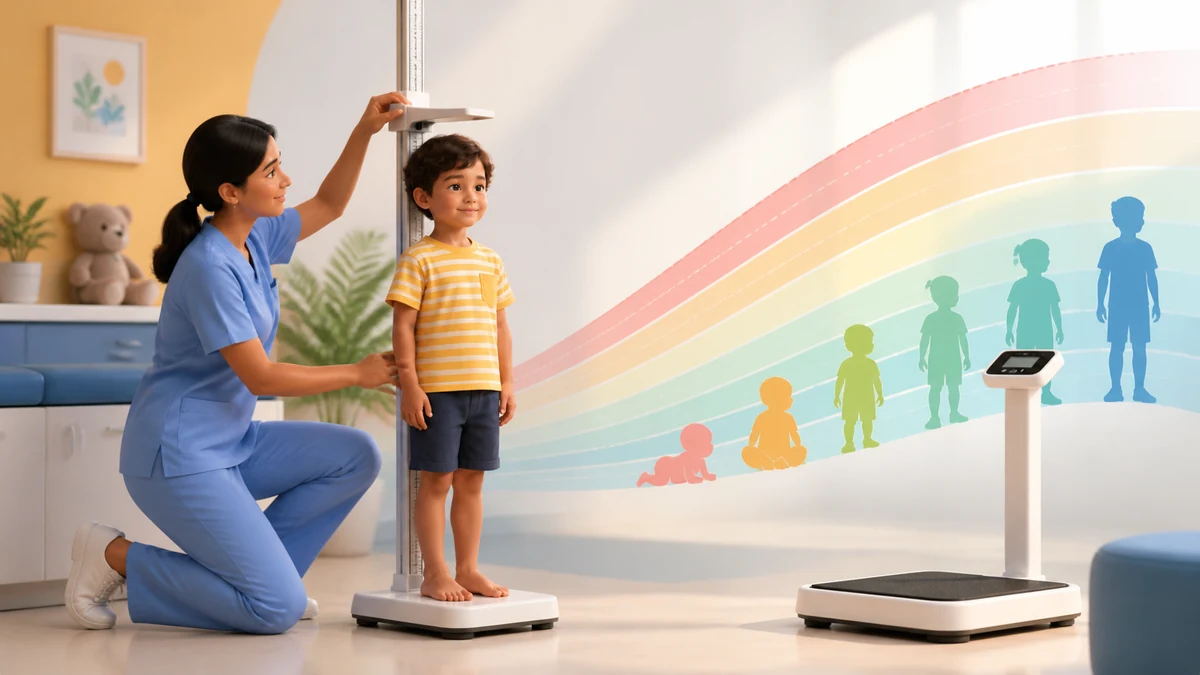
Remove shoes and heavy outer clothing. Measure height on a level surface with the child standing straight and looking forward, and use a reliable scale for weight. Small measurement errors can meaningfully change percentile near a category boundary.
Enter age as accurately as the tool allows because a 10-year-old and an 11-year-old are compared with different reference distributions.
BMI is calculated like an adult value
Metric BMI is weight in kilograms ÷ height in meters squared. With U.S. units, it is 703 × pounds ÷ inches squared. The mathematical BMI is then placed on a child growth reference to obtain the percentile.
What the percentile means
A percentile describes position in a reference population. A result at the 60th percentile means the BMI is equal to or higher than about 60% of peers of the same age and sex in that reference. It does not mean the child is 60% fat or has completed 60% of ideal growth.
CDC categories commonly use below the 5th percentile, 5th to below 85th, 85th to below 95th, and 95th or higher. A professional considers the whole growth pattern and health context.
Growth trends matter more than one point
Children grow in spurts, and puberty changes height and body composition. A sequence of accurate measurements plotted over time is usually more informative than one percentile. A marked shift across the chart may deserve review even if the latest value remains within a broad category.
Why adult categories should not be used
Fixed adult cutoffs do not account for normal changes during childhood and adolescence. Use an adult calculator only when the applicable guidance defines adulthood for that tool; CDC’s child reference covers ages 2 through 19.
Example of the two-step interpretation
First, height and weight produce a BMI such as 18.2 kg/m². Next, exact age and sex place that BMI on a reference curve. The same BMI can correspond to different percentiles at different ages.
Use neutral, supportive language
Growth conversations can affect how children feel about food and their bodies. Describe the result as one health-screening measurement and avoid praise, blame or restrictive changes based only on a percentile. A pediatric professional can consider development, family history, access to food, activity, sleep and emotional wellbeing together.
Common sources of misleading results
- Rounding age to the nearest year
- Measuring height with shoes on
- Entering feet as inches or pounds as kilograms
- Applying adult BMI labels
- Comparing different charts as if they were identical
Other growth tools
For children younger than two, weight, length and head circumference charts are generally more relevant than BMI categories; see the Baby Growth Percentile Calculator. Adult users can open the BMI Calculator.
Child BMI Calculator FAQ
Can BMI diagnose a health condition?
No. It is one screening measure considered alongside history, development, examination and other information.
Why is age in months useful?
Growth references change continuously, so months can improve placement compared with rounding to whole years.
Should siblings have similar percentiles?
Not necessarily. Age, sex, growth timing and individual development differ.
Review the CDC Child and Teen BMI guidance for categories, limitations and measurement advice.