

Taper Calculator
Find taper per length, taper ratio, half-angle, and included angle from two diameters and taper length.
Inputs
Results
A tapered shaft may change diameter by only a few millimeters, yet that small difference determines its ratio, machining angle, and fit. The Taper Calculator converts a large diameter, small diameter, and axial taper length into taper per unit length, taper ratio, half-angle, and included angle.
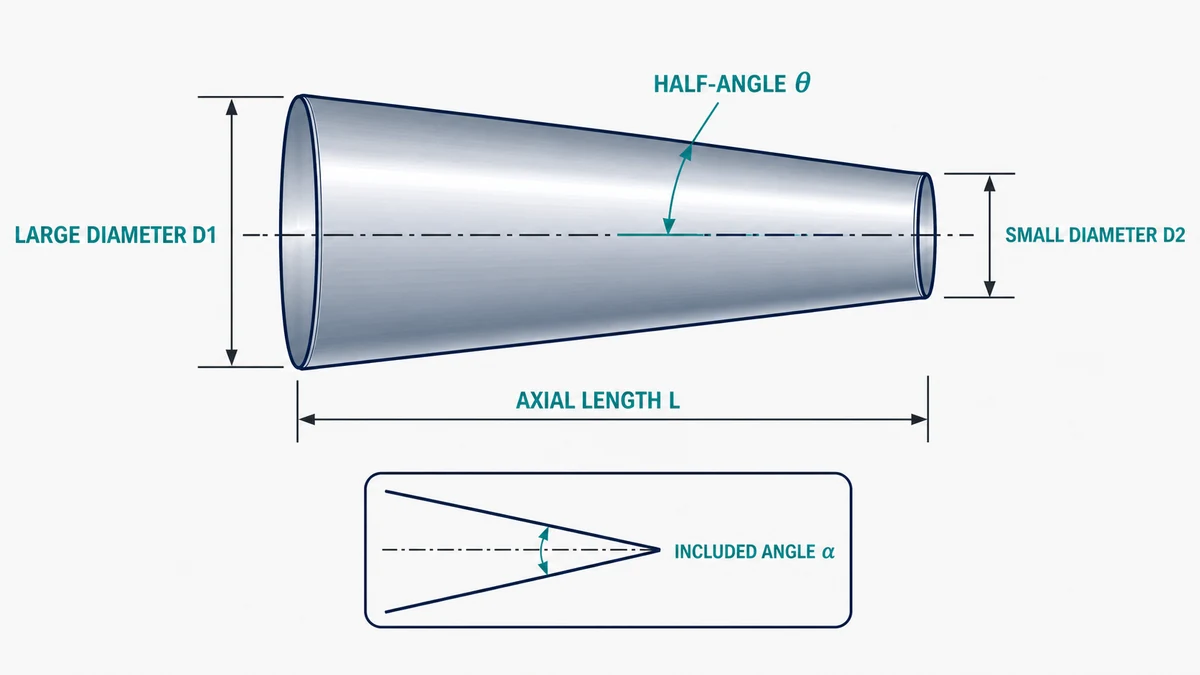
The calculation applies to a straight, uniform circular taper such as a tapered shaft, cone frustum, adapter, toolholder, or machined part. Mixed length units are supported, so each measurement can be entered in the unit shown beside its field.
What the Taper Calculator Calculates
The calculator returns four related descriptions of the same taper:
- Taper per unit length: Diameter change divided by axial taper length
- Taper ratio: The length required for one unit of diameter change, written as 1:n
- Half-angle θ: The angle between the centerline and one tapered side
- Included angle α: The full angle between the two opposite tapered sides
These outputs describe ideal geometry. They do not establish a machining tolerance, fit class, surface finish, tool setting, standard taper designation, or inspection result.
How to Calculate a Taper
- Measure the large diameter D1 at the wider end.
- Measure the small diameter D2 at the narrower end.
- Measure taper length L parallel to the centerline.
- Select the correct unit beside every measurement.
- Calculate the taper geometry.
- Review taper per length, ratio, half-angle, and included angle.
- Reset the fields before entering another part.
The large diameter must be greater than the small diameter, and taper length must be positive. The three measurements must refer to the same tapered section.
Understanding the Taper Measurements
Large diameter D1 is measured across the widest circular end of the taper. Small diameter D2 is measured across the narrower end. Both are full diameters, not radii.
Taper length L is the axial distance between those two diameter measurement planes. Measure it along or parallel to the centerline. Do not substitute the longer distance measured along the sloped outer surface.
A caliper or micrometer may be appropriate depending on the part, required precision, and access to the measuring surfaces. For production work, follow the drawing and specified inspection method rather than relying on approximate hand measurements.
Taper Calculator Formulas
The calculator first converts all three measurements to compatible units, then finds the diameter difference:
ΔD = D1 – D2
Taper Per Unit Length
T = ΔD ÷ L
A result of 0.2 means the diameter changes by 0.2 unit for every one unit of axial length. Because diameter difference and length use the same standardized unit, the numerical taper rate is dimensionless, although it is often described as mm/mm or in/in for clarity.
Taper Ratio
Taper ratio = 1 : (L ÷ ΔD)
A 1:5 taper changes by one unit of diameter across five units of axial length. A larger second number describes a shallower taper. For example, 1:20 is more gradual than 1:5.
Half-Angle and Included Angle
The half-angle uses half the diameter difference because the sloping side changes by the difference in radius:
θ = arctan[ΔD ÷ (2L)]
The full included angle is twice the half-angle:
α = 2θ
Check which angle a drawing or setup instruction requests. A machine setup may refer to the angle from the centerline, while a drawing may specify the complete angle between opposite sides.
Worked Taper Calculation Example
Suppose a tapered part has a large diameter of 40 mm, a small diameter of 20 mm, and an axial taper length of 100 mm.
Diameter difference: 40 – 20 = 20 mm
Taper per unit length: 20 ÷ 100 = 0.2
Taper ratio: 1 : (100 ÷ 20) = 1:5
Half-angle: arctan(20 ÷ 200) ≈ 5.71°
Included angle: 2 × 5.71° ≈ 11.42°
The part therefore changes by 0.2 mm in diameter per millimeter of axial length. Its geometric taper is 1:5, with an approximate 5.71-degree half-angle and 11.42-degree included angle.
Taper Per Inch and Taper Per Foot
Imperial machining drawings may express taper as diameter change per inch or per foot. When both diameters and length are measured in inches:
Taper per inch = diameter difference ÷ taper length
Taper per foot = taper per inch × 12
If a diameter changes by 0.25 inch over a 6-inch taper length, the taper is approximately 0.04167 in/in. Multiplying by 12 gives 0.5 inch of diameter change per foot.
Geometric Taper vs Standard Taper
A calculated ratio that resembles a published standard does not prove that a part conforms to that standard. Morse, Jacobs, Jarno, Brown & Sharpe, machine-tool, and pipe tapers may specify nominal dimensions, gauge lines, lengths, tolerances, fits, and inspection procedures in addition to a general taper rate.
Use the relevant drawing, manufacturer specification, or applicable standard before manufacturing, replacing, or mating components. A small difference in diameter, length, or angle can affect contact, alignment, holding force, and release behavior.
Common Taper Measurement Mistakes
- Measuring slant length instead of axial centerline length
- Entering a radius where the calculator requires a diameter
- Reversing the large and small diameters
- Mixing units during a manual calculation without conversion
- Confusing half-angle with the full included angle
- Assuming a calculated ratio identifies a standard taper
- Rounding measurements too early for precision work
- Measuring damaged, burred, worn, or dirty surfaces
Keep additional digits during the calculation and round only the reported result to the precision justified by the original measurements.
Frequently Asked Questions
What is a taper?
A taper is a gradual, uniform change in diameter over a measured axial length. A straight circular taper forms part of a cone or conical frustum.
How do I calculate a taper ratio?
Subtract the small diameter from the large diameter, then divide the axial taper length by that diameter difference. Write the result as 1:n.
What does a 1:10 taper mean?
It means the diameter changes by one unit across ten units of axial length. The same ratio applies when compatible units are used.
What is the difference between half-angle and included angle?
The half-angle is measured from the centerline to one tapered side. The included angle is measured between both sides and equals twice the half-angle.
Can the diameters and length use different units?
Yes. The live calculator supports mixed length units and standardizes them before applying the formulas. For manual calculations, convert all measurements to one unit first.
Does the result identify a Morse or another standard taper?
No. It calculates ideal geometry only. Confirm any standard taper using its official dimensions, gauge line, tolerance, and inspection requirements.
Related Geometry Calculators
Sources
- U.S. Army – Fundamentals of Machine Tools, TC 9-524
- OpenStax Algebra and Trigonometry 2e – Inverse Trigonometric Functions
- NIST – SI Units: Length
Define Which Taper Dimension Changes
A taper may be specified by change in diameter over length, change in radius, ratio, percentage, or included angle. Mixing diameter and radius doubles or halves the result. Identify the standard used by the drawing or machine, keep length units consistent, and note whether the reported angle is the half-angle per side or the full included angle.