
Concrete Calculator
Estimate concrete volume for slabs, pads, footings, and rectangular pours using length, width, depth, quantity, and optional waste allowance.
Results
Bag estimates are rounded up. Actual concrete needs can vary because of ground level, formwork accuracy, compaction, spillage, and supplier mix yield.
The Concrete Calculator turns the inside dimensions of a rectangular slab, pad, footing, or similar pour into volume. It can repeat identical sections, add a selected allowance, convert between cubic feet, cubic yards, and cubic metres, and estimate common bag counts.
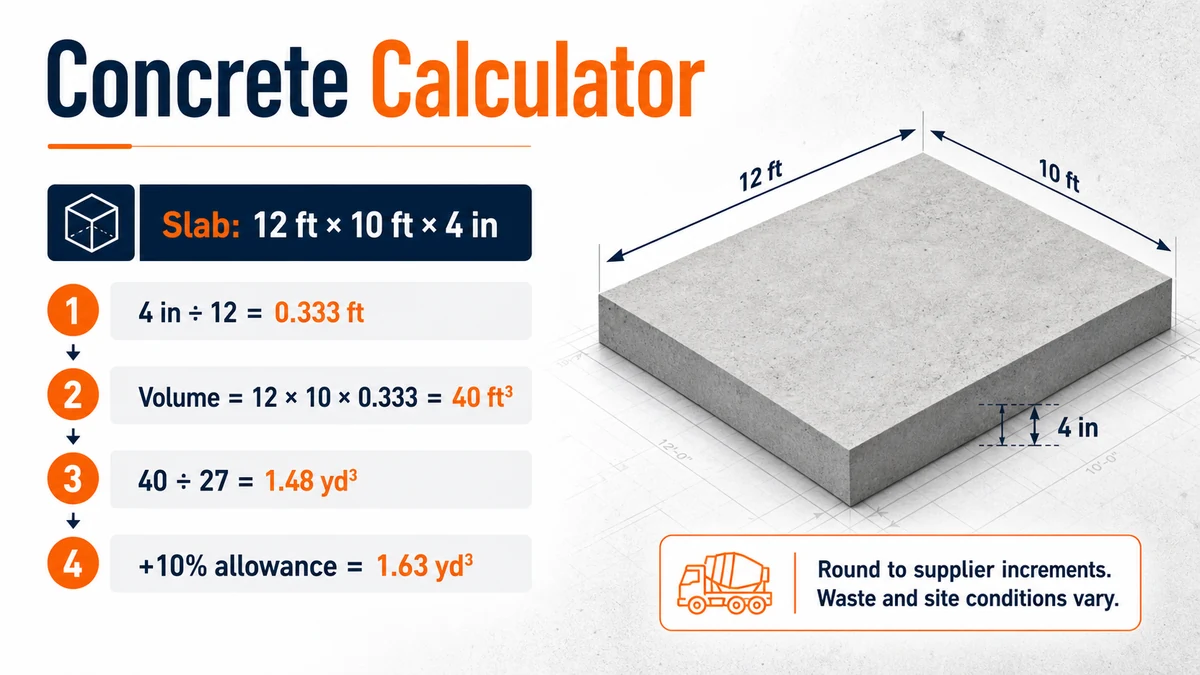
Measure the space concrete will actually occupy
Use the inside length and width of the forms and the finished average thickness. Do not use outside form dimensions. Measure several points when the subgrade is uneven, and separate areas with different depths instead of averaging unlike sections blindly.
Keep units compatible before multiplying
Rectangular volume = length × width × thickness
Convert every dimension to feet for cubic feet or to metres for cubic metres. In U.S. units, divide cubic feet by 27 to obtain cubic yards. For repeated identical sections, multiply the base volume by the quantity before adding the allowance.
Worked slab calculation
A slab measuring 20 ft by 12 ft by 4 in has thickness of 4 ÷ 12 = 0.333 ft. Base volume is about 79.9 ft³, or 2.96 yd³. A 10% allowance raises the planning quantity to about 3.26 yd³. Supplier ordering increments may require rounding upward.
Allowance is not a substitute for measurement
Concrete can be lost to uneven subgrade, spillage, form movement, and dimensional variation. ACI educational material notes that allowances vary with job size and conditions, commonly 10–15% for small loads and 5–10% for larger orders. Select a project-appropriate amount rather than automatically using the highest value.
Bag estimates depend on stated yield
Dry bag weight alone does not prove finished volume. Use the manufacturer’s published yield for the exact product and mix. Round bag count upward to a whole bag and allow for practical loss. For larger pours, compare bag mixing with ready-mix delivery, access, placing time, and crew capacity.
Irregular pours need to be divided
Break an L-shaped slab into rectangles and add the results. Calculate thickened edges, steps, piers, or footings as separate shapes. Subtract large blockouts only when their dimensions are reliable. The Concrete Calculator estimates quantity; it does not design reinforcement, joints, thickness, strength, or mixture specification.
Ordering checklist
- Verify dimensions and forms onsite.
- Confirm required strength, slump, air content, and aggregate size with the project specification.
- Ask the supplier about minimum load, delivery increment, access, and scheduling.
- Prepare placement and finishing labor before concrete arrives.
- Reassess quantity if actual consumption differs early in the pour.
Related project tools
Estimate surface coatings with the Paint Calculator, layouts with the Tile Calculator, or landscape coverage with the Mulch Calculator.
Concrete Calculator FAQ
How many cubic feet are in a cubic yard?
There are 27 cubic feet in one cubic yard.
Should I round the order down?
No. Concrete shortages are disruptive; follow supplier increments and an appropriate allowance.
Does the result specify the concrete mix?
No. Strength, durability, exposure, placement, and project requirements must determine the mixture.
Industry reference
American Concrete Institute: Concrete Craftsman Series preview includes volume and allowance examples.
For footings, columns, and steps
A rectangular footing uses the same length × width × depth formula. Calculate each footing and multiply by quantity. A column or round pier requires a cylinder formula rather than a rectangular slab formula, so use the appropriate shape tool or calculate it separately. Steps are best divided into simple rectangular volumes and added.
Depth errors grow across the entire area
On a 1,000 ft² slab, an extra half inch changes volume by about 41.7 ft³, or 1.54 yd³, before allowance. Check subgrade elevation and form depth at multiple locations. The Concrete Calculator cannot detect a low spot from one measurement.
Dry products and ready-mix are different ordering problems
Bag counts use manufacturer yield and require mixing capacity, water control, and labor. Ready-mix orders use delivered volume and supplier increments. For either method, verify access, placement rate, weather, joints, curing, and finishing plans with experienced project professionals.
Quantity accuracy reduces shortages and waste, but structural and material decisions require drawings, specifications, codes, and qualified advice.