Bird Age ↔ Human Age Converter

Simple, synced years+months • Live update
Live

Enter details

Choose a bird type, or pick custom to enter lifespan.
Years
Months
Typing here updates the human age instantly.
Years
Months
Typing here back-calculates bird age.
Quick summary
Enter bird age or human age to convert.

Results

Bird age (months)
mo
Human age (months)
mo
Life-stage (heuristic)
Updating…

Action

Note : This is a lifespan-ratio estimate, not a veterinary age assessment.” Merck notes that smaller birds such as budgies and canaries may live about 5–15 years, while larger parrots can live 20–50 years, so one fixed bird-age formula cannot fit all species.

Use this Bird Age Calculator to estimate your pet bird’s age in human years or convert a human-equivalent age back into bird years. Choose a species such as budgie, cockatiel, lovebird, zebra finch, canary, conure, or African grey parrot, or enter a custom lifespan for another bird species.

Reviewed by: AjaxCalculators Editorial Team
Last updated: April 29, 2026
Method source: Species-based lifespan ratio estimate using bird age, selected average bird lifespan, and a reference human lifespan
Editorial standards: AjaxCalculators Editorial Policy

What This Bird Age Calculator Does

This calculator converts between bird age and human-equivalent age. It is designed for pet birds and uses species-based average lifespan logic instead of one fixed “bird years” rule for every bird.

The calculator can estimate:

  • Bird age in human years
  • Human-equivalent age back to bird age
  • Bird age in months
  • Human-equivalent age in months
  • Life-stage estimate
  • Species-based age comparison
  • Custom lifespan conversion for birds not listed in the default species menu

The live calculator includes common pet bird presets such as Budgie, Cockatiel, Lovebird, Zebra Finch, Canary, Conure, and African Grey Parrot. It also includes a custom lifespan option when your bird’s expected lifespan is different from the listed presets.

Important Bird Age Estimate Note

This calculator provides a general age-comparison estimate only. It is not a veterinary diagnosis, a biological aging test, or a medical life-expectancy prediction.

Bird species can have very different lifespans. A 5-year-old budgie and a 5-year-old African grey parrot are not in the same relative life stage because their expected lifespans can be very different. That is why this calculator uses a species-based or custom-lifespan method instead of a single universal bird-age formula.

Real bird aging can vary based on species, genetics, diet, housing, exercise, enrichment, veterinary care, reproductive history, stress, environment, and health conditions. Use the result as a rough educational comparison, not as proof of your bird’s health or exact biological age.

How the Bird Age Calculator Works

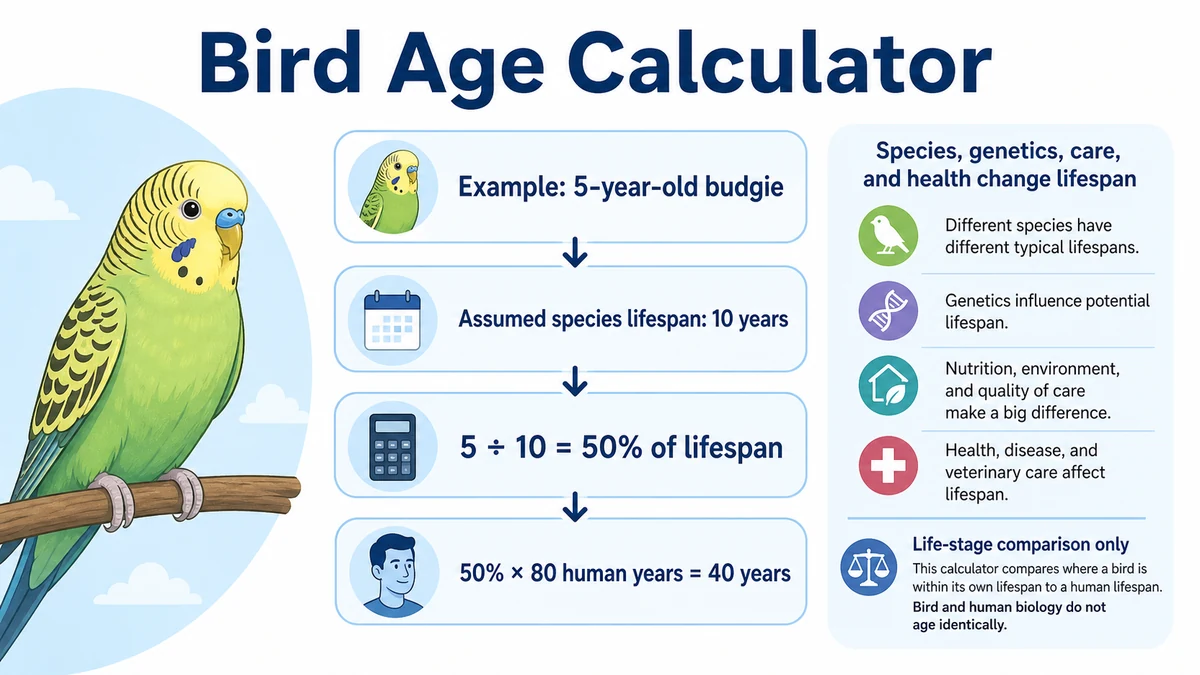
The calculator uses a lifespan-ratio method. It compares the bird’s current age with the selected bird lifespan, then scales that fraction to a human-equivalent lifespan reference.

A simplified version of the method is:

Human-equivalent age = (bird age ÷ selected bird lifespan) × reference human lifespan

In reverse mode:

Bird age = (human-equivalent age ÷ reference human lifespan) × selected bird lifespan

In these formulas:

  • Bird age is the pet bird’s current age
  • Selected bird lifespan is the species preset or custom lifespan
  • Reference human lifespan is the human lifespan value used internally for comparison
  • Human-equivalent age is the estimated comparison age in human terms

Recommended on-page improvement: Show the exact reference human lifespan used by the calculator. This makes the method easier for users to understand and improves trust.

Why Species Matters

Bird aging is not the same for every bird. Small birds, medium parrots, and large parrots can have very different average lifespans.

For example, a budgie may have a much shorter typical lifespan than an African grey parrot. If both birds are 5 years old, the budgie may be relatively mature or older within its own lifespan, while the African grey may still be comparatively young.

This is why a species-aware calculator is more useful than saying “1 bird year equals X human years” for every bird.

Default Species in the Calculator

Species Preset Visible Average Lifespan Used by Tool General Note
Budgie 7 years Small parakeet; lifespan estimates vary by care and health
Cockatiel 20 years Medium small parrot; many sources list a broad lifespan range
Lovebird 15 years Small parrot with species and care variation
Zebra Finch 6 years Small finch; often shorter-lived than many parrots
Canary 10 years Small songbird; lifespan varies by care and strain
Conure 15 years Parrot group with wide variation by species
African Grey Parrot 45 years Long-lived parrot; a major long-term care commitment
Custom lifespan User-entered Best for species not included or known individual estimates

Formula Summary

What You Want to Convert Formula
Bird age to human-equivalent age Human age = bird age ÷ bird lifespan × reference human lifespan
Human-equivalent age to bird age Bird age = human age ÷ reference human lifespan × bird lifespan
Years and months to months Total months = years × 12 + months
Months to years and months Years = floor(months ÷ 12), remaining months = months mod 12
Bird lifespan in months Lifespan months = lifespan years × 12 + lifespan months

Worked Example: Budgie Age to Human Age

Suppose you choose Budgie and the preset average lifespan is 7 years. Your budgie is 2 years old.

Step 1: Convert bird age to a lifespan fraction
Bird lifespan fraction = bird age ÷ selected bird lifespan
Bird lifespan fraction = 2 ÷ 7
Bird lifespan fraction ≈ 0.286

Step 2: Scale to human-equivalent age
Human-equivalent age = lifespan fraction × reference human lifespan

If the reference human lifespan is 72.6 years:

Human-equivalent age = 0.286 × 72.6
Human-equivalent age ≈ 20.7 human years

So, under this lifespan-ratio method, a 2-year-old budgie is roughly comparable to a young adult human age range. This is an estimate, not a veterinary assessment.

Worked Example: Cockatiel Age to Human Age

Suppose you choose Cockatiel and the preset average lifespan is 20 years. Your cockatiel is 5 years old.

Step 1: Find the lifespan fraction
5 ÷ 20 = 0.25

Step 2: Scale to human-equivalent age
If the reference human lifespan is 72.6 years:

0.25 × 72.6 = 18.15 human years

So, a 5-year-old cockatiel is about 18 human-equivalent years with this proportional method.

Worked Example: African Grey Parrot Age to Human Age

Suppose you choose African Grey Parrot and the preset average lifespan is 45 years. The bird is 10 years old.

Step 1: Find the lifespan fraction
10 ÷ 45 = 0.222

Step 2: Convert to human-equivalent age
If the reference human lifespan is 72.6 years:

0.222 × 72.6 ≈ 16.1 human years

This shows why species matters. A 10-year-old African grey may still be relatively young compared with its long expected lifespan, while a 10-year-old bird from a shorter-lived species may be in a later life stage.

Worked Example: Human Age Back to Bird Age

Suppose you choose Canary with a preset lifespan of 10 years. You enter a human-equivalent age of 36 years.

Step 1: Find the human lifespan fraction
If the reference human lifespan is 72.6 years:

36 ÷ 72.6 ≈ 0.496

Step 2: Scale to bird lifespan
Bird age = 0.496 × 10
Bird age ≈ 4.96 years

So, a 36-year human-equivalent age is roughly equivalent to a 5-year-old canary under this method.

Worked Example: Custom Lifespan

Suppose your bird species is not listed, and your avian veterinarian or care reference suggests an expected lifespan of 25 years. Your bird is 8 years old.

Step 1: Select custom lifespan
Custom lifespan = 25 years

Step 2: Find the lifespan fraction
8 ÷ 25 = 0.32

Step 3: Scale to human-equivalent age
If the reference human lifespan is 72.6 years:

0.32 × 72.6 = 23.2 human years

So, an 8-year-old bird with a 25-year expected lifespan is roughly comparable to a human-equivalent age of about 23 years using this calculator method.

How to Use This Bird Age Calculator

  1. Select your bird’s species from the dropdown.
  2. Choose Custom lifespan if your bird species is not listed or if you want to enter a different lifespan estimate.
  3. Enter the bird’s age in years and months.
  4. Review the human-equivalent age result.
  5. Or enter a human-equivalent age to back-calculate bird age.
  6. Review the bird age in months, human age in months, and life-stage result.
  7. Use the quick summary for a plain-language explanation.
  8. Click Reload / Reset to clear the calculator and start again.

How to Interpret the Result

Bird age is your pet bird’s actual age.

Human-equivalent age is a proportional comparison based on the selected bird lifespan and the reference human lifespan used by the calculator.

Bird age in months converts the entered bird age into total months.

Human age in months converts the estimated human-equivalent age into total months.

Life-stage is a heuristic label. It is a general estimate based on relative age, not a medical life-stage classification.

Why Bird Age Is Hard to Convert Exactly

There is no exact universal formula for converting bird years to human years. Birds vary widely in body size, lifespan, maturity age, metabolism, reproductive timing, and care needs.

A small finch, a canary, a budgie, a cockatiel, a conure, and an African grey parrot can all age differently. Some birds reach maturity quickly. Some long-lived parrots remain active for decades. This makes a single “multiply by X” formula inaccurate for all birds.

A lifespan-ratio method is useful because it compares each bird’s age against the expected lifespan for that species or custom setting.

Bird Age Life-Stage Guide

The calculator’s life-stage result should be treated as a rough guide. A practical lifespan-based approach may group birds by the percentage of expected lifespan already lived.

Relative Age Possible Life-Stage Label General Meaning
0% to 15% of lifespan Young / juvenile Growth, maturity, taming, training, and social development may be important
15% to 50% of lifespan Adult Stable adult care, nutrition, enrichment, and routine wellness monitoring
50% to 75% of lifespan Mature adult More attention to weight, mobility, diet, feather condition, and behavior changes
75% or more of lifespan Senior Closer monitoring and regular avian veterinary care become especially important

These stages are approximate. A bird’s health status may not match its estimated life-stage label.

Common Bird Age Examples

The examples below show why the same bird age can mean different things for different species.

Bird Species Selected Average Lifespan Bird Age Fraction of Lifespan
Budgie 7 years 3 years About 43%
Canary 10 years 3 years About 30%
Cockatiel 20 years 3 years About 15%
African Grey Parrot 45 years 3 years About 7%

A 3-year-old bird can be a very different relative age depending on the species.

Bird Age Conversion Chart by Lifespan Percentage

Bird’s Percent of Expected Lifespan General Human-Equivalent Idea Life-Stage Interpretation
10% Early life Young or developing
25% Young adult comparison Adult stage for many species
50% Midlife comparison Mature adult
75% Later-life comparison Senior range for many species
90%+ Advanced age comparison Very senior relative to expected lifespan

This chart is only a relative comparison. Some birds live well beyond average lifespan, while others develop health problems earlier.

Budgie Age in Human Years

Budgies are small parrots, also known as parakeets in many regions. Because they are smaller and usually shorter-lived than large parrots, each year can represent a larger portion of their expected lifespan.

With the calculator’s visible budgie preset of 7 years, a 1-year-old budgie has already lived about 14% of that average lifespan. A 5-year-old budgie has lived about 71% of that average lifespan. This is why the human-equivalent estimate rises faster for shorter-lived birds.

Cockatiel Age in Human Years

Cockatiels are popular companion birds and often live longer than budgies or zebra finches. The calculator’s visible cockatiel preset is 20 years.

Because the selected lifespan is longer, each calendar year represents a smaller portion of total expected lifespan. A 5-year-old cockatiel with a 20-year lifespan preset has lived about 25% of that lifespan, so it may compare more like a young adult than a senior bird.

Lovebird Age in Human Years

Lovebirds are small parrots with energetic behavior and strong social needs. The calculator’s visible lovebird preset is 15 years.

A 3-year-old lovebird with a 15-year preset has lived about 20% of its expected lifespan. A 10-year-old lovebird has lived about 67% of that expected lifespan, so it may fall into a mature or senior comparison range depending on the life-stage thresholds used.

Zebra Finch Age in Human Years

Zebra finches are small birds and generally have shorter lifespan expectations than many parrots. The calculator’s visible zebra finch preset is 6 years.

Because the lifespan preset is short, a 2-year-old zebra finch has already lived about one-third of the selected average lifespan. A 5-year-old zebra finch may be senior relative to that lifespan estimate.

Canary Age in Human Years

Canaries are small songbirds. The calculator’s visible canary preset is 10 years.

A 5-year-old canary is about halfway through the selected lifespan estimate. A 9-year-old canary is near the later portion of that preset lifespan, although individual canaries may live shorter or longer lives depending on health, genetics, care, and environment.

Conure Age in Human Years

Conures are a diverse group of parrots, and lifespan can vary by species. The calculator’s visible conure preset is 15 years, but some conure species may have different expected lifespans.

If you know your specific conure type and have a better lifespan estimate, the custom lifespan option may give a more suitable comparison than the generic conure preset.

African Grey Parrot Age in Human Years

African grey parrots are long-lived, intelligent parrots. The calculator’s visible African grey preset is 45 years.

A 10-year-old African grey may represent a much smaller percentage of expected lifespan than a 10-year-old budgie or canary. This makes the species-based method especially important for larger, longer-lived parrots.

When to Use the Custom Lifespan Option

Use the custom lifespan option when:

  • Your bird’s species is not in the dropdown
  • Your bird’s species has a wide lifespan range
  • Your bird is a hybrid or less common pet bird
  • You have a lifespan estimate from an avian veterinarian or reliable care source
  • You want to model a shorter or longer expected lifespan
  • The preset seems too broad for your specific bird

For example, if your specific parrot species is often expected to live 30 years, you can choose custom lifespan and enter 30 years instead of using a generic preset.

How Months Are Handled

The calculator supports years and months because bird age is often not a whole number of years.

For example:

2 years and 6 months = 2 × 12 + 6 = 30 months

For reverse conversion, the calculator can convert total months back into years and months.

For example:

30 months = 2 years and 6 months

This makes the result easier to understand than a decimal such as 2.5 years.

Bird Age vs Human Age Is a Comparison, Not a Diagnosis

Human-equivalent bird age is mainly a communication tool. It helps pet owners understand whether their bird may be young, adult, mature, or senior relative to its expected lifespan.

It does not measure:

  • organ function
  • immune health
  • nutritional status
  • feather health
  • bone health
  • reproductive health
  • stress level
  • infection risk
  • true remaining lifespan

For health questions, an avian veterinarian is the right source.

What Affects a Bird’s Real Aging?

Bird aging can be influenced by many factors beyond calendar age. Important factors include:

  • species
  • genetics
  • diet quality
  • cage size and environment
  • flight and exercise opportunities
  • mental enrichment
  • social interaction
  • sleep schedule
  • stress level
  • air quality
  • exposure to toxins
  • reproductive history
  • preventive veterinary care
  • early disease detection

A bird with excellent care may live longer and remain healthier than a bird of the same species and age with poor care or chronic illness.

Bird Wellness and Aging

Aging birds may need closer monitoring. Changes in weight, appetite, droppings, breathing, activity, balance, feather quality, voice, behavior, or sleep may signal a health issue.

For pet birds, preventive care may include:

  • regular checkups with an avian veterinarian
  • appropriate species-specific diet
  • fresh water
  • safe cage setup
  • proper perches
  • foraging opportunities
  • exercise and flight when safe
  • safe toys and enrichment
  • clean food and water bowls
  • safe air quality and toxin avoidance

Use the calculator as an age-comparison guide, then use veterinary care and daily observation for real health decisions.

Signs a Bird May Need Veterinary Attention

Do not rely on a bird age calculator if your bird seems unwell. Birds can hide illness, and changes may become serious quickly.

Contact an avian veterinarian if you notice:

  • reduced appetite
  • weight loss
  • fluffed feathers for long periods
  • labored breathing
  • tail bobbing
  • changes in droppings
  • vomiting or regurgitation that is abnormal
  • weakness or sitting at the cage bottom
  • balance problems
  • swelling
  • bleeding
  • feather plucking or skin injury
  • sudden behavior changes

Bird age estimates are not a substitute for medical care.

Bird Age Calculator vs Bird Life Expectancy

This calculator does not predict exactly how long a bird will live. It uses average lifespan assumptions to create a comparison.

Term Meaning
Bird age The bird’s actual calendar age
Human-equivalent age A comparison age based on lifespan proportion
Average lifespan A typical lifespan estimate for a species or group
Life expectancy A broader estimate that can vary by population, care, and conditions
Remaining lifespan Not predicted by this calculator

Why Two-Way Conversion Is Useful

The calculator can work in both directions. This is useful because users may ask two different questions:

  • “How old is my bird in human years?”
  • “What bird age would match this human age?”

For example, a user may want to know whether a bird is roughly comparable to a young adult, middle-aged adult, or senior human. Reverse conversion can help explain the relationship from the other side.

Common Mistakes to Avoid

  • Do not use one fixed bird-to-human formula for every species.
  • Do not assume a bird’s human-equivalent age is medically exact.
  • Do not use the result to predict how long your bird will live.
  • Do not ignore species differences in lifespan.
  • Do not treat a custom lifespan as guaranteed.
  • Do not compare a budgie, cockatiel, and African grey using one simple multiplier.
  • Do not use age conversion instead of avian veterinary care.
  • Do not assume an older bird is unhealthy or a younger bird is always healthy.
  • Do not ignore behavior, appetite, droppings, weight, feather condition, or breathing changes.

Important Assumptions and Limitations

  • This calculator uses species-based average lifespan logic or a custom lifespan entered by the user.
  • The result is a proportional comparison, not a biological aging measurement.
  • The life-stage label is heuristic and should be treated as approximate.
  • Species presets are simplified and may not match every individual bird.
  • Some bird groups, such as conures, include multiple species with different lifespans.
  • Individual lifespan can vary due to genetics, diet, housing, enrichment, veterinary care, and health history.
  • The calculator does not assess disease, quality of care, body condition, or life expectancy.
  • It does not replace advice from an avian veterinarian.

Practical Uses

This Bird Age Calculator can be useful for:

  • estimating bird age in human years
  • comparing pet bird life stages
  • explaining a bird’s relative age to family members
  • checking whether a bird is young, adult, mature, or senior relative to its species
  • converting human-equivalent age back to bird age
  • using a custom lifespan for birds not in the species list
  • creating educational pet-care content
  • adding age context to pet records

When You May Need More Than This Calculator

This calculator is best for rough age comparison. You may need avian veterinary advice if you want to understand:

  • your bird’s actual health status
  • age-related care needs
  • diet changes
  • senior bird monitoring
  • weight loss or weight gain
  • behavior changes
  • feather issues
  • breathing problems
  • reproductive concerns
  • species-specific lifespan expectations

References

  1. AjaxCalculators live Bird Age Calculator
  2. Merck Veterinary Manual: Introduction to Birds
  3. Merck Veterinary Manual: Choosing a Pet Bird
  4. MSD Veterinary Manual: Feeding a Pet Bird
  5. MSD Veterinary Manual: Overview of Pet Birds
  6. VCA Animal Hospitals: Cockatiels — General Information
  7. VCA Animal Hospitals: Parrot Lifespan

Related Calculators

Pet bird age note: This calculator provides an educational bird-age comparison only. It estimates human-equivalent age from species-based or custom lifespan assumptions. It does not diagnose health, predict remaining lifespan, or replace advice from an avian veterinarian. For diet, behavior, senior care, illness signs, weight changes, feather problems, breathing issues, or species-specific care, consult a qualified avian veterinarian.

More of our calculators...

Plant Spacing Calculator

Use our Plant Spacing Calculator to estimate how many plants fit in a garden bed, crop row, or square-foot layout from area and spacing.

Hamster Age Calculator

Use our Hamster Age Calculator to convert hamster years to human years or human age back to hamster age with chart-based interpolation.

Dog Age Calculator

Convert dog years to human years by breed size. Get a clear age estimate for puppies, adults, and seniors.

Dihybrid Cross (Punnett Square) Calculator

Use our Dihybrid Cross Calculator to build a 4×4 Punnett square for two traits, see gametes, genotype probabilities, and phenotype ratios fast.

Dog Pregnancy (Due Date) Calculator

Use our Dog Pregnancy (Due Date) Calculator to estimate your dog’s due date, safe whelping window, and pregnancy progress from mating, ovulation, LH surge, or diestrus.

Dog Size & Adult Weight Calculator

Use our Dog Size & Adult Weight Calculator to estimate your puppy’s adult weight from age and current weight. Quick size prediction with pet category output.

Punnett Square Calculator

Punnett Square Calculator to predict genotype and phenotype ratios for monohybrid and dihybrid genetic crosses.

Percent Yield Calculator

Use our Percent Yield Calculator to calculate chemistry percent yield from actual yield and theoretical yield in mg, g, or kg.

Cat Age Calculator

Use this Cat Age Calculator to estimate your cat’s age in human years using the common 15 / 24 / +4 cat age chart. Includes formula, examples, life stages, and care notes.