Simple Loan Calculator
Estimate monthly payment, total interest, and total repayment for a basic loan.
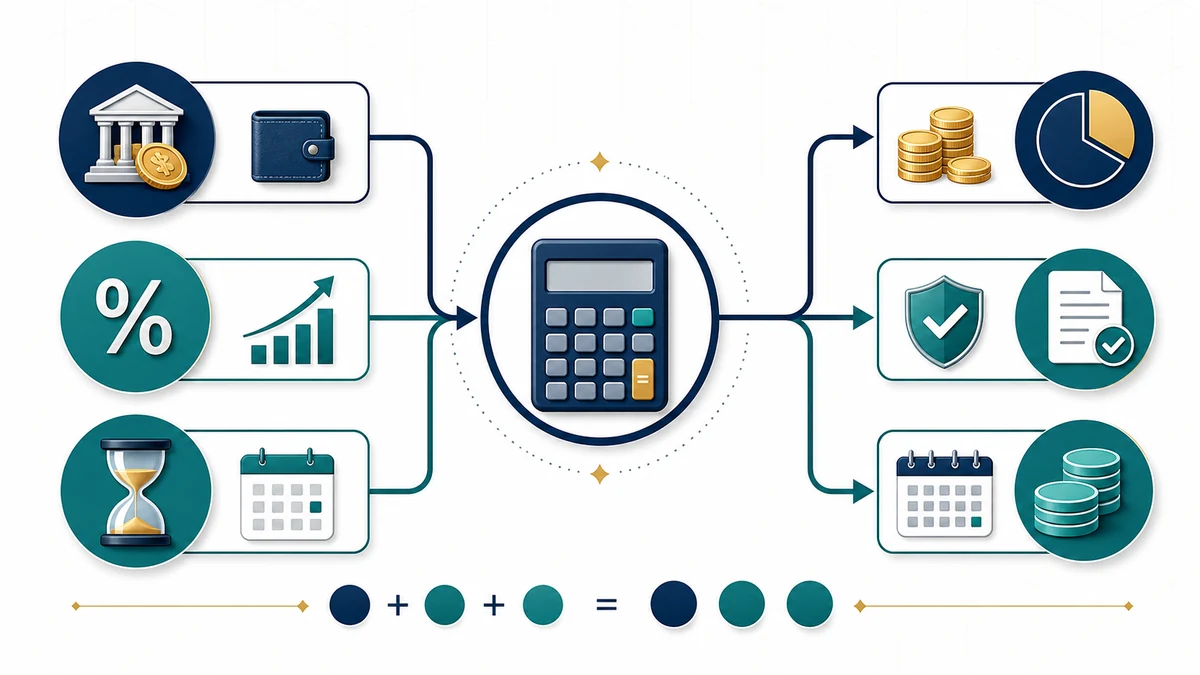
Use this Simple Loan Calculator to estimate monthly payment, total interest, and total repayment for a basic fixed-rate loan. Enter the loan amount, annual interest rate or APR, loan term, optional fees added to the loan, and optional extra monthly payment to see how much the loan may cost over time.
Important Note: This Simple Loan Calculator estimates monthly payment, amount financed, total interest, total repayment, payoff time, and optional extra-payment impact for a basic fixed-rate installment loan.
The calculator assumes a fixed annual rate, regular monthly payments, financed fees when entered, and optional extra monthly payments applied toward the loan balance. It is useful for planning and comparison, but it is not a lender quote, approval, credit decision, Truth in Lending disclosure, amortization schedule from a lender, or official APR calculation.
Actual loan costs can differ because of lender rules, APR disclosures, compounding method, payment due dates, fees, taxes, insurance, late fees, prepayment penalties, skipped payments, payment allocation rules, underwriting, credit score, and official loan documents. Always compare real loan offers using the lender’s official disclosures before borrowing.
Reviewed by: AjaxCalculators Editorial Team
Last updated: April 27, 2026
Method source: Standard fixed-rate amortized loan payment formula using loan principal, financed fees, annual interest rate, loan term, and optional extra monthly payment
Editorial standards: AjaxCalculators Editorial Policy
What This Simple Loan Calculator Calculates
This calculator estimates the main repayment numbers for a simple fixed-rate installment loan. It is best for personal-loan-style, auto-loan-style, and basic amortized loan estimates where the rate and payment schedule remain fixed.
| Result | What It Means | Important Use Note |
|---|---|---|
| Estimated monthly payment | The estimated regular monthly payment before optional extra payment. | Based on the fixed-rate amortization formula. |
| Loan principal used | The amount financed after adding any financed fees. | Fees added to the loan increase the financed balance. |
| Total interest | The estimated interest paid over the repayment period. | May change if extra payments, fees, or lender rules differ. |
| Total repayment | The estimated total amount paid over the life of the loan. | Usually includes principal plus interest, and financed fees when entered. |
| Payoff time | The estimated time needed to repay the loan. | Extra payments may reduce payoff time if applied to principal. |
| Extra-payment impact | Shows how extra monthly payment may affect payoff and interest. | Only accurate if the lender applies extra payments toward principal. |
How the Simple Loan Calculator Works
The calculator uses a standard fixed-rate amortized loan method. It first determines the amount financed, converts the annual rate into a monthly rate, converts the term into months, and then estimates the monthly payment.
| Step | Formula or Method | Use Note |
|---|---|---|
| Amount financed | Amount financed = loan amount + fees added to loan | Use only for fees that are financed into the loan balance. |
| Monthly interest rate | Monthly rate = annual rate ÷ 12 ÷ 100 | Converts percent APR/rate input into a monthly decimal rate. |
| Term in months | Months = years × 12 | Used when the term is entered in years. |
| Monthly payment | Payment = P × r × (1 + r)n ÷ [(1 + r)n − 1] | Used for fixed-rate amortized loans where r is greater than zero. |
| 0% interest payment | Payment = amount financed ÷ number of months | Used when the annual rate is 0%. |
| Total repayment | Total repayment = sum of all payments made | For extra-payment cases, use the actual payoff schedule rather than only multiplying by the original term. |
| Total interest | Total interest = total repayment − amount financed | Shows estimated borrowing cost before other external charges. |
2) Monthly Interest Rate
The annual interest rate or APR is converted into a monthly rate before calculating the payment.
Monthly interest rate = annual rate ÷ 12 ÷ 100
For example, if the annual rate is 7.5%:
Monthly interest rate = 7.5 ÷ 12 ÷ 100 = 0.00625
3) Loan Term in Months
The calculator lets you enter the loan term in years or months. If years are selected, the calculator converts the term into months.
Loan term in months = loan term in years × 12
For example:
- 3 years = 36 months
- 5 years = 60 months
- 10 years = 120 months
4) Monthly Loan Payment Formula
For a fixed-rate amortized loan, the monthly payment is calculated with this formula:
Monthly payment = P × r × (1 + r)n ÷ [(1 + r)n − 1]
In this formula:
- P is the amount financed
- r is the monthly interest rate
- n is the number of monthly payments
If the annual interest rate is 0%, the calculator can use a simple division:
Monthly payment at 0% interest = amount financed ÷ number of months
5) Total Repayment
Total repayment is the total amount paid through all scheduled monthly payments.
Total repayment = monthly payment × number of months
If extra monthly payments are used, the actual repayment schedule may finish earlier, so total repayment should be calculated from the actual payoff schedule rather than only multiplying the base payment by the original term.
6) Total Interest
Total interest is the amount paid above the financed principal.
Total interest = total repayment − amount financed
This shows the estimated cost of borrowing before considering other costs such as late fees, taxes, insurance, penalties, or lender-specific charges.
How Extra Monthly Payments Work
Extra monthly payments can reduce the loan balance faster when they are applied to principal. This can shorten the payoff time and reduce total interest.
| Extra Payment Item | What It Means | Important Caution |
|---|---|---|
| Regular monthly payment | The required amortized loan payment. | This is the estimated base payment before extra payment. |
| Extra monthly payment | An additional amount paid each month. | Works best when applied directly to principal. |
| Total monthly payment | Regular monthly payment + extra monthly payment | Make sure this amount fits the borrower’s budget. |
| Reduced payoff time | The loan may be paid off before the original term ends. | Depends on payment timing and lender allocation rules. |
| Interest savings | Less interest may accrue because the balance falls faster. | Check for prepayment penalties or restrictions. |
Before relying on an extra-payment plan, confirm whether the lender applies extra payments to principal or treats them as advance payments toward future installments.
Important Note About Extra Payments
Some lenders automatically apply extra payments to principal, while others may apply them to future scheduled payments unless you request principal-only treatment. Before relying on an extra-payment plan, check your loan agreement or lender policy.
If your calculator result includes extra payments, it is helpful for the live page to show:
- regular monthly payment
- monthly payment including extra
- new payoff time
- interest saved
- total repayment with extra payments
Fees Added to Loan
The optional fees field can represent origination fees, processing fees, financed closing costs, or other charges that are added to the loan balance.
| Fee Treatment | Effect on Calculator | Borrower Impact |
|---|---|---|
| Fee financed into loan | Added to the principal used in the payment formula. | Usually increases monthly payment and total interest. |
| Fee paid upfront | Should not be added to the financed balance. | May not increase monthly payment, but still increases real borrowing cost. |
| No fees | Amount financed equals the loan amount. | Simpler estimate, but still check lender disclosures. |
| Required lender fees | May be included in APR by the lender. | Compare official APRs and total loan costs from lender documents. |
Interest Rate vs APR
The calculator field is labeled annual interest rate / APR. For the payment formula, the entered percentage is used as the annual rate. In real loan disclosures, interest rate and APR may not be the same.
| Term | What It Means | Why It Matters |
|---|---|---|
| Interest rate | The cost charged for borrowing the principal. | Used directly in the amortized payment formula. |
| APR | The annual percentage rate may include interest plus certain required loan fees. | Often better for comparing real loan offers when calculated by the lender. |
| Financed fees | Fees added to the loan balance. | Can increase monthly payment and total interest. |
| Official APR disclosure | The lender’s regulated APR calculation. | Do not treat this calculator as an official APR disclosure. |
If you enter an APR but also add fees manually, avoid describing the result as an official APR-based disclosure. Describe it as an estimated payment and repayment calculation.
Assumptions and Important Notes
| Assumption or Limitation | What It Means |
|---|---|
| Fixed annual rate | The calculator assumes the annual rate does not change during the loan. |
| Monthly payments | The calculator assumes regular monthly repayment. |
| Financed fees | Fees entered in the fee field are treated as added to the loan balance. |
| Extra payments | Extra monthly payment is assumed to be paid every month. |
| Principal-only extra payment assumption | Extra-payment savings assume the lender applies extra payments toward principal. |
| No adjustable rates | The calculator does not model variable-rate or adjustable-rate loans. |
| No balloon payment | The calculator does not model a large final balloon payment. |
| No interest-only period | The calculator assumes normal amortized repayment, not interest-only repayment. |
| No skipped or deferred payments | Payment holidays, deferments, and forbearance are not modeled. |
| No full lender disclosure | The calculator does not replace official loan documents, APR disclosures, or an amortization schedule. |
| No currency conversion | The currency symbol changes display only; it does not convert money values. |
Worked Example: Basic Loan Payment
Suppose you borrow $10,000 at a 7.5% annual interest rate for 5 years, with no added fees.
| Step | Calculation | Result |
|---|---|---|
| Convert loan term to months | 5 × 12 | 60 months |
| Convert annual rate to monthly rate | 7.5 ÷ 12 ÷ 100 | 0.00625 |
| Identify principal | P = 10,000 | $10,000 |
| Use amortized payment formula | P × r × (1 + r)n ÷ [(1 + r)n − 1] | Fixed-rate monthly payment formula |
| Calculate monthly payment | Formula result | About $200.38 |
| Calculate total repayment | $200.38 × 60 | About $12,022.80 |
| Calculate total interest | $12,022.80 − $10,000 | About $2,022.80 |
So, a $10,000 loan at 7.5% for 5 years has an estimated monthly payment of about $200.38 and estimated total interest of about $2,022.80.
Worked Example: Loan With Fees Added
Suppose you borrow $10,000 and $250 in fees are added to the loan balance.
| Step | Calculation | Result |
|---|---|---|
| Start with loan amount | Loan amount | $10,000 |
| Add financed fees | $10,000 + $250 | $10,250 |
| Use amount financed as principal | P = $10,250 | The payment formula uses $10,250. |
| Interpret the impact | Higher financed balance | Monthly payment and total interest usually increase. |
This is why financed fees should be included when comparing loan offers. A loan with a lower rate but higher financed fees may not always be cheaper overall.
Worked Example: Extra Monthly Payment
Suppose the regular monthly payment is $200.38 and you add an extra $50 per month.
| Step | Calculation | Result |
|---|---|---|
| Identify regular monthly payment | Regular payment | $200.38 |
| Add extra monthly payment | $200.38 + $50 | $250.38 total monthly payment |
| Apply extra payment | Extra payment reduces principal if lender applies it that way. | Balance may fall faster. |
| Estimate payoff impact | Lower balance means less interest accrues over time. | Loan may be paid off earlier. |
| Check lender policy | Confirm principal-only payment handling. | Prevents incorrect interest-savings assumptions. |
How to Use This Simple Loan Calculator
- Enter the currency symbol you want to display.
- Enter the loan amount.
- Enter the annual interest rate or APR percentage.
- Enter the loan term.
- Select whether the loan term is in years or months.
- Enter any fees added to the loan, if applicable.
- Enter an extra monthly payment if you plan to pay more than the required amount.
- Click Calculate.
- Review the monthly payment, total interest, total repayment, and any extra-payment impact shown by the calculator.
How to Interpret the Results
| Result | What It Means | Important Caution |
|---|---|---|
| Estimated monthly payment | The calculated regular monthly payment. | Does not guarantee lender approval or exact billing amount. |
| Loan principal used | Loan amount plus financed fees. | Only include fees that are actually financed. |
| Total interest | Estimated interest paid over the loan payoff period. | May differ if payment dates, compounding, fees, or lender rules differ. |
| Total repayment | Estimated total paid through the repayment schedule. | Does not include every possible external cost, penalty, or insurance/tax charge. |
| Payoff time | Estimated time needed to fully repay the loan. | Extra-payment payoff depends on principal-only application. |
| Currency symbol | The symbol shown beside money results. | The calculator does not convert currencies or exchange rates. |
Monthly Payment vs Total Loan Cost
A lower monthly payment does not always mean a cheaper loan. Longer terms can make monthly payments smaller while increasing total interest over the life of the loan.
| Comparison Item | Why It Matters | What to Check |
|---|---|---|
| Monthly payment | Shows short-term affordability. | Can be lower on a longer loan even when total cost is higher. |
| Loan term | Controls how long interest accrues. | Longer terms often increase total interest. |
| APR or annual rate | Shows the annual borrowing-cost rate used for comparison. | Compare APR to APR, not APR to interest rate. |
| Amount financed | The balance used to calculate repayment. | Financed fees increase the balance. |
| Total interest | Shows estimated borrowing cost. | Use this when comparing term lengths. |
| Total repayment | Shows the estimated total paid over the loan. | Better for comparing the full cost of loan options. |
| Prepayment rules | Controls whether extra payments save money. | Check for penalties and payment allocation rules. |
When This Loan Calculator Is Useful
- estimating a personal loan payment
- checking total interest before borrowing
- comparing different loan terms
- seeing how fees affect the financed amount
- estimating the impact of extra monthly payments
- planning a basic installment loan
- understanding how APR and term affect repayment
- reviewing whether a loan payment fits your budget
Common Mistakes to Avoid
| Mistake | Why It Causes Problems |
|---|---|
| Comparing loans only by monthly payment | A longer term can lower the monthly payment but increase total interest. |
| Ignoring total repayment | The full repayment amount shows the estimated lifetime cost of the loan. |
| Forgetting financed fees | Fees added to the loan balance can increase both payment and interest. |
| Confusing interest rate and APR | APR may include certain fees, while interest rate is the cost of borrowing the principal. |
| Entering years when the tool is set to months | Wrong term units can make the payment result completely incorrect. |
| Assuming extra payments always reduce principal | Some lenders may apply extra money to future payments unless principal-only treatment is requested. |
| Ignoring prepayment penalties | A penalty can reduce or eliminate the benefit of paying early. |
| Ignoring taxes, insurance, and required charges | Real borrowing costs may include charges not modeled by a simple loan calculator. |
| Treating the result as a loan approval | The calculator does not check credit score, income, lender underwriting, or eligibility. |
Formula Summary
| What You Want to Find | Formula | Use Note |
|---|---|---|
| Amount financed | Amount financed = loan amount + fees added to loan | Use when fees are financed. |
| Loan term in months | Months = years × 12 | Use when the term is entered in years. |
| Monthly interest rate | Monthly rate = annual rate ÷ 12 ÷ 100 | Converts percentage rate to decimal monthly rate. |
| Monthly payment | Payment = P × r × (1 + r)n ÷ [(1 + r)n − 1] | Use for fixed-rate amortized loans. |
| 0% interest monthly payment | Payment = amount financed ÷ number of months | Use when annual rate is 0%. |
| Total monthly payment with extra | Total monthly payment = regular monthly payment + extra monthly payment | Used for extra-payment scenarios. |
| Total repayment without extra | Total repayment = monthly payment × number of months | Works for the standard repayment schedule. |
| Total interest | Total interest = total repayment − amount financed | Shows estimated interest cost. |
| Interest saved from extra payments | Interest saved = interest without extra − interest with extra | Only valid when extra-payment schedule is modeled correctly. |
When This Calculator May Not Be Enough
This calculator is best for simple fixed-rate installment loan estimates. Some loan types need a more specific calculator or official lender schedule.
| Loan Situation | Why This Calculator May Not Be Enough |
|---|---|
| Adjustable-rate loan | The interest rate can change over time. |
| Balloon-payment loan | A large final payment is not modeled by a standard amortization formula. |
| Interest-only loan | Payments may not reduce principal during the interest-only period. |
| Student loan with deferment or forgiveness | Special repayment rules, subsidies, forgiveness, or deferment can change the result. |
| Mortgage with taxes and insurance | Escrow, property tax, insurance, PMI, HOA, and closing costs may matter. |
| Credit card debt | Credit cards often use daily periodic interest and changing balances. |
| Official loan comparison | Use lender APR, total payments, finance charge, and official disclosure documents. |
Frequently Asked Questions
What does this Simple Loan Calculator estimate?
It estimates monthly payment, amount financed, total interest, total repayment, payoff time, and optional extra-payment impact for a basic fixed-rate installment loan.
What is the formula for monthly loan payment?
The standard fixed-rate formula is Payment = P × r × (1 + r)n ÷ [(1 + r)n − 1], where P is amount financed, r is monthly interest rate, and n is the number of monthly payments.
How are loan fees handled?
If you enter fees added to the loan, the calculator treats them as financed fees. That means they increase the principal used in the payment formula.
What is the difference between interest rate and APR?
The interest rate is the cost of borrowing the principal. APR may include the interest rate plus certain loan fees and charges. Official APR should come from lender disclosures.
Why can a lower monthly payment cost more overall?
A longer loan term can reduce the monthly payment but keep the loan balance outstanding for longer, which can increase total interest.
Do extra monthly payments always save interest?
They can save interest if the lender applies the extra amount to principal and there is no prepayment penalty. Check the loan agreement or lender policy.
Can this calculator show official APR?
No. It uses the percentage you enter for payment estimates. It does not generate an official APR disclosure under lending regulations.
Does the currency symbol convert money?
No. The currency symbol only changes the display. It does not convert exchange rates or adjust loan terms by country.
Can I use this for mortgages, student loans, or credit cards?
Use it only for simple fixed-rate estimates. Mortgages, student loans, and credit cards may need more specialized calculators because of taxes, insurance, deferment, daily interest, changing balances, or special repayment rules.
References
- Consumer Financial Protection Bureau — Interest Rate vs APR
- Consumer Financial Protection Bureau — Loan Amortization Basics
- Consumer Financial Protection Bureau — Compare Loan Offers Beyond Monthly Payment
- Consumer Financial Protection Bureau — Regulation Z, APR Determination
- Consumer Financial Protection Bureau — Auto Loan Resources
Related Calculators
- Mortgage/Loan Amortization Calculator
- Interest Rate Calculator
- Refinance Calculator
- Car Finance Calculator
- Mortgage Calculator
- Mortgage Interest Calculator
- Mortgage Calculator with Taxes and Insurance
- Credit Card Interest Calculator
- Balance Transfer Calculator
- APY Calculator
Simple Loan Calculator Disclaimer
This Simple Loan Calculator is for educational, planning, and comparison use only. It estimates monthly payment, amount financed, total interest, total repayment, payoff time, financed-fee impact, and optional extra-payment impact from the values entered.
It does not provide financial, tax, legal, lending, accounting, investment, credit, or debt-management advice. It does not guarantee loan approval, lender pricing, credit eligibility, official APR, official finance charge, or a lender-issued amortization schedule.
Actual loan terms can differ because of lender rules, underwriting, credit score, income, debt-to-income ratio, payment dates, APR disclosures, compounding method, repayment schedule, origination fees, taxes, insurance, late fees, prepayment penalties, deferments, skipped payments, and payment-allocation rules. For real borrowing decisions, compare official lender disclosures and seek qualified professional guidance when needed.