Rent vs Buy Calculator
Compare the estimated long-term cost of renting versus buying a home using mortgage, rent, ownership cost, appreciation, and investment assumptions.
Rent vs Buy Results
This calculator is an estimate only. Actual rent-versus-buy results can change because of mortgage terms, taxes, insurance, repairs, appreciation, rent growth, investment returns, moving costs, tax deductions, closing costs, and local market conditions.
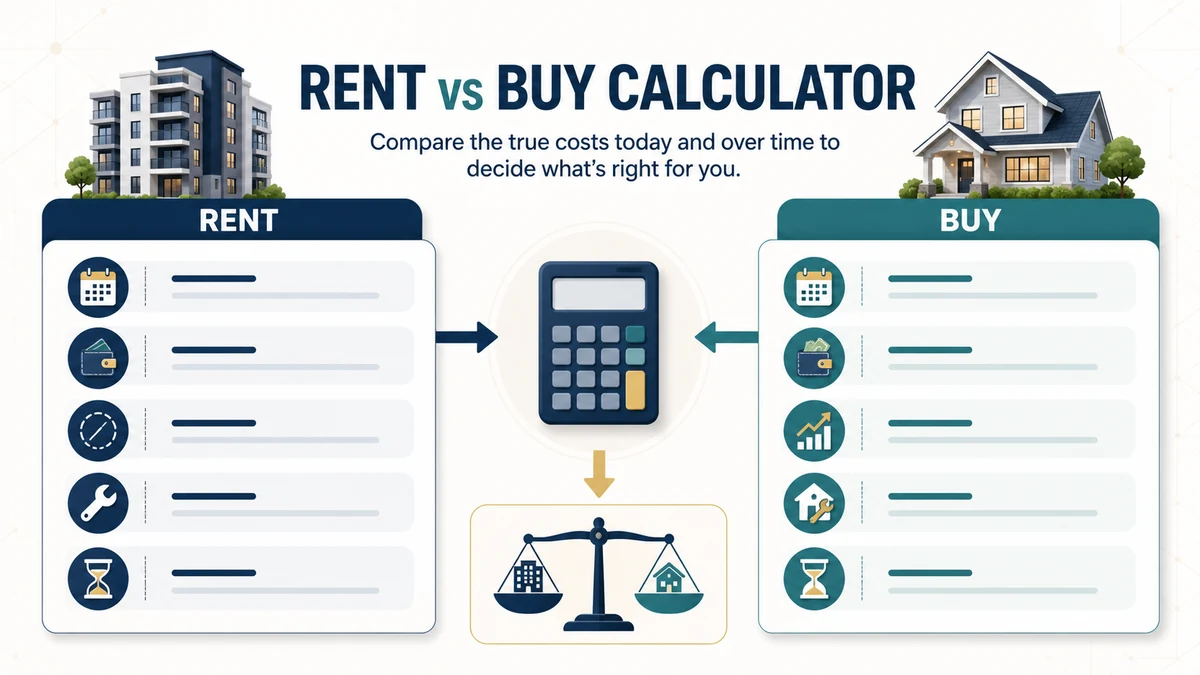
The Rent vs Buy Calculator compares two housing paths across a chosen time horizon. It goes beyond monthly rent versus mortgage payment by tracking ownership expenses, transaction costs, home equity, rent increases, and the possible return on money a renter does not put into a home.
Eight assumptions that can reverse the answer
- Home price and down payment.
- Mortgage rate and term.
- Property tax, insurance, association fees, and maintenance.
- Closing and selling costs.
- Starting rent and annual rent growth.
- Length of time in the home.
- Home appreciation.
- Investment return on renter savings or avoided upfront costs.
Because future appreciation, rent, and returns are uncertain, a single result should never be treated as a forecast.
Buying creates both costs and an asset
A mortgage payment contains interest and principal. Interest is a financing cost; principal generally builds equity. The owner also pays expenses that do not become equity, including taxes, insurance, maintenance, and transaction charges. At the end of the modeled period, estimated home value minus remaining mortgage and selling costs produces net sale equity.
Renting preserves flexibility and capital
Rent is a housing cost without home equity, but the renter avoids a down payment, closing costs, and many ownership responsibilities. A comparison may model investment growth on available capital and any monthly cost difference. That return is uncertain and requires the money actually to remain invested.
Time horizon is the first sensitivity test
Buying and selling carry large one-time costs. Run the Rent vs Buy Calculator for the shortest plausible stay, the expected stay, and a longer stay. A move after three years can look very different from remaining ten years, even with identical monthly inputs.
Compare cash flow and ending position separately
Ask two questions: which option requires more cash during the period, and which produces the stronger modeled net position at the end? A lower monthly cost does not guarantee a better final result, and a higher modeled net worth may still require cash flow that does not fit the household budget.
Reality checks before acting
- Include the full housing payment, maintenance, and utilities that differ.
- Use local quotes for insurance, taxes, rent, and closing charges.
- Stress-test appreciation and investment returns downward.
- Consider job stability, moving flexibility, and repair risk outside the equation.
- Seek qualified tax advice rather than assuming a deduction.
Supporting calculators
Check monthly affordability with the Budget Calculator, recurring debt with the Debt-to-Income Ratio Calculator, and cash reserves with the Emergency Fund Calculator.
Rent vs Buy Calculator FAQ
Does the lower monthly payment win?
No. Compare transaction costs, equity, maintenance, and the ending financial position.
Can the calculator predict home prices?
No. Appreciation is an assumption that should be tested across several scenarios.
What costs are commonly missed?
Repairs, insurance changes, association dues, selling costs, moving expenses, and renter insurance are frequent omissions.
Official guidance
The CFPB explains that calculators depend heavily on future assumptions and that ownership also carries repair, maintenance, and transaction risks: consider whether it is the right time to buy.
Use a breakeven year as a range
Some comparisons report the first year in which buying overtakes renting. That crossover can move dramatically when selling costs, appreciation, rent growth, maintenance, or investment return changes. Record a range of crossover years from several scenarios rather than one definitive date.
Keep lifestyle value outside the dollar total
Stability, freedom to renovate, school continuity, maintenance responsibility, accessibility, and the ability to relocate all matter but may not have defensible dollar values. The Rent vs Buy Calculator should inform the financial portion of a decision without pretending to score every personal consideration.
Quote-checking worksheet
- current rent, renter insurance, and expected increases;
- full monthly owner payment and estimated utilities;
- cash needed at purchase and sale;
- annual maintenance and major repair reserve;
- time horizon and possible early move;
- cautious appreciation and investment-return cases.
Update estimates with local, current figures before relying on the comparison.