
VO₂ Max Calculator
Inputs
Results
Action
Use this VO₂ Max Calculator to estimate aerobic fitness from the Rockport 1-mile walk test. Enter your age, sex, body weight, walk time, and heart rate recorded immediately after completing the walk.
Important: This is a field-test estimate, not a direct laboratory measurement of oxygen consumption. It does not diagnose cardiovascular health or determine whether strenuous exercise is safe for you.
Rockport VO₂ Max Formula
The calculator uses the following equation:
Estimated VO₂ max = 132.853 − (0.0769 × weight in lb) − (0.3877 × age) + (6.315 × sex) − (3.2649 × walk time) − (0.1565 × post-walk heart rate)
Where:
- Weight is entered in pounds.
- Age is entered in years.
- Sex code is male = 1 and female = 0, following the original equation.
- Walk time is entered in decimal minutes.
- Post-walk heart rate is entered in beats per minute.
The result is reported in ml/kg/min, meaning milliliters of oxygen per kilogram of body weight per minute.
Input Conversions
If body weight is entered in kilograms:
Weight in pounds = weight in kilograms × 2.20462
Convert minutes and seconds to decimal minutes before applying the equation:
Decimal minutes = minutes + seconds ÷ 60
For example:
12 minutes 15 seconds = 12 + 15 ÷ 60 = 12.25 minutes
Worked Example
Suppose the test inputs are:
- Age: 30 years
- Sex: Male
- Weight: 180 lb
- 1-mile walk time: 12 minutes 15 seconds
- Post-walk heart rate: 165 bpm
First convert the walk time:
12 + 15 ÷ 60 = 12.25 minutes
Apply the Rockport equation:
VO₂ max = 132.853 − (0.0769 × 180) − (0.3877 × 30) + (6.315 × 1) − (3.2649 × 12.25) − (0.1565 × 165)
Estimated VO₂ max ≈ 47.88 ml/kg/min
This result is an estimated aerobic-capacity value based on the test performance and equation inputs. It should not be interpreted as a clinical diagnosis or an exact laboratory result.
How to Perform the Test
- Use a flat, accurately measured 1-mile course, equivalent to approximately 1.609 kilometers.
- Walk the full distance as quickly as possible without jogging or running.
- Record the complete time in minutes and seconds.
- Measure heart rate immediately after finishing because it can decline quickly during recovery.
- Use similar terrain, weather, equipment, and testing conditions when comparing results over time.
Important Limitations
- The original Rockport equation was developed using healthy adults aged 30–69.
- Accuracy may be lower for people outside the original study population or with unusually high or low fitness levels.
- The equation uses binary male/female coding inherited from the original research model.
- Distance errors, hills, traffic stops, uneven pacing, running, or delayed heart-rate measurement can distort the estimate.
- Heat, humidity, altitude, illness, fatigue, dehydration, caffeine, stress, and recent exercise can affect walk time and heart rate.
- Beta blockers and other medications that alter heart rate can make the result less representative.
- Wrist-based monitors may produce inaccurate readings during or immediately after movement.
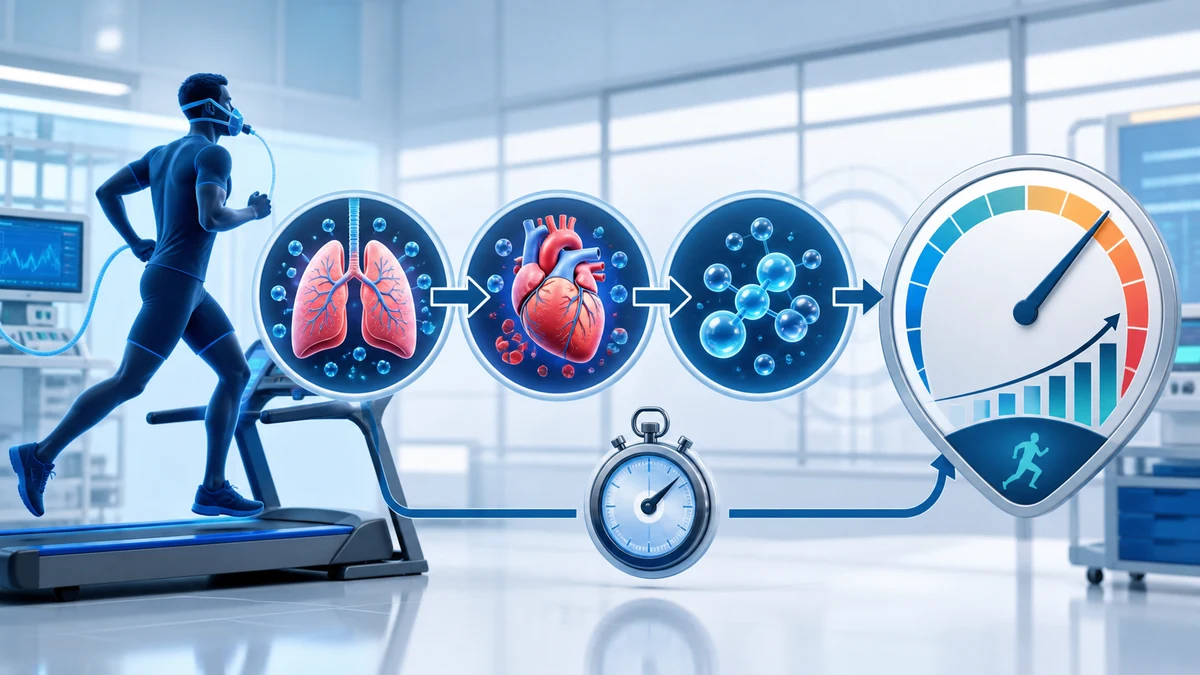
- A laboratory cardiopulmonary exercise test using respiratory-gas analysis provides a more direct assessment.
Safety Note
The test requires a fast walking effort. Ask a qualified healthcare professional before performing it if you have cardiovascular disease, uncontrolled high blood pressure, significant respiratory disease, a recent operation or injury, or symptoms during physical activity.
Stop the test if you experience chest pain or pressure, severe or unusual shortness of breath, dizziness, faintness, confusion, or an irregular heartbeat. Seek appropriate medical evaluation rather than relying on the calculator result.
How to Use the VO₂ Max Calculator
Begin with one clearly defined workout, event, test, or record. Gather the requested values: the selected field test plus time, distance, heart rate, age, sex, or other required measurements. Use the same measurement method throughout and choose the displayed units before calculating. When a value comes from a watch, treadmill, pedometer, scorebook, or field test, record the device or protocol as well. Consistent inputs make later comparisons far more useful.
Enter the values, review them for unit or time-format errors, and calculate. The main results are estimated aerobic capacity in milliliters of oxygen per kilogram per minute. Save both the result and the assumptions behind it. If you are comparing training plans or performance scenarios, change one important variable at a time so the effect of distance, duration, intensity, body weight, pace, or repetitions remains clear.
How to Interpret the Result
This calculator is designed to translate a standardized field-test result into an indirect VO₂ max estimate. Treat the answer as an estimate or mathematical summary, not a promise of performance, a medical diagnosis, or a substitute for a qualified coach or health professional. A precise-looking number can still be limited by the quality of the measurements and the assumptions built into the formula.
Use the result as a starting point and compare it with repeated real-world observations. For pace and distance tools, compare similar routes and conditions. For heart-rate or aerobic tools, consider perceived effort and the same testing protocol. For calorie estimates, remember that population-based activity values cannot measure one person’s metabolism exactly. For strength estimates, keep exercise technique and repetition standards consistent.
Practical Measurement Checklist
Before relying on the result, confirm the units, distinguish elapsed time from moving time, check whether a value is measured or predicted, and repeat unusual readings. Warm up appropriately, use calibrated equipment when available, and avoid comparing results collected under very different conditions. Record the date, surface, weather, equipment, and relevant recovery factors when they could affect performance.
Important limitation: field tests depend on protocol, pacing, environment, equipment, health status, and effort and are not equivalent to laboratory gas analysis. Stop exercise and seek appropriate medical guidance if you experience concerning symptoms. People with health conditions, injuries, pregnancy, or medicines that affect exercise response should follow individualized professional advice rather than a general calculator result.
Use the Result for Better Comparisons
Create a realistic baseline, then test a conservative and an ambitious scenario. Look for the point where a target becomes impractical rather than focusing only on the most attractive result. Review the Max Heart Rate Calculator and Running Split Calculator when those measurements help explain the same workout or performance goal.
Protocol consistency affects the estimate
Use an accurately measured one-mile course, walk as directed without running and record heart rate immediately at the finish. A treadmill, hills, wind, heat or delayed pulse reading can produce a result that is not directly comparable with a track-based test.
The equation has a defined population
The original model was developed from healthy adults and uses walk time, heart rate, age, weight and sex. The Rockport validation study describes it as a submaximal estimate. Stop exercise for concerning symptoms and seek appropriate medical guidance.
Frequently Asked Questions
What does the VO₂ Max Calculator calculate?
It uses the selected field test plus time, distance, heart rate, age, sex, or other required measurements to estimate estimated aerobic capacity in milliliters of oxygen per kilogram per minute. The exact fields and formula depend on the calculator mode and the units selected.
Which inputs have the biggest effect on the result?
The most influential inputs are usually the main distance, time, intensity, body-weight, heart-rate, score, or repetition values. Change one of them at a time and compare the output to identify the most sensitive assumption.
How accurate is the VO₂ Max Calculator?
The arithmetic is accurate for the values entered, but real-world accuracy depends on measurement quality, the selected formula, consistent technique, and whether the conditions match the assumptions. Repeated measurements are usually more informative than one isolated result.
Can I compare results from different days or devices?
Yes, but use the same units, device settings, route, test protocol, and definitions whenever possible. Device algorithms and environmental conditions can differ, so treat small changes cautiously unless they repeat over time.
Should I use the estimate as a training target?
It can help with planning and scenario comparison, but targets should match current fitness, recovery, technique, health, and conditions. Progress gradually and adjust using real performance and appropriate professional guidance.
Is this calculator medical or coaching advice?
No. It is an educational planning tool. A clinician, qualified coach, or official sport organization can account for symptoms, medical history, testing standards, competition rules, and individual goals that a general calculator cannot evaluate.