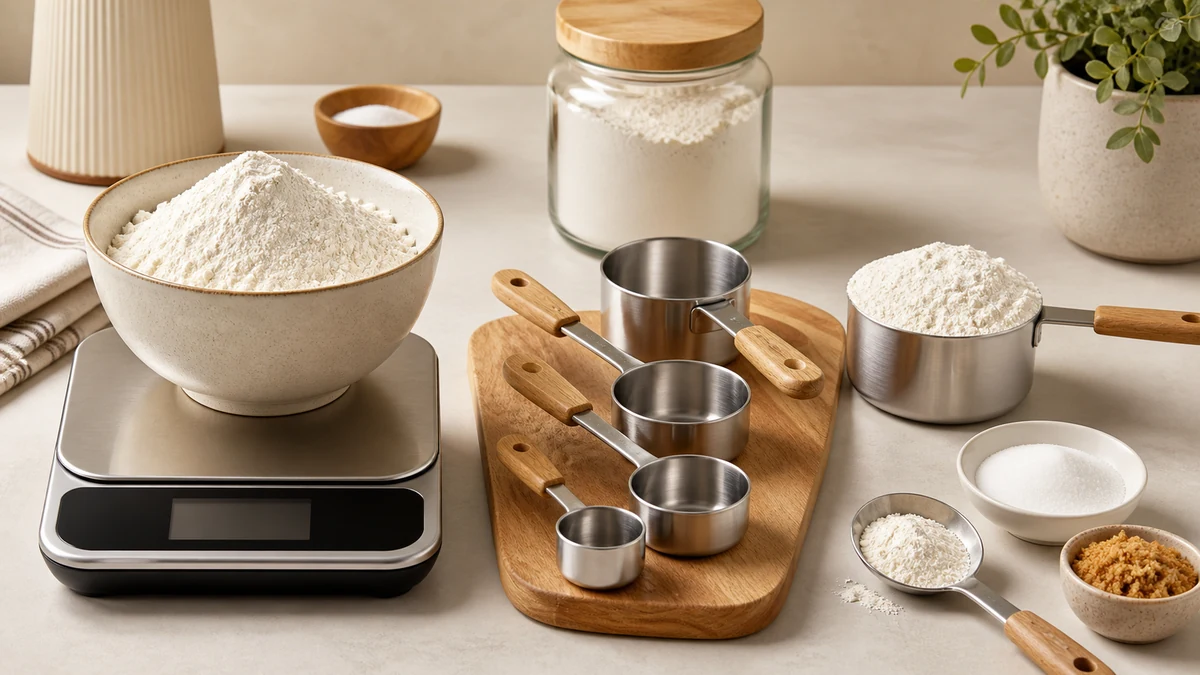
Grams ⇄ Cups Converter

Convert using ingredient density and your preferred cup standard.

Inputs

Reference Density Table
Ingredient Approx. Density Approx. US Customary Cup Weight Important Note
Water About 1.00 g/mL About 236.6 g per 236.59 mL cup Water is close to 1 g/mL under normal kitchen conditions.
All-purpose flour Varies by measuring method Often about 120 g per cup in baking references Flour changes significantly with scooping, sifting, settling, and packing.
Milk Slightly denser than water Varies by fat content and product type Whole milk, skim milk, and cream do not weigh exactly the same per cup.
Sugar Varies by sugar type Granulated, powdered, and brown sugar differ Brown sugar packing can change cup weight considerably.
Oil Usually less dense than water Varies by oil type and temperature Olive oil, vegetable oil, and other oils may differ slightly.
Honey, syrup, jam, or spreads Often denser than water Varies by brand and temperature Sticky ingredients can be harder to measure accurately by cup.
Custom ingredient User-entered g/mL Calculated from selected cup size × custom density Use verified density data when accuracy matters.

Kitchen note: These values are approximate. Packing, grind, moisture, temperature, brand, ingredient condition, and measuring method can change real cup results.

Use this Grams to Cups Converter to convert ingredient weight into cup measurements, or convert cups back into grams. Choose an ingredient, select the cup standard, enter your amount, and the calculator estimates the result using ingredient density.

Important Note: This Grams to Cups Converter estimates ingredient conversions using the relationship mass = volume × density. It can convert grams to cups or cups to grams using ingredient-specific density presets, a custom density option, and selectable cup standards.

Grams measure mass, while cups measure volume. Because ingredients have different densities, there is no universal grams-to-cups conversion. A cup of flour, a cup of honey, a cup of oil, and a cup of water can all weigh different amounts.

Kitchen cup conversions are approximate. Real results can vary by ingredient brand, grind size, packing method, scooping method, sifting, moisture, temperature, cup standard, and measuring technique. For precise baking, nutrition tracking, recipe development, product formulation, laboratory work, medical use, or regulated production, weigh ingredients directly with a reliable scale.

Reviewed by: AjaxCalculators Editorial Team
Last updated: April 26, 2026
Method source: Standard density relationship using mass = volume × density, with ingredient-specific kitchen density presets and selectable cup standards
Editorial standards: AjaxCalculators Editorial Policy

What This Grams to Cups Converter Calculates

This calculator converts between ingredient mass and kitchen cup volume using ingredient density and the selected cup standard.

Conversion or Result What It Means Use Note
Grams to cups Converts an ingredient weight into an estimated cup amount. Useful when a recipe gives grams but you want a cup estimate.
Cups to grams Converts a cup amount into an estimated ingredient weight. Useful when a recipe gives cups but you want to weigh the ingredient.
Ingredient preset Uses an approximate density for the selected ingredient. Choose the closest ingredient match.
Custom density Uses your entered density in g/mL. Best when you have reliable density data for a specific ingredient.
Cup standard Uses the selected cup volume in mL. US customary, US legal, and metric cups produce different results.
Reference weight per cup Shows the approximate weight of one selected cup of the ingredient. Useful for checking whether the conversion looks reasonable.

Why Grams to Cups Conversion Depends on Ingredient

Grams and cups measure different things.

  • Grams (g) measure mass or weight.
  • Cups measure volume.

Because ingredients have different densities, the same weight can fill different cup volumes. For example, 100 grams of flour takes up more space than 100 grams of honey because flour is less dense and honey is more dense.

This is why a grams-to-cups converter must use ingredient density. A fixed conversion such as “1 cup = 240 grams” only works for some ingredients and cup standards, not for every recipe ingredient.

How the Grams to Cups Converter Works

The calculator uses the density relationship between mass, volume, and density.

Calculation Step Formula Meaning
Main density relationship Mass = Volume × Density Mass depends on how much volume is filled and how dense the ingredient is.
Grams to cups Cups = grams ÷ (cup volume in mL × density in g/mL) Divides ingredient weight by the weight of one selected cup.
Cups to grams Grams = cups × cup volume in mL × density in g/mL Multiplies cup volume by ingredient density.
Grams per cup Grams per cup = cup volume in mL × density in g/mL Finds the approximate weight of one cup for the selected ingredient.
Custom density Use the same formulas with the user-entered g/mL value. Useful when the ingredient is not in the preset list.

2) Grams to Cups Formula

To convert grams into cups, divide the ingredient weight by the weight of one cup of that ingredient.

Cups = grams ÷ (cup volume in mL × density in g/mL)

In this formula:

  • grams are the ingredient weight
  • cup volume is the selected cup size in milliliters
  • density is the ingredient density in grams per milliliter

3) Cups to Grams Formula

To convert cups into grams, multiply the number of cups by the cup volume and the ingredient density.

Grams = cups × cup volume in mL × density in g/mL

This is useful when a recipe gives cups but you want to weigh the ingredient in grams.

4) Custom Density Formula

If you choose a custom ingredient, the calculator uses the density you enter.

Custom grams = cups × cup volume × custom density

Or, in the reverse direction:

Custom cups = grams ÷ (cup volume × custom density)

Custom density is useful when your ingredient is not in the preset list or when you have a known density from a product label, recipe source, or measurement reference.

Cup Standards Used by the Calculator

The calculator lets you choose the cup standard because one cup is not always the same volume in every system.

Cup Standard Approximate Volume Common Use Conversion Note
US customary cup 236.59 mL Many U.S. home recipes Slightly smaller than a 240 mL legal cup.
US legal cup 240 mL U.S. nutrition-labeling style references Used by FDA guidance for nutrition-labeling household measures.
Metric cup 250 mL Many metric recipe systems Larger than both US customary and US legal cups.

Changing the cup standard changes the result because a larger cup holds more volume and therefore more ingredient mass.

Common Ingredient Conversion Differences

Different ingredients convert differently because they have different densities and different measuring behavior.

Ingredient Why the Cup Result Differs Best Measurement Tip
Water Close to 1 g/mL, so grams and milliliters are nearly the same. Volume conversion is usually more predictable than for dry ingredients.
Flour Light, airy, and strongly affected by scooping, sifting, settling, and packing. Use a kitchen scale for baking accuracy.
Sugar Granulated, powdered, brown, and coarse sugars have different cup weights. Select the closest ingredient type and avoid assuming all sugars match.
Butter More consistent than flour, but cup size and temperature still matter. Use package markings or weight when possible.
Honey, jam, syrup, and spreads Dense and sticky ingredients vary by brand, water content, and temperature. Weigh directly for repeatable results.
Oil Usually less dense than water, so one cup weighs less than one cup of water. Use the oil preset or a verified product density.
Oats, nuts, and flakes Volume depends on flake size, cut, air space, and how loosely the cup is filled. Use weight for consistent recipe scaling.

Grams to Cups vs Cups to Grams

Grams to cups is useful when a recipe gives metric weight but you want a cup estimate.

Cups to grams is useful when a recipe gives cup measurements but you want a more repeatable weight measurement.

For baking, cups-to-grams conversion is often more useful because weighing ingredients can reduce variation from scooping, packing, and leveling.

Assumptions and Important Notes

Assumption or Limitation What It Means
Approximate ingredient densities The calculator uses kitchen-style density estimates, not exact values for every brand or batch.
Ingredient preset must match the ingredient Using water density for flour, oil, sugar, oats, or honey will produce incorrect results.
Cup standard matters A metric cup holds more volume than a US customary cup.
Dry ingredients vary Flour, sugar, cocoa, starch, oats, nuts, and powders can vary with packing, sifting, grind, moisture, and settling.
Sticky ingredients vary Honey, jam, syrup, Nutella, and similar foods can vary by brand and temperature.
No nutrition verification The calculator converts mass and volume only; it does not verify calories, serving size, allergens, or nutrients.
No commercial formulation guarantee For product development, food labeling, or regulated production, use verified data and measured weights.
No medical or laboratory use Do not use approximate kitchen cup conversions for dosing, laboratory procedures, or safety-critical work.

Worked Example: Convert 120 Grams of Flour to Cups

Suppose you want to convert 120 grams of flour to cups using a US customary cup.

Step Calculation or Input Result or Meaning
Select ingredient Flour The calculator uses the flour density preset.
Select cup standard US customary cup About 236.59 mL per cup.
Use formula Cups = grams ÷ (cup volume × density) Converts mass into estimated cup volume.
Calculate 120 g ÷ estimated grams per cup for flour Approximate cup amount.
Interpret result Flour density is variable The result can change depending on whether the flour is spooned, scooped, sifted, or packed.

For baking, weighing flour directly is usually more repeatable than estimating cups from grams.

Worked Example: Convert 1 Cup of Water to Grams

Suppose you want to convert 1 US customary cup of water to grams.

Step Calculation Result
Use the selected cup size 1 US customary cup About 236.59 mL
Use water density About 1 g/mL Water is close to 1 gram per milliliter.
Apply formula Grams = cups × cup volume × density 1 × 236.59 × 1
Calculate 236.59 × 1 About 236.59 g

So, 1 US customary cup of water is approximately 236.59 grams under this simplified kitchen-density assumption.

Worked Example: Why 100 Grams of Different Ingredients Gives Different Cups

Suppose you convert 100 grams of two different ingredients.

A low-density ingredient, such as flour, fills more cup volume. A high-density ingredient, such as honey, fills less cup volume.

This is why 100 grams of flour may be close to a larger fraction of a cup, while 100 grams of honey may be much less. The same gram amount does not produce the same cup amount for every ingredient.

Why 100 Grams Can Give Different Cup Results

The same gram amount can fill different cup volumes because ingredients have different densities.

Ingredient Type Density Pattern What Happens to 100 Grams
Low-density dry ingredients Light and airy, often with more space between particles. 100 grams fills a larger cup volume.
Water-like liquids Close to 1 g/mL. 100 grams is close to 100 mL.
Dense sticky ingredients More mass per milliliter than water. 100 grams fills a smaller cup volume.
Flakes, chopped nuts, oats, and irregular pieces Air gaps and piece size affect cup volume. 100 grams can vary depending on how loosely the cup is filled.

How to Use This Grams to Cups Converter

  1. Select the conversion type: grams to cups or cups to grams.
  2. Choose the ingredient from the preset list, or select custom.
  3. Enter the weight amount if converting grams to cups.
  4. Enter the cups amount if converting cups to grams.
  5. Select the cup standard: US customary, US legal, or metric.
  6. If using a custom ingredient, enter the density in g/mL.
  7. Click Calculate.
  8. Review the converted value and the approximate reference density information.

How to Interpret the Result

Output What It Means Important Caution
Converted value The estimated cups or grams result. It is based on the selected density and cup standard.
Ingredient The preset or custom ingredient used for density. A different ingredient type or brand can change the result.
Cup standard The selected cup volume used in the formula. US customary, US legal, and metric cups are not identical.
Reference density The approximate density basis for the conversion. Density presets are kitchen estimates, not guaranteed lab values.
Reference grams per cup The estimated weight of one selected cup of the ingredient. Useful for checking whether the result matches your recipe source.

If your result differs from a recipe chart, check the ingredient type, cup standard, density, packing method, sifting method, and whether the recipe uses U.S. or metric cups.

Why Measuring by Weight Is More Accurate

Weight measurements are usually more repeatable than cup measurements, especially for baking.

Measurement Method Strength Weakness
Measuring by grams Repeatable and precise when using a reliable scale. Requires a kitchen scale.
Measuring by cups Convenient for quick home cooking. Can vary with scooping, packing, leveling, cup standard, and ingredient condition.
Density-based conversion Useful when converting between recipe systems. Only as accurate as the ingredient density and measuring assumptions.

For precise baking, a scale helps reduce errors from uneven scooping, compacted flour, air gaps, humidity, and differences between dry and liquid measuring cups.

When This Converter Is Useful

This Grams to Cups Converter is useful for quick recipe conversions when an approximate cup or gram result is acceptable.

Use Case How the Converter Helps
Converting grams to cups Helps when a recipe gives weight but you want an estimated cup amount.
Converting cups to grams Helps when a recipe gives cups but you want to weigh ingredients.
Recipe scaling Helps move between metric and cup-based recipe systems.
Ingredient comparison Shows why flour, sugar, honey, oil, and water do not convert the same way.
Custom ingredients Allows a user-entered density for ingredients not in the preset list.
Cup standard comparison Shows how US customary, US legal, and metric cups affect results.
Kitchen estimation Useful when a rough cooking conversion is enough and a scale is not available.

When You Should Use a Scale Instead

Some tasks need more precision than a density-based cup estimate can provide.

Situation Why a Scale Is Better
Bread, pastry, cake, and cookie baking Small flour or hydration differences can affect texture and structure.
Nutrition tracking Calories and nutrients are usually more accurate when ingredients are weighed.
Recipe development Weights make results easier to repeat and test.
Commercial food production Requires controlled formulas, repeatability, and often regulatory documentation.
Food labeling Requires reliable serving, weight, and nutrient data.
Medical, lab, or safety-critical work Approximate kitchen cup conversions are not appropriate.
Expensive or rare ingredients Weighing reduces waste and improves consistency.

Frequently Asked Questions

How do I convert grams to cups?

Use cups = grams ÷ (cup volume in mL × ingredient density in g/mL). The ingredient density and cup standard must be known or estimated.

How do I convert cups to grams?

Use grams = cups × cup volume in mL × ingredient density in g/mL. This gives an estimated weight for the selected ingredient and cup size.

Why is there no single grams-to-cups conversion?

Grams measure mass, while cups measure volume. Different ingredients have different densities, so the same gram amount can fill different cup volumes.

Is 1 cup always 240 grams?

No. That approximation only works for some water-like ingredients and some cup standards. Flour, oil, sugar, honey, oats, and other ingredients can weigh very different amounts per cup.

What cup standard should I choose?

Choose the cup standard that matches your recipe source. US customary cups are about 236.59 mL, US legal cups are 240 mL, and metric cups are 250 mL.

Why does flour vary so much by cup?

Flour can be spooned, scooped, sifted, compacted, or settled, and each method can change the amount of flour in a cup.

Is weighing ingredients better than using cups?

For baking and repeatable recipes, weighing is usually better because grams stay consistent while cup measurements can vary with technique and ingredient condition.

Can I use this converter for nutrition labels or commercial food production?

No. Use verified ingredient data, measured weights, and appropriate regulatory or production methods for nutrition labeling, product formulation, or commercial use.

Can I use a custom density?

Yes. Select the custom ingredient option and enter density in g/mL. Use reliable density data if accuracy matters.

Common Mistakes to Avoid

Mistake Why It Causes Problems
Assuming 1 cup always equals the same number of grams Cup weight depends on ingredient density and cup size.
Using water conversion for all ingredients Flour, sugar, oil, oats, honey, and butter do not have the same density as water.
Ignoring the cup standard US customary, US legal, and metric cups have different volumes.
Assuming scooped flour and spooned flour weigh the same Flour can compact differently depending on the measuring method.
Using approximate cups for precision baking Small measurement differences can affect texture, rise, hydration, and consistency.
Treating preset densities as exact Ingredient brand, moisture, grind size, and temperature can change real density.
Ignoring dry vs liquid measuring behavior Dry cups and liquid measuring cups can be used differently in practice.
Using this converter for regulated or medical work Kitchen-density estimates are not appropriate for medical, laboratory, or regulated production use.

Formula Summary

What You Want to Find Formula Use Note
Cups from grams Cups = grams ÷ (cup volume in mL × density in g/mL) Use when converting weight into cup volume.
Grams from cups Grams = cups × cup volume in mL × density in g/mL Use when converting cup volume into weight.
Ingredient density Density = grams ÷ milliliters Use when you have measured mass and volume.
Grams per cup Grams per cup = cup volume in mL × density in g/mL Useful for checking one-cup reference values.
Cup volume from grams and density Volume in mL = grams ÷ density in g/mL Then divide by selected cup size to get cups.
Custom ingredient conversion Use the same formulas with custom density Best when the user has reliable density data.

References

  1. NIST — Metric Kitchen: Cooking Measurement Equivalencies
  2. NIST — Metric Kitchen: Cookware and Tools
  3. FDA — Determining Metric Equivalents of Household Measures
  4. USDA FoodData Central
  5. King Arthur Baking — Ingredient Weight Chart

Related Calculators

Grams to Cups Converter Disclaimer

This Grams to Cups Converter provides approximate kitchen conversions only. It estimates grams-to-cups and cups-to-grams conversions using ingredient density, selected cup standard, and the values entered by the user.

Actual results can vary by ingredient brand, variety, grind size, packing method, scooping method, sifting, moisture, temperature, storage condition, cup standard, and measuring technique. Dry ingredients, powders, flakes, chopped ingredients, sticky ingredients, and spreads can vary especially strongly.

For precise baking, nutrition tracking, recipe development, product formulation, food labeling, commercial production, medical use, laboratory work, or regulated applications, use a reliable calibrated scale and ingredient-specific data from a trusted source. Do not use approximate kitchen cup conversions for medical dosing, laboratory procedures, safety-critical work, or regulated production.

More of our calculators...

ml to Grams Converter

mL to Grams Converter helps you convert milliliters into grams for water, flour, sugar, and more with ease.

Alcohol Dilution Calculator

Use our Alcohol Dilution Calculator to estimate how much water or weak alcohol to add to reach a target ABV and final volume.

Taco Bar Calculator

Taco Bar Calculator helps you estimate taco meat, shells, toppings, and servings for your party or event.

Grams To Calories Calculator

Use our Grams to Calories Calculator to estimate calories from grams of carbs, protein, fat, and alcohol using standard macro calorie factors.