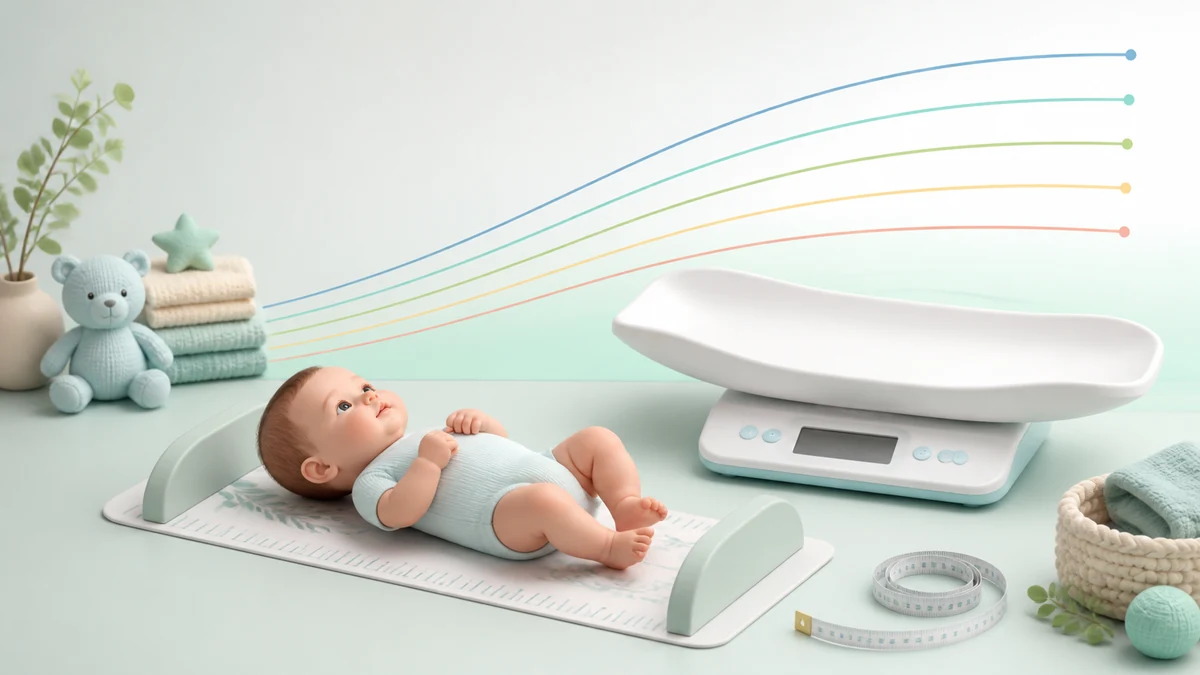
Baby Growth Percentile Calculator
Estimate a baby’s weight-for-age, length-for-age, or head-circumference-for-age percentile from age, sex, and measurement.
Results
This calculator is for general education and quick screening only. Baby growth should be assessed using official growth charts, repeated measurements, gestational age when relevant, feeding history, health history, and a clinician’s judgment. A single percentile does not diagnose a growth problem.
Important Note: A percentile is a growth comparison, not a diagnosis. A baby’s growth trend over time matters more than one single percentile result. A baby near a low or high percentile may still be healthy, but sudden percentile crossing, poor feeding, delayed development, or clinician concern should be checked by a pediatrician.
Use this Baby Growth Percentile Calculator to estimate how your baby’s weight, length, and head circumference compare with children of the same age and sex. Growth percentiles are commonly used by healthcare professionals to monitor whether a baby is growing along an expected pattern over time.
Important: A percentile is not a diagnosis. One result should not be used alone to decide whether a baby is healthy or unhealthy. Growth trend, feeding, development, birth history, and clinical context all matter.
Reviewed by: AjaxCalculators Editorial Team
Last updated: May 2026
Method source: WHO Child Growth Standards and CDC growth chart interpretation principles
Editorial standards: Built with transparent explanations, practical examples, limitations, and parent-friendly interpretation.
What Is a Baby Growth Percentile Calculator?
A baby growth percentile calculator estimates where a baby’s measurement falls compared with a reference population of babies of the same age and sex. For example, if a baby’s weight is at the 60th percentile, it means the baby weighs more than about 60 out of 100 babies in the reference group and less than about 40 out of 100.
Percentiles can be calculated for different growth measurements, including weight-for-age, length-for-age, weight-for-length, and head circumference-for-age.
What This Calculator Can Estimate
| Measurement | What It Compares | Why It Matters |
|---|---|---|
| Weight-for-age | Baby’s weight compared with babies of the same age and sex | Helps track general weight gain pattern |
| Length-for-age | Baby’s length compared with babies of the same age and sex | Helps monitor linear growth |
| Head circumference-for-age | Baby’s head size compared with babies of the same age and sex | Helps monitor head growth pattern |
| Weight-for-length | Baby’s weight compared with length | Helps understand body proportion |
How Baby Growth Percentiles Work
Growth charts compare a baby’s measurements with standardized reference curves. The percentile shows the relative position of the baby’s measurement on that chart.
| Percentile | Meaning |
|---|---|
| 3rd percentile | Lower than about 97 out of 100 babies in the reference group |
| 10th percentile | Higher than about 10 out of 100 babies and lower than about 90 out of 100 |
| 50th percentile | Near the middle of the reference group |
| 90th percentile | Higher than about 90 out of 100 babies in the reference group |
| 97th percentile | Higher than about 97 out of 100 babies in the reference group |
Baby Growth Percentile Formula Concept
Growth percentile calculators usually use reference chart data rather than one simple universal formula. The general method is:
Percentile = position of the baby’s measurement compared with children of the same age and sex in the reference growth chart
More advanced growth calculators may use LMS chart data, where L, M, and S values represent the growth chart’s skewness, median, and variation. These values allow the calculator to estimate a z-score and convert it into a percentile.
Common Growth Chart References
| Age Range | Common Reference | Typical Measurements |
|---|---|---|
| Birth to 24 months | WHO Child Growth Standards | Weight, length, head circumference, weight-for-length |
| 2 to 20 years | CDC Growth Charts | Weight, stature/height, BMI-for-age |
How to Use the Baby Growth Percentile Calculator
- Select your baby’s sex.
- Enter the baby’s age in months or date of birth if available.
- Enter weight using the correct unit.
- Enter length or height using the correct unit.
- Enter head circumference if the calculator includes it.
- Click calculate to estimate the growth percentile.
Worked Example
| Input | Example Value |
|---|---|
| Sex | Girl |
| Age | 6 months |
| Weight | 7.3 kg |
| Length | 66 cm |
| Head circumference | 42 cm |
The calculator compares each measurement with the selected growth chart reference for a 6-month-old girl. The result may show separate percentiles for weight, length, and head circumference.
How to Interpret the Result
| Result Pattern | General Meaning |
|---|---|
| Consistent percentile over time | Often suggests steady growth pattern |
| Sudden drop across percentile lines | May need review by a healthcare professional |
| Sudden rise across percentile lines | May need review depending on feeding, age, and medical context |
| Very low percentile | Not always abnormal, but should be interpreted with growth history |
| Very high percentile | Not always abnormal, but should be interpreted with body proportion and history |
Important Measurement Tips
- For babies under 2 years, length is usually measured lying down.
- Use the same unit consistently to avoid conversion mistakes.
- Measure weight without heavy clothing when possible.
- Head circumference should be measured around the widest part of the head.
- Small measurement errors can change percentile results, especially in young babies.
Assumptions and Limitations
- The calculator assumes the entered age, sex, and measurements are accurate.
- It does not diagnose underweight, overweight, growth delay, or any medical condition.
- It does not adjust for prematurity unless a corrected-age option is included.
- It does not account for birth weight, feeding method, genetics, ethnicity, illness, or medical history.
- Growth trends over time are more useful than a single result.
When to Ask a Doctor
Consider speaking with a pediatrician or qualified healthcare professional if your baby has poor feeding, repeated vomiting, dehydration signs, unusual sleepiness, delayed development, sudden growth percentile changes, or if you are worried about weight gain, length, or head growth.
Practical Uses
- Tracking baby weight gain between checkups
- Understanding length and head circumference results
- Comparing growth measurements with standard chart references
- Preparing questions for a pediatric appointment
- Monitoring growth trend over several months
References
- World Health Organization – WHO Child Growth Standards
- Centers for Disease Control and Prevention – Clinical Growth Charts
- CDC Growth Chart Training – Using WHO Growth Standard Charts
- National Institutes of Health – Guidance on using growth charts
Related Calculators
Frequently Asked Questions
What does a baby growth percentile mean?
A percentile shows how a baby’s measurement compares with babies of the same age and sex in a reference growth chart. For example, the 50th percentile is near the middle of the reference group.
Is the 50th percentile the ideal baby growth percentile?
No. The 50th percentile is not a goal. Healthy babies can grow along many different percentile lines. A steady growth pattern is usually more important than being exactly average.
Should I worry if my baby is in a low percentile?
Not always. Some healthy babies naturally track along a lower percentile. However, sudden drops, feeding problems, poor weight gain, or clinician concern should be checked.
Should I worry if my baby is in a high percentile?
Not always. Some healthy babies naturally track higher on the chart. The result should be interpreted with length, weight-for-length, family growth pattern, and medical history.
What measurements are used for baby growth percentiles?
Common measurements include weight, recumbent length, head circumference, and weight-for-length.
Which growth chart should be used for babies?
WHO Child Growth Standards are commonly used for children from birth to 2 years, while CDC charts are commonly used for older children.
Does this calculator work for premature babies?
Only if it includes corrected age. Premature babies may need adjusted-age interpretation, so parents should follow pediatric guidance.
Can this calculator diagnose a growth problem?
No. It only estimates percentiles from entered measurements. Diagnosis requires clinical assessment by a qualified healthcare professional.
Disclaimer : This Baby Growth Percentile Calculator is for educational tracking only. A percentile result compares your baby’s measurement with a reference growth chart, but it does not diagnose a growth problem or confirm that a baby is healthy or unhealthy. Growth trend over time is usually more important than one single percentile. Always speak with a pediatrician if your baby has poor feeding, unusual weight changes, developmental concerns, sudden percentile changes, or if the result worries you.