
🌮 Taco Bar Calculator

Plan protein, toppings, and sides for your crowd.

Tip: kids count as 0.5 of an adult.

🧀 Main ingredients

Meat mass
Cheddar cheese
Monterey cheese

🥣 Pick your dips

🥬 Pick your vegetables

🍚 Choose your side

⚡ Quick summary

Enter the number of people to see a summary…
📎 Serving assumptions per person (tap to view)
ItemPer person (oz)Notes
Ground beef / Shrimp6.5Protein portion
Hamburger5.0Protein portion
Chicken5.5Protein portion
Pork (Carnitas)7.0Protein portion
Cheddar cheese1.0Shown separately to mix or pick one
Monterey cheese1.0Shown separately to mix or pick one
Sour cream1.0Dip
Guacamole1.5Dip
Taco sauce1.0Dip
Pico de Gallo1.0Dip
Lettuce1.3Veg portion
Onions0.5Veg portion
Beans2.6Veg/side
Refried beans2.6Veg/side
Tomatoes1.8Veg portion
Olives0.5Veg portion
Bell pepper1.0Veg portion
Taco shells2 pieces per person
Tortillas1 piece per person
Rice (cooked)4.0~½ cup cooked per person

Practical serving averages from common recipe/party guidelines; adjust to your crowd.

Use this Taco Bar Calculator to estimate how much taco meat, cheese, dips, vegetables, taco shells, tortillas, and rice you need for a party or event. Enter the number of people, choose a meat type, select your unit, and pick the toppings and sides you plan to serve.

Important Note: This Taco Bar Calculator estimates taco meat, cheese, dips, vegetables, shells, tortillas, and cooked rice from average serving assumptions and the number of people entered.

The result is a party-planning estimate only. Actual food needs can vary by appetite, guest age, taco size, menu style, event length, side dishes, vegetarian guests, dietary restrictions, leftovers, food waste, and whether tacos are the main meal or part of a larger buffet.

For safe serving, keep hot foods hot, cold foods cold, use separate utensils, avoid cross-contamination, and follow official food-safety guidance for buffets and leftovers. For catering, commercial events, schools, workplaces, or public food service, follow local food-safety rules and professional guidance.

Reviewed by: AjaxCalculators Editorial Team
Last updated: April 26, 2026
Method source: Practical taco bar serving averages using guest count, protein type, topping portions, shell count, tortilla count, and cooked rice serving estimates
Editorial standards: AjaxCalculators Editorial Policy

Serving Assumptions Per Person

The calculator uses practical taco bar serving estimates. Use these as starting amounts and adjust for your crowd.

Item Per Person Planning Note
Ground beef / shrimp 6.5 oz Protein portion estimate.
Hamburger 5.0 oz Protein portion estimate.
Chicken 5.5 oz Protein portion estimate.
Pork carnitas 7.0 oz Protein portion estimate.
Cheddar cheese 1.0 oz Shown separately so you can serve one cheese or both.
Monterey cheese 1.0 oz Shown separately so you can serve one cheese or both.
Sour cream 1.0 oz Dip/topping estimate.
Guacamole 1.5 oz Dip/topping estimate.
Taco sauce 1.0 oz Sauce estimate.
Pico de gallo 1.0 oz Fresh salsa estimate.
Lettuce 1.3 oz Vegetable topping estimate.
Onions 0.5 oz Vegetable topping estimate.
Beans 2.6 oz Vegetable/side estimate.
Refried beans 2.6 oz Vegetable/side estimate.
Tomatoes 1.8 oz Vegetable topping estimate.
Olives 0.5 oz Vegetable/topping estimate.
Bell pepper 1.0 oz Vegetable topping estimate.
Taco shells 2 pieces Hard-shell estimate per person.
Tortillas 1 piece Soft tortilla estimate per person.
Cooked rice 4.0 oz About 1/2 cup cooked rice per person.

What This Taco Bar Calculator Calculates

This calculator estimates ingredient quantities for a taco bar based on guest count, selected meat type, selected toppings, selected sides, and chosen weight unit.

Ingredient Group Examples Included What the Result Means
Protein Ground beef, chicken, hamburger, shrimp, pork carnitas Estimated total meat amount for the selected guest count.
Cheese Cheddar cheese, Monterey cheese Estimated cheese amount if those options are selected.
Dips and sauces Sour cream, guacamole, taco sauce, pico de gallo Estimated topping or dip quantity for the crowd.
Vegetables and toppings Lettuce, onions, beans, refried beans, tomatoes, olives, bell pepper Estimated topping quantities based on average per-person portions.
Sides and wrappers Taco shells, tortillas, cooked rice Estimated shell, tortilla, and cooked-rice quantities.
Unit conversion oz, lb, g, kg Shows ingredient weights in the selected measurement unit.

How the Taco Bar Calculator Works

The calculator multiplies each selected ingredient’s per-person serving assumption by the number of people entered. Children can be counted as partial adult-equivalent servings when appropriate.

Step Formula or Method Example
Estimate adult-equivalent guests Adult-equivalent count = adults + (children × 0.5) 10 adults + 6 children = 13 adult-equivalent servings.
Estimate meat Total meat = meat per person × number of people 6.5 oz × 20 = 130 oz.
Estimate toppings Total topping = topping per person × number of people 1 oz sour cream × 20 = 20 oz.
Estimate shells Taco shells = 2 × number of people 2 × 20 = 40 shells.
Estimate tortillas Tortillas = 1 × number of people 1 × 20 = 20 tortillas.
Estimate cooked rice Cooked rice = 4 oz × number of people 4 oz × 20 = 80 oz cooked rice.
Convert weight units Convert ounces to lb, g, or kg if selected. 130 oz ÷ 16 = 8.125 lb.

Meat Portion Estimate

The calculator uses different protein serving assumptions depending on the selected meat type. These are practical party-planning estimates, not exact catering guarantees.

Meat Type Serving Assumption Per Person Planning Note
Ground beef 6.5 oz Common taco-bar protein estimate.
Shrimp 6.5 oz Use extra caution with safe holding and chilling.
Hamburger 5.0 oz Use as a lighter ground-meat estimate.
Chicken 5.5 oz Adjust upward for heavy eaters or taco-only meals.
Pork carnitas 7.0 oz Use as a more generous protein estimate.

If tacos are the main meal, the event is long, or guests are heavy eaters, consider preparing extra protein. If tacos are part of a larger buffet with several sides, the standard estimate may be enough.

Dips and Sauce Estimate

The calculator estimates several common taco bar dips and sauces. These amounts should be adjusted if your guests strongly prefer one topping over another.

Dip or Sauce Serving Assumption Per Person Planning Note
Sour cream 1.0 oz Keep chilled until serving and do not leave out too long.
Guacamole 1.5 oz Often popular; consider extra for avocado-heavy menus.
Taco sauce 1.0 oz Offer mild and spicy options if serving a mixed crowd.
Pico de gallo 1.0 oz Best kept chilled and served with a separate spoon.

Vegetable and Side Estimate

The calculator estimates vegetables, beans, and cooked rice using per-person serving assumptions.

Item Serving Assumption Per Person Planning Note
Lettuce 1.3 oz Prepare close to serving time for better texture.
Onions 0.5 oz Serve separately because not all guests like onions.
Beans 2.6 oz Can work as a side or vegetarian filling.
Refried beans 2.6 oz Keep hot if served warm.
Tomatoes 1.8 oz Use a separate serving spoon to reduce mess and cross-contact.
Olives 0.5 oz Saltier topping; many crowds need less.
Bell pepper 1.0 oz Can be served raw or cooked depending on menu style.
Cooked rice 4.0 oz About 1/2 cup cooked rice per person.

Shells and Tortillas

The calculator estimates hard taco shells and soft tortillas separately. This helps when serving a mixed taco bar where guests can choose their preferred style.

Item Calculator Assumption Example for 25 People
Taco shells 2 shells per person 25 × 2 = 50 shells
Tortillas 1 tortilla per person 25 × 1 = 25 tortillas

If guests are likely to eat more than two tacos, or if tacos are the only main dish, buy extra shells and tortillas. Shells can break, and tortillas are often useful for leftovers.

Worked Example: Taco Bar for 20 People

Suppose you are planning a taco bar for 20 people and choose ground beef as the meat.

Step Calculation Result
Estimate ground beef 6.5 oz × 20 130 oz
Convert meat to pounds 130 oz ÷ 16 8.125 lb
Estimate cheddar cheese 1 oz × 20 20 oz, or 1.25 lb
Estimate sour cream 1 oz × 20 20 oz
Estimate guacamole 1.5 oz × 20 30 oz
Estimate taco shells 2 × 20 40 shells
Estimate tortillas 1 × 20 20 tortillas
Estimate cooked rice 4 oz × 20 80 oz, or 5 lb cooked rice

So, for 20 people, the calculator gives a practical starting estimate for meat, cheese, dips, taco shells, tortillas, and cooked rice. Increase the amounts if guests are heavy eaters, the event is long, or tacos are the main meal.
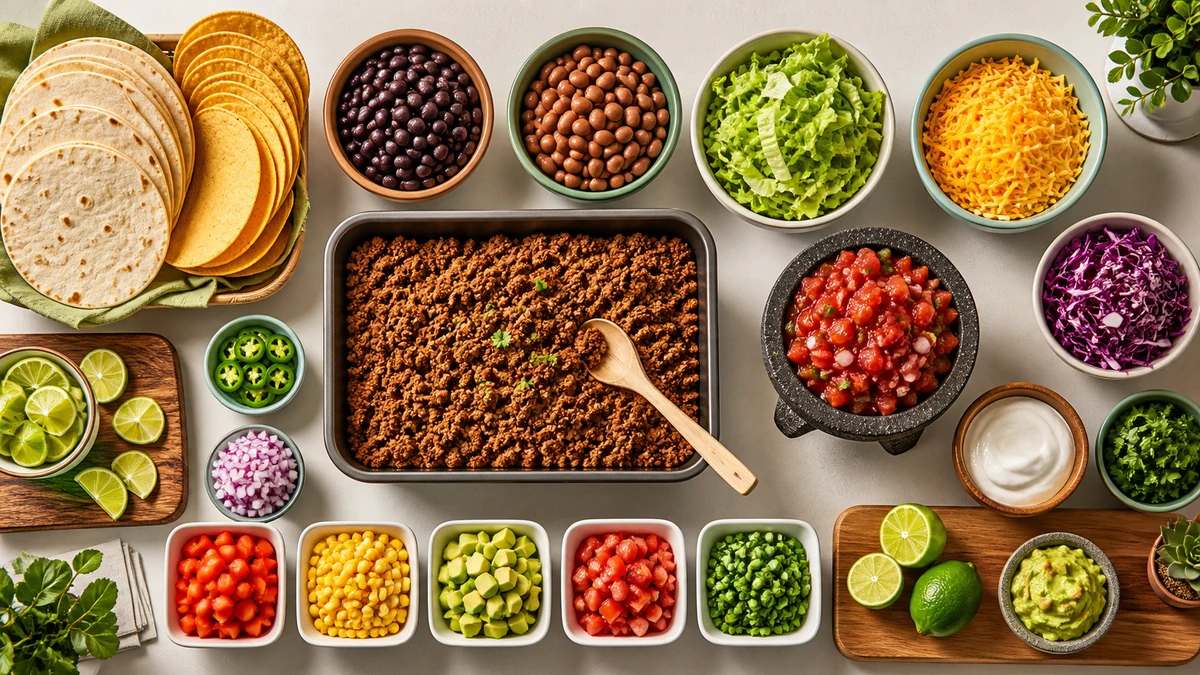
How to Use This Taco Bar Calculator

  1. Enter the number of people you want to serve.
  2. Count children as about half an adult serving if that fits your event.
  3. Select the meat type, such as ground beef, chicken, hamburger, shrimp, or pork carnitas.
  4. Select the weight unit you want to use: oz, lb, g, or kg.
  5. Choose the main ingredients, dips, vegetables, shells, tortillas, and sides you plan to serve.
  6. Review the quick summary and ingredient amounts.
  7. Adjust the estimate for appetite, event length, dietary restrictions, side dishes, leftovers, and grocery package sizes.
  8. Use Refresh to clear the calculator and start again.

How to Interpret the Result

Result What It Means Important Caution
Meat mass Estimated protein amount for the selected meat type and guest count. Raw grocery weight may need to be higher because some meats shrink during cooking.
Cheese amounts Estimated cheddar and Monterey cheese amounts if selected. If serving both cheeses, total cheese available may be higher than a one-cheese menu.
Dips and sauces Estimated quantities for sour cream, guacamole, taco sauce, and pico de gallo. Keep perishable dips chilled and serve in small refillable bowls.
Vegetables Estimated topping amounts for lettuce, onions, beans, tomatoes, olives, and bell pepper. Adjust based on guest preferences and whether toppings are also served as sides.
Shells and tortillas Estimated hard shells and soft tortillas. Buy extra if shells may break or guests may eat more tacos.
Cooked rice Estimated cooked rice amount. Dry rice and cooked rice are not the same weight or volume.
Selected unit The display unit used for ingredient weights. Unit conversion does not change the actual amount of food needed.

How Many Tacos Per Person?

The live calculator uses 2 taco shells per person and 1 tortilla per person as a practical starting point for a mixed taco bar setup.

Event Type Likely Taco Demand Planning Adjustment
Light lunch or snack table Lower The standard estimate may be enough.
Family dinner or casual party Medium Use the calculator result and add a small buffer.
Game day, outdoor event, or long gathering Higher Prepare extra protein, tortillas, and shells.
Tacos as part of a large buffet Lower to medium Guests may eat fewer tacos because other foods are available.
Tacos as the only main dish Medium to high Increase meat, tortillas, shells, and popular toppings.

Raw vs Cooked Meat Note

This calculator estimates serving portions by weight, but grocery shopping may depend on whether you are buying raw or cooked meat. Many meats lose weight during cooking because of water and fat loss.

Meat Planning Issue What It Means What to Do
Raw meat shrinkage Raw meat can weigh less after cooking. Buy extra if the calculator result represents your desired cooked serving amount.
Ground beef fat level Higher-fat ground beef may lose more fat during cooking. Consider a small buffer for cooked yield.
Chicken or pork moisture loss Cooking method can change final weight and texture. Use a tested recipe or catering yield if accuracy matters.
Shrimp size and preparation Peeled, unpeeled, raw, and cooked shrimp can differ in usable yield. Check package details before buying.
Commercial catering Serving size and yield requirements may be stricter. Use professional catering guidance and local food-safety rules.

Vegetarian and Dietary Adjustments

If some guests do not eat meat or have dietary restrictions, adjust the protein plan and separate ingredients clearly.

Guest Need Possible Adjustment Serving Note
Vegetarian guests Reduce meat and increase beans, refried beans, rice, vegetables, or plant-based protein. Use separate utensils for vegetarian fillings.
Vegan guests Offer beans, rice, vegetables, salsa, guacamole, and vegan tortillas or shells. Keep dairy toppings separate.
Dairy-free guests Separate cheese and sour cream from other toppings. Label dairy-containing ingredients clearly.
Gluten-free guests Offer gluten-free shells or tortillas if appropriate. Check labels and avoid cross-contact.
Spice-sensitive guests Offer mild and spicy sauces separately. Label spicy items clearly.
Allergy concerns Keep ingredients separated and labeled. For serious allergies, follow professional food-allergen handling guidance.

Food Safety Tips for a Taco Bar

Taco bars often include perishable foods such as cooked meat, cheese, sour cream, guacamole, beans, rice, and chopped vegetables. These foods should be handled carefully before, during, and after serving.

Food Safety Step What to Do Why It Matters
Keep hot foods hot Use warmers, chafing dishes, slow cookers, or safe hot-holding equipment. Helps keep cooked meat, beans, and rice out of the danger zone.
Keep cold foods cold Keep sour cream, cheese, guacamole, pico de gallo, and cut vegetables chilled. Cold holding helps slow bacterial growth.
Use the 2-hour rule Do not leave perishables at room temperature for more than 2 hours. FDA and FoodSafety.gov recommend a shorter 1-hour limit above 90°F.
Use small serving bowls Refill from safely stored food instead of leaving large amounts out. Reduces the time perishable foods spend at unsafe temperatures.
Separate utensils Use a separate spoon, scoop, or tong for each ingredient. Reduces cross-contact and cross-contamination.
Separate raw and cooked foods Keep raw meat, raw seafood, and their juices away from ready-to-eat toppings. Helps prevent harmful bacteria from spreading.
Refrigerate leftovers promptly Store leftovers within safe time limits. Reduces foodborne illness risk.

Assumptions and Important Notes

Assumption or Limitation What It Means
Average serving assumptions The calculator uses standard party-planning portions, not exact consumption predictions.
Guest count drives the estimate Ingredient totals are multiplied by the number of people entered.
Kids may count as partial servings The live tool suggests counting kids as about 0.5 of an adult when appropriate.
Appetite varies Heavy eaters, long events, and taco-only meals may need extra food.
Guest preferences are unknown The calculator cannot know which toppings your crowd will use most.
Dietary restrictions are not automatic Vegetarian, vegan, dairy-free, gluten-free, and allergy needs require manual adjustment.
Raw and cooked weights can differ Cooking shrinkage may mean you need to buy more raw meat than the served amount.
No package-size calculation The calculator does not round up to grocery package sizes.
No cost estimate The calculator does not estimate grocery prices or total party cost.
No commercial catering guarantee For catering, schools, workplaces, or public events, use professional guidance and local food-safety rules.

Practical Uses of a Taco Bar Calculator

This calculator helps turn a taco bar guest count into a practical grocery-planning estimate.

Practical Use How the Calculator Helps
Plan a taco party grocery list Estimates meat, toppings, dips, shells, tortillas, and rice.
Estimate taco meat for a crowd Uses different protein assumptions for ground beef, chicken, shrimp, hamburger, and pork carnitas.
Plan a DIY taco bar Helps choose which toppings and sides to prepare.
Compare meat options Shows how different protein choices change the total meat amount.
Plan shells and tortillas Estimates hard shells and soft tortillas separately.
Prepare for casual events Useful for birthdays, family gatherings, game days, potlucks, and parties.
Reduce food waste Gives a starting point so you do not greatly overbuy.
Avoid running short Helps identify when to add extra food for heavy eaters or long events.

Common Mistakes to Avoid

Mistake Why It Causes Problems
Counting every child as a full adult serving Some children may eat much less than adults.
Forgetting vegetarian or vegan guests You may buy too much meat and not enough beans, rice, vegetables, or plant-based filling.
Ignoring dairy-free or gluten-free needs Cheese, sour cream, tortillas, and shells may not work for every guest.
Assuming raw meat and cooked meat weigh the same Cooking shrinkage can reduce the final served amount.
Buying only hard shells or only soft tortillas Guests may prefer different taco styles.
Not buying extra shells Hard shells can break before or during serving.
Leaving perishables out too long Meat, cheese, sour cream, guacamole, beans, rice, and cut vegetables need safe handling.
Using the same utensil for multiple toppings This can create cross-contact and cross-contamination.
Forgetting labels Guests may not know which foods are spicy, vegetarian, dairy-free, or gluten-free.
Relying on the estimate without adjusting for event style A short lunch, long party, buffet, or taco-only dinner can need different amounts.

Formula Summary

What You Want to Find Formula Use Note
Total ingredient amount Total amount = serving amount per person × number of people Main formula for selected ingredients.
Adult-equivalent guest count Adult-equivalent count = adults + (children × 0.5) Use only when children are expected to eat about half an adult serving.
Total meat Total meat = meat portion per person × number of people Meat portion depends on selected meat type.
Taco shells Taco shells = 2 × number of people Hard-shell estimate.
Tortillas Tortillas = 1 × number of people Soft tortilla estimate.
Cooked rice Cooked rice = 4 oz × number of people Cooked rice estimate, not dry rice weight.
Ounces to pounds Pounds = ounces ÷ 16 Useful for U.S. grocery planning.
Ounces to grams Grams = ounces × 28.3495 Metric conversion.
Grams to kilograms Kilograms = grams ÷ 1,000 Metric bulk-shopping conversion.

Grocery Shopping and Leftover Planning

The calculator gives ingredient estimates, but grocery shopping often requires rounding up to package sizes and planning for safe leftovers.

Planning Item What to Check Why It Matters
Package sizes Meat, cheese, tortillas, and sauces may come in fixed package sizes. You may need to round up from the calculator estimate.
Raw-to-cooked yield Raw meat may shrink after cooking. Buy enough raw meat to meet your cooked-serving target.
Popular toppings Guacamole, cheese, and tortillas may run out first. Add extra for crowd favorites.
Low-demand toppings Olives, onions, and spicy sauces may be less popular. Do not overbuy less-used toppings unless your crowd prefers them.
Leftovers Plan storage containers and refrigerator space. Perishable leftovers should be cooled and stored safely.
Serving supplies Plates, napkins, serving spoons, labels, tongs, and foil trays. The calculator estimates food, not supplies.

Frequently Asked Questions

What does this Taco Bar Calculator estimate?

It estimates taco meat, cheese, dips, vegetables, taco shells, tortillas, and cooked rice from the number of people and selected ingredients.

How much taco meat do I need per person?

The calculator uses different meat assumptions by meat type. For example, it uses 6.5 oz per person for ground beef or shrimp, 5.5 oz for chicken, 5 oz for hamburger, and 7 oz for pork carnitas.

How many taco shells should I plan per person?

The calculator uses 2 taco shells per person as a starting estimate. Buy extra if shells may break or if tacos are the main meal.

How many tortillas should I plan per person?

The calculator uses 1 tortilla per person as a starting estimate. Increase this amount if your guests prefer soft tacos or if tortillas are used for leftovers.

Should I count children as full servings?

Not always. The live calculator suggests that children can often be counted as about 0.5 of an adult serving, but you should adjust based on age and appetite.

Does the calculator estimate raw meat or cooked meat?

It estimates serving portions by weight. Grocery planning may require extra raw meat because meat can lose weight during cooking.

Does this calculator handle vegetarian guests?

It does not automatically separate vegetarian guests. If some guests do not eat meat, reduce meat and increase beans, refried beans, rice, vegetables, or plant-based protein.

Does this calculator include food safety rules?

It includes basic planning notes, but you should follow official food-safety guidance for cooking, hot holding, cold holding, cross-contamination, and leftovers.

Can I use this for catering or commercial food service?

Use it only as a rough planning estimate. Catering, commercial events, schools, workplaces, and public food service should follow local food-safety rules and professional guidance.

Does the calculator estimate grocery cost?

No. It estimates ingredient quantities only. Prices, package sizes, local availability, and brand choices must be checked separately.

References

  1. FDA — Serving Up Safe Buffets
  2. USDA FSIS — Keep Food Safe: Food Safety Basics
  3. USDA FSIS — Leftovers and Food Safety
  4. FoodSafety.gov — 4 Steps to Food Safety
  5. FoodSafety.gov — Keeping Hot Foods Hot and Cold Foods Cold
  6. FDA — Are You Storing Food Safely?

Related Calculators

Taco Bar Calculator Disclaimer

This Taco Bar Calculator is for party-planning and grocery-estimation use only. It estimates taco bar ingredients from average serving assumptions and the values entered by the user.

Actual needs can vary by appetite, guest age, event length, taco size, menu style, side dishes, vegetarian guests, dietary restrictions, allergies, grocery package sizes, cooking shrinkage, food waste, and desired leftovers. The calculator does not guarantee exact consumption, exact cooked yield, exact grocery cost, or catering-level accuracy.

For safe serving, keep hot foods hot, cold foods cold, use separate utensils, avoid cross-contamination, label allergens and dietary options clearly, and follow official food-safety guidance for buffets and leftovers. For catering, commercial food service, schools, workplaces, or public events, follow local food-safety rules and professional guidance.

More of our calculators...

Alcohol Dilution Calculator

Use our Alcohol Dilution Calculator to estimate how much water or weak alcohol to add to reach a target ABV and final volume.

ml to Grams Converter

mL to Grams Converter helps you convert milliliters into grams for water, flour, sugar, and more with ease.

Grams to Cups Converter

Use our Grams to Cups Converter to convert grams to cups or cups to grams for flour, sugar, butter, milk, water, honey, oats, rice, and custom ingredients.

Grams To Calories Calculator

Use our Grams to Calories Calculator to estimate calories from grams of carbs, protein, fat, and alcohol using standard macro calorie factors.