Alcohol Dilution Calculator
Dilute a strong spirit to your target ABV.
Inputs
Results
References & notes
- Uses conservation of alcohol:
Vs × A + Vw × B = (Vs + Vw) × C. - Rearranged for added weak liquid:
Vw = Vs × (A − C) ÷ (C − B). - Target ABV must be between the weak ABV and the strong ABV.
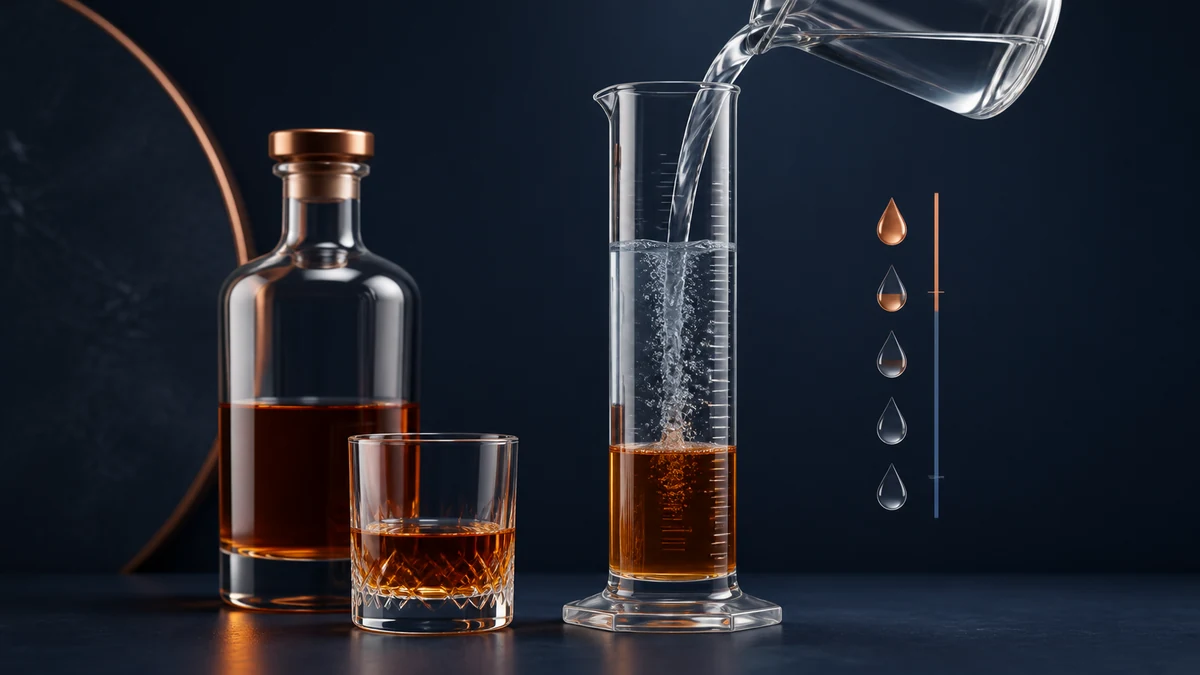
Use this Alcohol Dilution Calculator to estimate how much water or weaker alcoholic liquid to add to a stronger alcohol to reach a target alcohol by volume (ABV). It also estimates the final volume and mixing ratio.
Important: This calculator uses simplified volume-based dilution math. It is suitable for general planning and educational calculations, not professional proofing, commercial labeling, taxation, laboratory analysis, or regulatory compliance.
Alcohol Dilution Formula
The calculator assumes the amount of ethanol remains the same before and after dilution:
VsA + VwB = (Vs + Vw)C
Where:
- Vs = starting volume of stronger alcohol
- A = starting ABV
- Vw = volume of water or weaker alcohol to add
- B = ABV of the weaker liquid
- C = target ABV
Solving for the amount of weaker liquid to add:
Vw = Vs × (A − C) ÷ (C − B)
If plain water is used:
B = 0% ABV
Worked Example
Suppose you have 500 mL of 60% ABV alcohol and want to dilute it to 40% ABV using water.
Here:
- Starting volume = 500 mL
- Starting ABV = 60%
- Water ABV = 0%
- Target ABV = 40%
Apply the formula:
Water to add = 500 × (60 − 40) ÷ (40 − 0)
Water to add = 250 mL
The simplified estimated final volume is:
500 + 250 = 750 mL
The mixing ratio is therefore:
500 : 250 = 2 : 1
So the calculator estimates that 250 mL of water should be added to 500 mL of 60% ABV alcohol to produce an approximately 40% ABV mixture.
Using a Weaker Alcohol Instead of Water
The added liquid does not have to be 0% ABV. If a weaker alcoholic liquid is used, its alcohol content must also be included.
For example, mixing equal volumes of 60% ABV and 20% ABV liquids gives a simplified target of 40% ABV:
Vw = Vs × (60 − 40) ÷ (40 − 20) = Vs
Therefore, under the simplified model, equal volumes are required.
Target ABV Requirement
For dilution with a weaker liquid, the target must normally fall between the two starting strengths:
Weak-liquid ABV < target ABV < strong-liquid ABV
For example, adding water to 60% ABV alcohol can reduce it to 40%, but it cannot increase it to 70%.
Important Notes
- ABV means alcohol by volume. In U.S. distilled spirits terminology, proof is twice the percentage ABV; for example, 40% ABV equals 80 proof.
- The calculator assumes the entered ABV values are accurate.
- The displayed final volume is approximate. Ethanol and water mixtures do not behave as perfectly additive volumes.
- Temperature can affect alcohol-volume and hydrometer measurements. Professional proofing uses temperature corrections and official alcohol-density or gauging tables.
- Sugars, flavorings, botanicals, and other dissolved substances can affect density-based alcohol measurements.
- Use only food-grade ingredients intended for consumption when making beverage calculations. Never assume laboratory, industrial, denatured, or cleaning alcohol is drinkable.
- High-strength ethanol is flammable. Keep concentrated alcohol away from flames, sparks, and other ignition sources.
- This calculator does not determine whether home dilution, production, labeling, sale, or possession is permitted under local law.
- Commercial producers and laboratories should use the applicable official proofing and measurement procedures instead of this simplified calculator.
How to Use the Alcohol Dilution Calculator
- Enter starting liquid volume, current alcohol by volume (ABV), and desired final ABV.
- Keep all entries in the units shown by the calculator and choose the correct ingredient or strength option.
- Select Calculate and review the estimated final batch volume and the amount of diluent to add.
- Check the result against the practical notes below before using it in a recipe, batch, or serving plan.
How the Calculation Works
The calculator applies conservation of pure alcohol: starting volume × starting ABV = final volume × target ABV. It therefore estimates final volume as starting volume × starting ABV ÷ target ABV. The amount of water or weaker liquid to add is the estimated final volume minus the starting volume.
If 750 mL of spirit starts at 40% ABV and the target is 30% ABV, the estimated final volume is 750 × 40 ÷ 30 = 1,000 mL. The calculated addition is therefore about 250 mL. Add gradually, mix thoroughly, and verify strength when precision matters.
How to Interpret the Result
The displayed answer is a mathematical estimate based on the values you enter. Keep extra decimal places while calculating, then round only at the end to a precision your measuring tools can actually support. A result should help you plan and check quantities; it cannot correct an inaccurate input or an unsuitable reference value.
Practical Accuracy Checklist
- Use the same volume unit for the starting liquid and the result.
- Enter ABV values as percentages and make sure the target is below the starting strength.
- Add most of the calculated diluent, mix, allow the liquid to reach the instrument calibration temperature, then verify before making a final adjustment.
- For beverages, remember that dilution changes strength but does not remove the alcohol already present.
Limits and Good Practice
The result assumes volumes combine ideally and that no alcohol is lost. Real mixtures can contract slightly, density changes with temperature, and label ABV may be rounded. Use calibrated equipment and an alcoholmeter suited to the mixture when production accuracy or legal compliance matters.
For another kitchen planning tool, try the Taco Bar Calculator. For volume-to-mass work, use the mL to Grams Converter. The NIAAA standard-drink guide explains that a U.S. standard drink contains 14 grams of pure alcohol.
Frequently Asked Questions
Can I dilute alcohol with water?
Yes. The estimate tells you how much diluent is needed to reach a lower target ABV. Use potable water and clean equipment for beverages, and add it gradually.
Can the target ABV be higher than the starting ABV?
No. Adding water or a weaker liquid cannot increase ABV. Raising strength requires a stronger component and a different blending calculation.
Does the calculator work with liters and milliliters?
Yes. Use any single volume unit consistently. The final volume and diluent amount are returned in that same unit.
Why can the measured ABV differ after mixing?
Temperature, instrument calibration, dissolved sugar, and small volume contraction can all affect a reading. Many simple alcoholmeters are designed for alcohol-and-water mixtures only.
Does dilution reduce the number of standard drinks?
No. Dilution changes concentration and serving volume, but it does not remove the pure alcohol in the batch unless liquid is discarded or alcohol is lost.
Is this result suitable for commercial labeling?
It is a planning estimate, not a laboratory determination. Commercial producers should follow applicable testing, recordkeeping, labeling, and licensing requirements.