Refinance Calculator
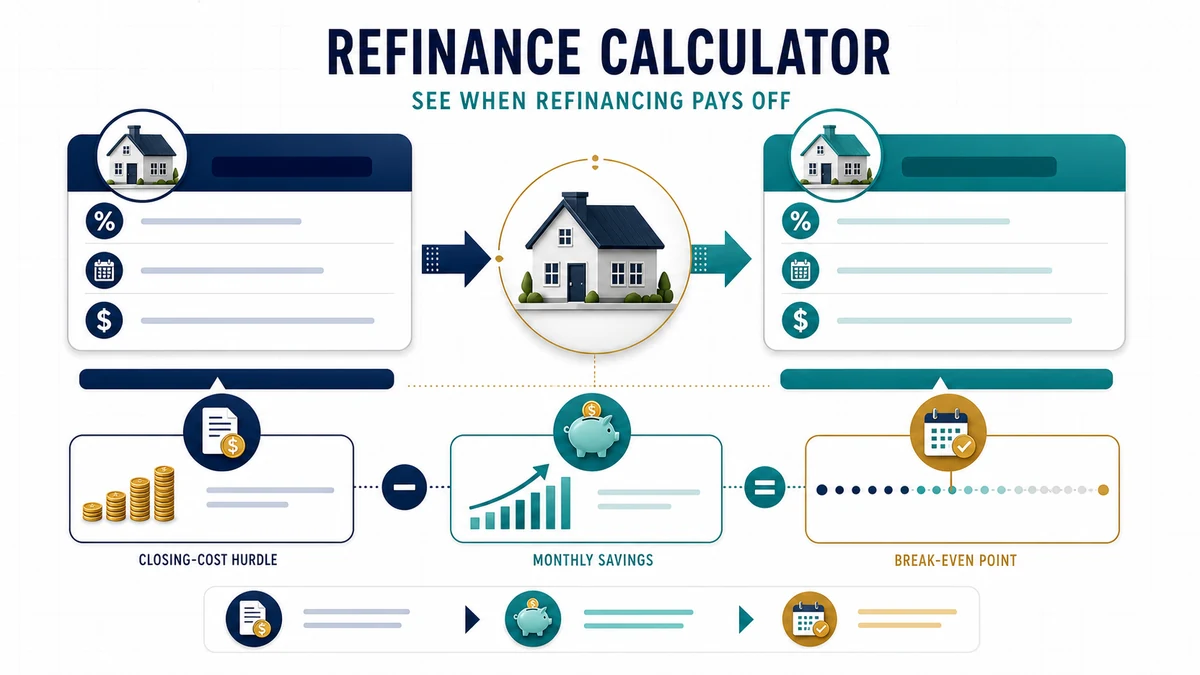
Compare your current mortgage vs. a refinance: payment, savings, and break-even.
Important Note : Refinancing can lower a monthly mortgage payment, but it does not automatically save money overall. This calculator estimates payment, interest, savings, and break-even time using simplified fixed-rate amortization math. Actual refinance results can vary because of lender fees, points, closing costs, escrow changes, taxes, insurance, mortgage insurance, cash-out amounts, prepayment penalties, credit profile, loan program, and the exact terms shown on your Loan Estimate.
The break-even result is especially important. If the monthly savings are small or the closing costs are high, it may take years to recover the refinance cost. If you sell the home, refinance again, or pay off the loan before reaching the break-even point, the refinance may not save money.
A lower monthly payment can also come from extending the loan term. That may improve monthly cash flow but can increase total interest paid over the life of the loan. Always compare monthly payment, total interest, closing costs, loan term, and how long you plan to keep the home before deciding. For an official refinance decision, review your lender’s Loan Estimate and compare offers from multiple lenders.
Use this Refinance Calculator to compare your current mortgage with a new refinance loan. Enter your current balance, current interest rate, remaining term, new refinance rate, new term, closing costs, and optional cash-out amount to estimate the new monthly payment, monthly savings, break-even time, total interest, and payoff dates.
This calculator is useful when you want to check whether refinancing may lower your payment, reduce interest, shorten or extend your loan term, or help you understand how long it may take to recover refinance closing costs.
Reviewed by: AjaxCalculators Editorial Team
Last updated: April 30, 2026
Method source: Standard fixed-rate mortgage amortization formulas using current balance, interest rate, remaining term, refinance loan term, closing costs, cash-out amount, estimated monthly payment, and break-even comparison.
Editorial standards: See our Editorial Policy for how we review and update calculator content.
What This Refinance Calculator Does
This calculator compares your existing mortgage against a possible refinance loan. It can estimate:
- Current monthly principal and interest payment
- New monthly principal and interest payment
- Estimated monthly savings
- Estimated closing costs
- Break-even time
- New refinance loan principal
- Approximate interest remaining on the current loan
- Total interest on the new loan
- Estimated current payoff date
- Estimated new payoff date
The calculator focuses on principal and interest. It does not include every possible refinance cost or escrow change, so the result should be treated as a planning estimate.
What Is Mortgage Refinancing?
Mortgage refinancing means replacing your current mortgage with a new mortgage. The new loan pays off the old loan, and you then make payments on the new loan under the new rate, term, and loan conditions.
Homeowners often refinance to lower their interest rate, reduce monthly payments, change the loan term, switch from an adjustable-rate loan to a fixed-rate loan, remove or adjust mortgage insurance, or take cash out from home equity.
Refinance Calculator Formula
This calculator uses fixed-rate amortization math for the current loan and the new refinance loan.
The monthly principal and interest payment is calculated with this formula:
M = P × [r(1 + r)n] ÷ [(1 + r)n − 1]
Where:
- M = monthly principal and interest payment
- P = loan principal
- r = monthly interest rate, calculated as annual interest rate ÷ 12
- n = total number of monthly payments
The calculator then compares the current payment with the new payment:
Monthly savings = current monthly P&I − new monthly P&I
The break-even time is estimated as:
Break-even time = closing costs ÷ monthly savings
This break-even formula only works when the new monthly payment is lower than the current payment. If the refinance does not create monthly savings, there may be no simple monthly-payment break-even point.
Worked Example
Suppose your current mortgage balance is $265,000, your current interest rate is 7.25%, and you have 24 years remaining. You are considering refinancing into a new 30-year loan at 6.25% with $4,500 in closing costs.
| Input | Example Value |
|---|---|
| Current balance | $265,000 |
| Current interest rate | 7.25% |
| Remaining term | 24 years |
| New interest rate | 6.25% |
| New term | 30 years |
| Closing costs | $4,500 |
| Cash-out amount | $0 |
Using standard fixed-rate payment math, the current estimated monthly P&I payment is about:
$1,981.64
The new estimated monthly P&I payment is about:
$1,631.89
The estimated monthly savings is:
$1,981.64 − $1,631.89 = $349.75
The estimated break-even time is:
$4,500 ÷ $349.75 = about 12.9 months
In this example, the refinance may recover the closing costs in a little over one year based on monthly payment savings. However, the new 30-year term may also extend the repayment timeline, so total interest should be reviewed carefully.
How to Use the Refinance Calculator
- Enter your current mortgage balance. This is the remaining principal today.
- Enter your current interest rate.
- Enter the remaining term on your current loan in years.
- Optionally enter your current monthly P&I if you know it. If entered, the calculator can use it for savings and break-even comparisons.
- Enter the new refinance interest rate.
- Enter the new loan term, such as 15, 20, or 30 years.
- Enter estimated closing costs as a dollar amount or percentage.
- Enter a cash-out amount if you plan to borrow extra cash through the refinance.
- Select the refinance date to estimate payoff timing.
- Click Calculate to compare payment, savings, interest, and break-even time.
How to Interpret the Results
Current monthly P&I shows the estimated principal-and-interest payment on your current mortgage.
New monthly P&I shows the estimated principal-and-interest payment on the refinance loan.
Monthly savings compares the current P&I payment with the new P&I payment. A positive number means the new payment is lower. A negative number means the refinance payment is higher.
Closing costs shows the estimated refinance cost entered by the user. If entered as a percentage, the calculator estimates it as a percentage of the current balance.
Break-even time estimates how long it may take for monthly savings to recover the closing costs.
New loan principal shows the estimated amount borrowed for the refinance. If a cash-out amount is entered, it is added to the new loan principal.
Interest remaining estimates the approximate interest left on the current loan based on current balance, rate, and remaining term.
Total interest on new loan estimates the interest paid over the new refinance term.
Payoff dates estimate when the current and new loans may be paid off based on the selected terms.
What Is a Refinance Break-Even Point?
The refinance break-even point is the time it takes for monthly savings to recover the refinance closing costs.
For example, if refinancing saves $250 per month and closing costs are $5,000, the simple break-even time is:
$5,000 ÷ $250 = 20 months
This means you would need to keep the refinanced loan for about 20 months before the monthly savings offset the closing costs. If you sell the home or refinance again before that point, the refinance may not save money.
Monthly Payment Savings vs Total Interest Savings
A refinance can lower the monthly payment but still increase total interest if the new loan term is much longer. For example, refinancing from 24 years remaining into a new 30-year loan may reduce the monthly payment because the balance is spread over more months. However, the longer term can also increase the total interest paid over time.
That is why it is important to compare both:
- Monthly savings: how much cash flow improves each month
- Total interest: how much the loan may cost over the full repayment period
A lower payment is helpful, but it is not the only measure of whether refinancing is beneficial.
What Are Refinance Closing Costs?
Refinance closing costs are upfront costs charged to create the new loan. They may include lender fees, appraisal fees, title fees, credit report fees, recording fees, prepaid items, escrow setup, discount points, and other settlement costs.
Some lenders advertise “no-closing-cost” refinancing. That does not always mean the refinance is free. The costs may be covered through a higher interest rate or added to the loan balance. Both options can affect the total cost of the refinance.
Cash-Out Refinance
A cash-out refinance lets you borrow more than the balance of your current mortgage and receive the difference as cash. This increases the new loan principal and may increase your monthly payment, total interest, and loan-to-value ratio.
This calculator includes an optional cash-out amount. If you enter a cash-out amount, it is added to the new refinance loan principal.
Before using a cash-out refinance, consider the purpose of the funds, the new monthly payment, the total cost of borrowing, and whether using home equity is worth the added debt.
Interest Rate vs APR
A mortgage interest rate is the rate used to calculate interest on the loan balance. APR, or annual percentage rate, is broader and can include the interest rate plus certain loan costs, such as points, broker fees, and other charges.
For this calculator, use the mortgage interest rate if you want a basic principal-and-interest payment estimate. If you enter a fee-inclusive APR instead of the note rate, the monthly payment estimate may not match your lender’s amortization schedule.
When Refinancing May Make Sense
Refinancing may be worth considering when:
- You can qualify for a lower interest rate.
- The monthly savings recover closing costs within your expected time in the home.
- You want to shorten the loan term and reduce total interest.
- You want to switch from an adjustable-rate mortgage to a fixed-rate mortgage.
- You want to remove or reduce mortgage insurance, if eligible.
- You need cash out and understand the long-term cost.
When Refinancing May Not Be Worth It
Refinancing may not be worth it when:
- You plan to move before reaching the break-even point.
- Closing costs are high compared with monthly savings.
- The new term increases total interest too much.
- Your credit score or home value has declined.
- Your current loan has a prepayment penalty.
- You are replacing a low-rate loan with a higher-rate loan without a strong reason.
- Cash-out borrowing creates a larger debt than you can comfortably repay.
Example Refinance Comparison Table
| Scenario | Current Loan | Refinance Loan |
|---|---|---|
| Loan balance/principal | $265,000 | $265,000 |
| Interest rate | 7.25% | 6.25% |
| Term | 24 years remaining | 30 years |
| Monthly P&I | $1,981.64 | $1,631.89 |
| Monthly savings | — | $349.75 |
| Closing costs | — | $4,500 |
| Break-even time | — | About 12.9 months |
This table is a simplified example. Your real refinance comparison may differ based on exact lender terms, fees, escrow, taxes, insurance, and loan program.
Simple Break-Even Example Table
| Closing Costs | Monthly Savings | Break-Even Time |
|---|---|---|
| $3,000 | $150 | 20 months |
| $4,500 | $250 | 18 months |
| $6,000 | $300 | 20 months |
| $8,000 | $200 | 40 months |
The higher the closing costs or the smaller the monthly savings, the longer it takes to break even.
Shorter Term vs Longer Term Refinance
A shorter-term refinance, such as moving from a 30-year loan to a 15-year loan, may increase the monthly payment but reduce total interest and pay off the mortgage faster.
A longer-term refinance may reduce the monthly payment, but it can increase total interest because payments continue for more years.
| Refinance Choice | Typical Monthly Payment Effect | Typical Total Interest Effect |
|---|---|---|
| Shorter term | Higher monthly payment | Lower total interest |
| Longer term | Lower monthly payment | May increase total interest |
The best choice depends on your goals: lower monthly payment, faster payoff, lower total interest, or improved loan stability.
Costs This Calculator May Not Include
This calculator is a simplified refinance comparison. It may not include:
- Escrow changes
- Property taxes
- Homeowners insurance
- Mortgage insurance changes
- Prepayment penalties
- Discount points
- Lender credits
- Rate lock costs
- Appraisal or inspection requirements
- Title, recording, and settlement fees
- Cash-to-close adjustments
- Tax effects
For a full comparison, review your official Loan Estimate and ask the lender how each cost affects your monthly payment and total loan cost.
Questions to Ask Before Refinancing
- How much will the refinance lower my monthly payment?
- What are the total closing costs?
- How long will it take to break even?
- Will I keep the home long enough to recover the costs?
- Will the new loan increase or decrease total interest?
- Am I extending the loan term?
- Are closing costs paid upfront, rolled into the loan, or offset by a higher rate?
- Does my current mortgage have a prepayment penalty?
- Will taxes, insurance, escrow, or mortgage insurance change?
- Have I compared Loan Estimates from multiple lenders?
Common Uses for a Refinance Calculator
This calculator can help you:
- Compare your current mortgage payment with a refinance payment
- Estimate monthly payment savings
- Estimate the refinance break-even point
- Compare shorter and longer loan terms
- Estimate how cash-out refinancing changes loan principal
- Check whether closing costs may be worth paying
- Estimate total interest on the new loan
- Plan a conversation with a lender
Assumptions and Limitations
- The calculator assumes fixed-rate mortgage amortization.
- It estimates principal and interest only.
- It does not automatically include taxes, insurance, escrow, PMI, or HOA dues.
- It estimates closing costs from the user-entered value.
- If closing costs are entered as a percentage, they are estimated as a percentage of the current balance.
- Cash-out amount is added to the new loan principal.
- Interest remaining on the current loan is approximate.
- The break-even calculation is based on monthly payment savings, not every possible refinance benefit or cost.
- It does not guarantee lender approval, rate availability, or final loan terms.
Tips for More Accurate Refinance Estimates
- Use your current unpaid principal balance, not the original loan amount.
- Use the exact remaining term if you know it.
- Enter your current monthly principal and interest payment if available.
- Use the mortgage interest rate, not APR, for basic amortization estimates.
- Use lender-provided closing cost estimates when possible.
- Include cash-out only if you plan to borrow extra funds.
- Compare total interest, not just monthly savings.
- Review official Loan Estimates from multiple lenders before deciding.
Related Calculators
- Mortgage Calculator
- Mortgage Interest Calculator
- Mortgage Calculator with Taxes and Insurance
- Mortgage/Loan Amortization Calculator
- Loan Calculator
- Interest Rate Calculator
References
- Consumer Financial Protection Bureau: Should I Refinance?
- Consumer Financial Protection Bureau: No-Cost or No-Closing-Cost Refinancing
- Consumer Financial Protection Bureau: Mortgage Interest Rate vs APR
- Consumer Financial Protection Bureau: Loan Estimate Explainer
- Consumer Financial Protection Bureau: Mortgage Key Terms
Frequently Asked Questions
What does a refinance calculator do?
A refinance calculator compares your current mortgage with a new refinance loan. It estimates the new monthly payment, monthly savings, closing costs, break-even time, total interest, and payoff dates.
How do I calculate refinance break-even time?
Divide the refinance closing costs by the estimated monthly savings. For example, $4,500 in closing costs divided by $300 in monthly savings equals a 15-month break-even time.
What is a good refinance break-even point?
A good break-even point depends on how long you plan to keep the home and the new loan. If you expect to sell or refinance again before reaching the break-even point, refinancing may not save money.
Does a lower refinance payment always save money?
No. A lower payment can come from a lower interest rate, a longer term, or both. Extending the loan term can lower the monthly payment but may increase total interest over time.
Should I use interest rate or APR in this calculator?
Use the mortgage interest rate for basic principal-and-interest payment estimates. APR can include fees and other loan costs, so it may not match the rate used for amortization math.
What are refinance closing costs?
Refinance closing costs are the costs charged to create the new loan. They may include lender fees, appraisal fees, title fees, recording fees, points, prepaid items, and settlement costs.
Is a no-closing-cost refinance free?
Not usually. The costs may be covered by a higher interest rate or added to the loan balance. Either option can affect the total cost of the refinance.
What is a cash-out refinance?
A cash-out refinance replaces your current mortgage with a larger new mortgage and lets you receive some of the difference as cash. This increases the new loan principal.
Why is my lender’s refinance estimate different from this calculator?
Your lender’s estimate may differ because of exact fees, points, escrow, taxes, insurance, mortgage insurance, credit profile, rate lock, loan program, closing date, and lender-specific rules.
Can refinancing increase total interest?
Yes. Refinancing into a longer loan term can reduce the monthly payment but increase total interest if the loan is paid over more years.
Should I compare multiple refinance offers?
Yes. Comparing Loan Estimates from multiple lenders can help you review rates, fees, points, lender credits, monthly payment, closing costs, and long-term cost.
Disclaimer
This calculator is for educational and planning purposes only. It estimates refinance payments, savings, interest, break-even time, and payoff dates using simplified fixed-rate amortization math. It does not provide financial, mortgage, legal, tax, or lending advice. Actual refinance terms, payments, APR, closing costs, points, lender credits, escrow amounts, taxes, insurance, mortgage insurance, prepayment penalties, cash-to-close, payoff amounts, and approval requirements may vary by lender, borrower profile, property, loan program, location, and market conditions. Always review official Loan Estimates, closing disclosures, payoff statements, and lender documents before making a refinance decision.