
CAGR Calculator
Calculate final value, difference, and total growth from an initial value, CAGR, and number of periods.
Inputs
Results
Use this CAGR Growth Calculator to project how a starting value may grow over time when you already know or assume a compound annual growth rate (CAGR). It calculates the final value, total change, total growth percentage, and growth factor.
Important: This calculator projects growth from an entered CAGR. It does not predict future investment or business performance.
CAGR Growth Formula
When the starting value, CAGR, and number of years are known:
Final value = initial value × (1 + CAGR)years
The CAGR percentage must first be converted to decimal form:
CAGR decimal = CAGR % ÷ 100
The change in value is:
Difference = final value − initial value
Total growth over the entire period is:
Total growth % = (final value − initial value) ÷ initial value × 100
The growth factor is:
Growth factor = final value ÷ initial value
Worked Example
Suppose a business, investment, or other value starts at $10,000 and grows at an assumed 7% CAGR for 5 years.
Final value = $10,000 × (1.07)5
Final value ≈ $14,025.52
The total increase is:
$14,025.52 − $10,000 = $4,025.52
Total growth:
$4,025.52 ÷ $10,000 × 100 ≈ 40.26%
Growth factor:
$14,025.52 ÷ $10,000 ≈ 1.4026×
Under a constant 7% annual compound-growth assumption, the starting value would therefore grow by about 40.26% over five years.
How CAGR Is Normally Calculated
If you already know the beginning value, ending value, and number of years, CAGR can instead be calculated as:
CAGR = [(ending value ÷ beginning value)1 ÷ years − 1] × 100
For example, if $10,000 grows to $15,000 in five years:
CAGR = [($15,000 ÷ $10,000)1/5 − 1] × 100 ≈ 8.45%
Important Notes
- CAGR represents a smoothed annual compound growth rate; it does not show the actual year-by-year path.
- An investment can experience gains and losses during individual years even when its overall CAGR is positive.
- For a true CAGR interpretation, use years rather than months, quarters, or other periods.
- The projection assumes the entered CAGR remains constant throughout the full period.
- Additional deposits, withdrawals, dividends, fees, taxes, and other cash flows are not automatically included.
- For investments, CAGR does not measure volatility, risk, or the timing of cash flows.
- Inflation is not included, so the calculator shows nominal rather than inflation-adjusted growth.
- Historical CAGR does not guarantee the same rate of growth in the future.
- When there are multiple deposits or withdrawals at different times, CAGR alone may not accurately represent investment performance.
How to Use the CAGR (Compound Annual Growth Rate) Calculator
Start with one clearly defined scenario and collect the values the calculator requests: beginning value, ending value, and number of years. Use figures from current statements, quotes, pay records, contracts, or official documents whenever possible. Keep every rate and time period on the same basis before calculating. If one value is uncertain, enter a realistic estimate and then test a lower and higher alternative instead of treating a single forecast as certain.
Enter the values carefully, check the units, and calculate. The main results are compound annual growth rate and annualized growth factor. Save the assumptions alongside the result so you can reproduce the calculation later. For comparisons, change only one major input at a time. That makes it easier to see which variable is responsible for the difference and reduces the chance of comparing scenarios built on inconsistent assumptions.
How to Interpret the Results
This calculator is designed to smooth a multi-year change into one equivalent annual rate. The result is an estimate based on the values supplied, not a quote, approval, tax ruling, investment recommendation, or contractual promise. Read the output together with its assumptions and compare the total cost or benefit—not only the most attractive headline number. A result that looks better in the short term may be less suitable when fees, timing, risk, or long-term obligations are included.
For a useful sensitivity check, recalculate with a less favorable rate, a different term, a larger cost, or a smaller income or return. Note the point at which the decision changes. This break point often provides more practical insight than a single best-case result because it shows how much uncertainty the plan can absorb.
Scenario Checklist
Before acting, confirm the source and date of every input; distinguish percentages from decimal values; include relevant fees and recurring costs; align monthly and annual figures; and verify whether values are before or after tax. Also consider inflation, opportunity cost, liquidity, and risk where relevant. Document the scenario name and calculation date so later comparisons use the same basis.
Important limitation: CAGR hides volatility, interim cash flows, losses, fees, taxes, and the path taken between endpoints. Rules, market conditions, provider terms, and personal circumstances can change. Verify material decisions with the appropriate lender, employer, tax authority, regulator, financial professional, or contract documentation.
Related Finance Calculators
Continue your comparison with the Basis Point (BPS) Calculator and Compound Interest Calculator. Using related calculators can reveal costs or assumptions that a single result does not capture.
Frequently Asked Questions
What does the CAGR (Compound Annual Growth Rate) Calculator calculate?
It uses beginning value, ending value, and number of years to estimate compound annual growth rate and annualized growth factor. The exact fields and displayed results depend on the values entered and the calculator formula.
Which inputs have the biggest effect on the result?
The inputs with the greatest effect are usually the largest balances, prices, rates, time periods, payments, or recurring amounts. Change one of these at a time and compare the results to identify the most sensitive variable.
How accurate is the CAGR (Compound Annual Growth Rate) Calculator?
It is mathematically accurate for the supplied inputs and stated assumptions. Real-world accuracy depends on the quality of those inputs and whether all relevant fees, taxes, timing rules, rate changes, and personal circumstances are represented.
How should I compare different scenarios?
Create a realistic base case, then a conservative case and an optimistic case. Keep units and timing consistent, alter one important assumption at a time, and compare total outcomes as well as periodic amounts.
Does the calculator include every tax, fee, and rule?
No general calculator can capture every jurisdiction, provider term, exemption, fee, or future change. Include additional costs where fields allow and confirm the final figures with current official documents or the relevant provider.
Can I use this result for an official financial decision?
Use it for education, planning, and initial comparison. Before signing, filing, investing, borrowing, or making another material commitment, confirm the assumptions and final numbers with authoritative documents and an appropriately qualified professional.
Sources
- FINRA — Calculating Your Investment Returns
- FINRA — Evaluating Investment Performance
- Investor.gov — Compound Growth and Investing Basics
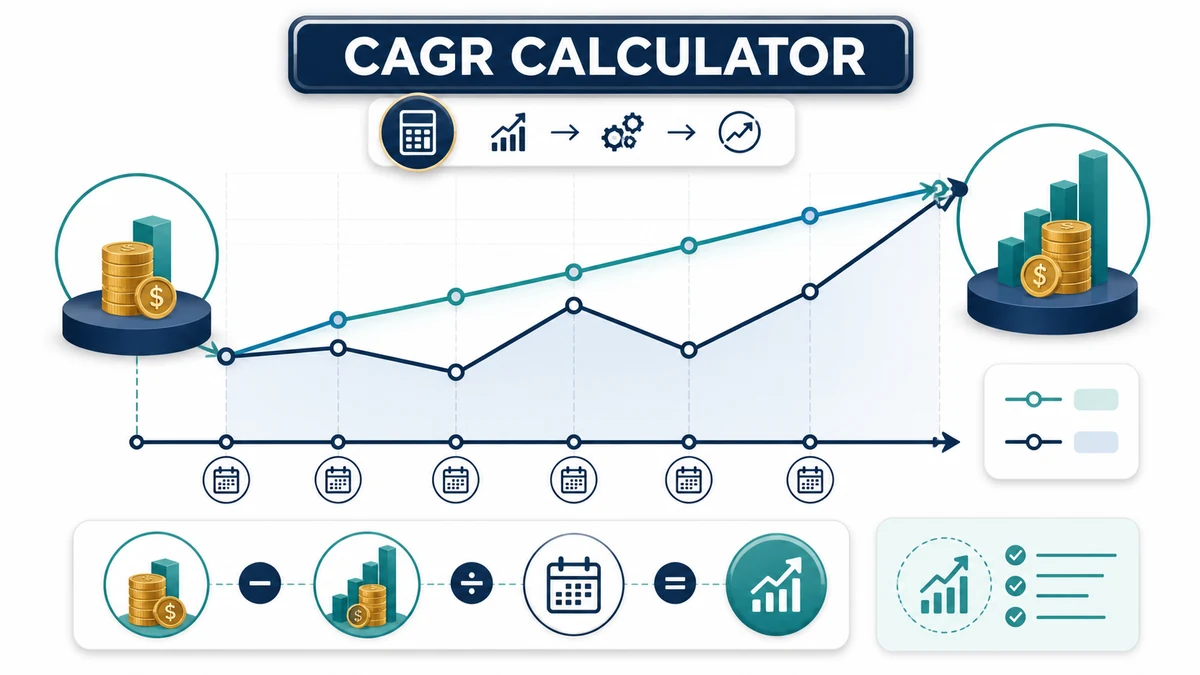
CAGR Smooths the Path Between Two Values
Compound annual growth rate gives the constant yearly rate that would connect a beginning value with an ending value over a stated number of periods. It hides volatility, interim cash flows, drawdowns, and changing risk. Confirm the period count and use comparable valuation dates. For investments with deposits or withdrawals, an internal-rate or time-weighted method may answer the question more accurately.