Shannon Diversity Index (H′)

Enter the number of individuals for each species (up to 40). Auto-updates as you type.

Controls

Species counts

Rows: 0/40

Actions

Results (auto-updating)

Log base: ln
Shannon index (H′)
Evenness (E)
Richness (k, species with n>0)
Total individuals (N)
Average per species (N/k)
Classification

Quick summary will appear here after you enter counts.

Step-by-step derivation

Provide at least one non-zero count to see the algebraic steps.

References

  1. Formula: H′ = −Σ (pᵢ · log_b(pᵢ)), where pᵢ = nᵢ / N, N = Σ nᵢ, b ∈ {e,10,2}.
  2. Evenness: E = H′ / log_b(k) for k ≥ 2; else E = 0.
  3. Shannon (1948) “A Mathematical Theory of Communication”.
  4. Ecology practice commonly uses ln, log₁₀, or log₂; base only rescales H′.

Use this Shannon Diversity Index Calculator to measure species diversity from count data. Enter the number of individuals for each species, choose the log base, and calculate Shannon index H′, evenness, richness, total individuals, average count per species, and a step-by-step derivation.

Important Note: This Shannon Diversity Index Calculator estimates biodiversity from species-count data using the Shannon formula H′ = −Σ(pᵢ × logb(pᵢ)). It also calculates evenness, richness, total individuals, average count per species, and a step-by-step derivation.

Results depend strongly on sampling design, sample size, sampling effort, species identification accuracy, habitat coverage, season, survey method, and log base. Compare H′ values only when samples were collected using comparable methods, comparable effort, and the same log base.

This calculator is useful for education, fieldwork summaries, ecology assignments, biodiversity comparisons, and survey-data checks. It should not be used alone to judge ecosystem health, conservation value, pollution status, habitat quality, or management success without ecological context and supporting evidence.

Reviewed by: AjaxCalculators Editorial Team
Last updated: April 28, 2026
Method source: Standard Shannon diversity index formula using species proportions, optional log base, and Pielou-style evenness
Editorial standards: AjaxCalculators Editorial Policy

What This Shannon Diversity Index Calculator Calculates

This calculator estimates species diversity from abundance count data. It uses the number of individuals counted for each species or category.

Result Meaning Use Note
Shannon index H′ A diversity index based on species proportions. Higher values usually indicate greater diversity when samples are comparable.
Evenness E How evenly individuals are distributed among species. Closer to 1 means the species counts are more even.
Richness k The number of species with non-zero counts. Empty or zero-count rows should not increase richness.
Total individuals N The total number of individuals counted across all species. Useful for checking sample size and sampling effort.
Average per species Total individuals divided by richness. A simple count summary, not a complete diversity measure.
Step-by-step derivation The formula path used by the calculator. Useful for learning, checking homework, or verifying fieldwork calculations.

What the Shannon Diversity Index Means

The Shannon Diversity Index, often written as H′, is a biodiversity measure that combines two ideas:

  • Richness: how many species are present
  • Evenness: how evenly individuals are distributed among those species

A community with many species and a fairly even distribution usually has a higher Shannon index. A community dominated by one or two species usually has a lower Shannon index, even if several rare species are present.

In ecology, the Shannon index is often used to compare biodiversity between habitats, samples, plots, ponds, forests, streams, surveys, or time periods. It is most useful when the samples were collected using similar methods and comparable effort.

How the Shannon Diversity Index Calculator Works

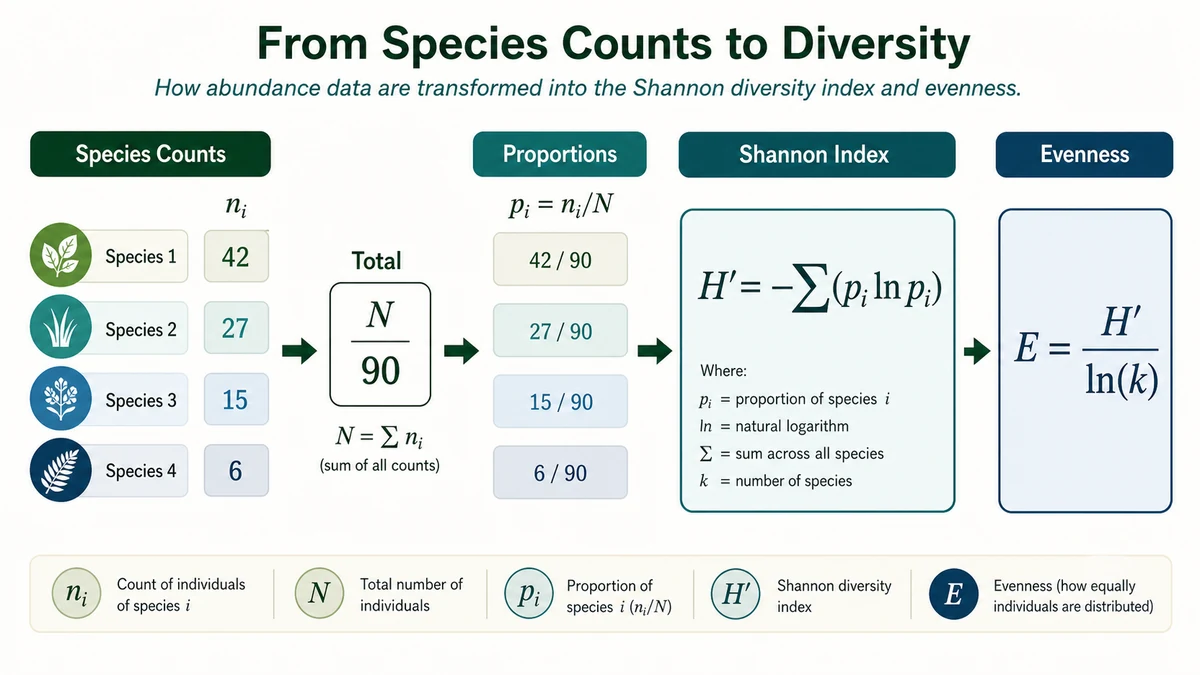
1) Total Individuals

The calculator first adds all species counts to get the total number of individuals.

N = n₁ + n₂ + n₃ + … + nₖ

In this formula:

  • N is the total number of individuals
  • nᵢ is the count for species i
  • k is the number of species with non-zero counts

2) Species Proportion

Next, the calculator finds the proportion of the total sample represented by each species.

pᵢ = nᵢ ÷ N

In this formula:

  • pᵢ is the proportion for species i
  • nᵢ is the number of individuals in species i
  • N is the total number of individuals across all species

3) Shannon Index Formula

The Shannon diversity index is calculated as:

H′ = −Σ(pᵢ × logb(pᵢ))

In this formula:

  • H′ is the Shannon diversity index
  • Σ means to sum the value for all species
  • pᵢ is the proportion of individuals in species i
  • logb is the selected logarithm base
  • b can be e for natural log, 10 for log₁₀, or 2 for log₂

Natural log is common in ecology, but different log bases can be used. Changing the log base rescales H′, so values should be compared using the same log base.

4) Evenness Formula

Evenness compares the observed Shannon index with the maximum possible Shannon index for the same number of species.

E = H′ ÷ logb(k)

In this formula:

  • E is evenness
  • H′ is the Shannon index
  • k is species richness, or the number of species with non-zero counts
  • logb(k) is the maximum possible Shannon index for k equally abundant species

Evenness ranges from 0 to 1 when k is at least 2. A value closer to 1 means individuals are more evenly distributed among species.

5) Average per Species

The calculator can also show the average number of individuals per species.

Average per species = N ÷ k

This is a simple descriptive value. It is not the same as diversity, because it does not show whether individuals are evenly distributed or concentrated in one species.

Worked Example

Suppose a sample contains four species with these counts:

Species Count nᵢ Proportion pᵢ pᵢ × ln(pᵢ)
Species A 10 0.10 −0.2303
Species B 20 0.20 −0.3219
Species C 30 0.30 −0.3612
Species D 40 0.40 −0.3665
Total 100 1.00 −1.2799

Using natural log:

H′ = −Σ(pᵢ × ln(pᵢ))

H′ = −(−1.2799)

H′ ≈ 1.2799

Now calculate evenness:

E = H′ ÷ ln(k)

E = 1.2799 ÷ ln(4)

E ≈ 1.2799 ÷ 1.3863

E ≈ 0.923

This sample has a Shannon diversity index of about 1.280 using natural log and an evenness value of about 0.923. The high evenness value means the individuals are fairly evenly distributed among the four species.

How to Use This Shannon Diversity Index Calculator

  1. Add a row for each species or category in your sample.
  2. Enter the number of individuals counted for each species.
  3. Choose the log base: ln, log₁₀, or log₂.
  4. Choose the number of significant figures for rounding.
  5. Review the Shannon index, evenness, richness, total individuals, and step-by-step derivation.

How to Interpret the Result

Metric What It Tells You Important Caution
Shannon index H′ Combines richness and evenness into one diversity value. Do not compare values from different log bases or different sampling methods.
Evenness E Shows how balanced the species counts are. Evenness is meaningful only when richness is at least 2.
Richness k Counts how many species are present with non-zero abundance. Richness alone does not show whether one species dominates.
Total individuals N Shows total sample size. Small or uneven sample sizes can make comparisons weaker.
Average per species N/k Shows a simple average count per non-zero species. It does not measure diversity because it ignores distribution shape.
Classification Gives a rough label based on the calculator’s internal thresholds. Classification labels should not replace study-specific ecological interpretation.

What Counts as a High Shannon Index?

There is no universal cutoff for a high or low Shannon index. Interpretation depends on the organism group, ecosystem, sampling design, sample size, log base, and research question.

Pattern Likely Interpretation Caution
H′ = 0 Only one species or category is present. This may reflect true dominance or limited sampling.
Low H′ Lower diversity or strong dominance by one or a few species. May also occur when sampling missed rare species.
Higher H′ More diversity when richness and evenness are higher. Only compare with samples collected using similar methods.
Maximum H′ Occurs when all species are equally abundant. The maximum depends on richness and log base.

The best use of H′ is usually comparison between samples collected in the same way, such as two plots, two ponds, two transects, or the same site before and after a treatment.

Why Log Base Matters

The Shannon formula can use different logarithm bases. Changing the log base rescales the numeric value of H′, but it does not change the underlying species proportions.

Log Base Common Notation Result Unit Important Note
Natural log ln Nats Common in ecology and many biodiversity examples.
Base 10 log10 Decimal digits Rescales H′ compared with natural log.
Base 2 log2 Bits Common in information-theory contexts.

When comparing Shannon index values, always use the same log base. A natural-log H′ value should not be directly compared with a base-10 or base-2 H′ value unless converted.

Richness vs Evenness vs Diversity

Richness, evenness, and Shannon diversity are related, but they are not the same measurement.

Measure What It Tells You Example Limitation
Richness How many species are present. 10 species found in a plot. Does not show whether one species dominates.
Evenness How similar the species counts are. All 10 species have similar counts. Needs richness context to be useful.
Shannon diversity Combines richness and evenness. Higher when many species are present and counts are balanced. Still does not identify which species are ecologically important.

Two samples can have the same richness but different Shannon index values if one sample is more evenly distributed than the other.

When to Use the Shannon Diversity Index

The Shannon index is useful when you want a single number that reflects both how many species are present and how evenly individuals are distributed among them.

It can be used for:

  • ecological field surveys
  • forest biodiversity studies
  • plant community analysis
  • bird, insect, fish, or macroinvertebrate samples
  • microbial community summaries
  • before-and-after habitat comparisons
  • comparing plots, sites, transects, ponds, streams, or treatment groups

Important Assumptions and Limitations

Assumption or Limitation What It Means
Count data required The calculator expects abundance counts, not percentages or raw presence/absence labels.
Comparable sampling effort H′ comparisons are strongest when samples use similar methods, area, timing, and effort.
Correct species identification Misidentified species can change richness, proportions, H′, and evenness.
Non-zero species only Richness should count species with nᵢ greater than zero.
Log base consistency required Natural log, base 10, and base 2 produce different numeric H′ values.
Rare species sensitivity Rare species can influence H′, especially when sampling effort is uneven.
No species identity interpretation H′ does not show which species are present, native, invasive, threatened, or dominant.
No ecosystem-health conclusion A high or low H′ value does not by itself prove habitat quality, pollution status, or conservation value.
Classification is rough guidance Any “low,” “moderate,” or “high” label should be interpreted within the study context.

Common Mistakes to Avoid

Mistake Why It Causes Problems
Entering percentages instead of counts The calculator is designed for species counts; percentages may distort N and derivation output.
Comparing different log bases ln, log10, and log2 rescale H′ differently.
Including empty rows as present species Richness should include only species with non-zero counts.
Ignoring sample size Small samples may miss rare species and produce unstable comparisons.
Comparing different sampling methods directly Different methods can detect different species or abundance patterns.
Treating H′ as a complete biodiversity assessment H′ is one summary index and does not include species identity, rarity, threat status, or ecosystem function.
Assuming high H′ means healthy ecosystem Disturbed or invaded systems can sometimes have high richness or evenness depending on context.
Using richness alone when dominance matters Two samples can have the same richness but very different evenness and H′.

Formula Summary

What You Want to Find Formula Meaning
Total individuals N = Σnᵢ Add all species counts.
Species proportion pᵢ = nᵢ ÷ N Find the share of the sample represented by species i.
Shannon index H′ = −Σ(pᵢ × logb(pᵢ)) Combines species proportions into a diversity index.
Richness k = number of species with nᵢ > 0 Counts only species with non-zero abundance.
Maximum Shannon index H′max = logb(k) Maximum possible H′ for k equally abundant species.
Evenness E = H′ ÷ logb(k) Compares observed H′ with the maximum possible H′.
Average per species N/k Simple count average across non-zero species.

Sample Design and Comparability Notes

Shannon diversity is most useful when the compared samples were collected with similar effort, area, timing, and identification rules.

Comparison Issue Why It Matters Best Practice
Different sample sizes Larger samples may detect more rare species. Use comparable effort or apply appropriate ecological methods before comparison.
Different sampling areas A larger plot may contain more habitat types and more species. Compare plots or transects of similar size when possible.
Different seasons Species presence and abundance can change seasonally. Compare samples from the same season or clearly note timing differences.
Different survey methods Nets, traps, visual surveys, quadrats, and DNA methods may detect different organisms. Compare only similar survey methods unless the study design accounts for method differences.
Species identification error Misidentification can change richness and proportions. Use consistent taxonomy, field guides, expert review, or verified IDs.
Rare species detection Rare species can affect richness and H′, especially with uneven effort. Use adequate sampling effort and document detection limits.

Practical Uses

This Shannon Diversity Index Calculator is useful when species-count data need to be summarized into a diversity metric.

Use Case How the Calculator Helps
Ecology field surveys Summarizes species-count data from plots, transects, quadrats, or sample sites.
Forest biodiversity studies Compares tree, plant, insect, bird, or understory diversity between plots.
Freshwater or marine samples Summarizes fish, macroinvertebrate, plankton, or benthic community data.
Microbial community summaries Provides a simple diversity index when abundance-style data are available.
Before-and-after comparisons Compares diversity before and after a disturbance, restoration, or management action.
Classroom and lab reports Shows the step-by-step calculation for learning and assignment checks.
Data-quality checks Helps identify whether one species dominates or whether counts are evenly distributed.

When You May Need More Than This Calculator

The Shannon index is useful, but it is not a complete ecological assessment. You may need additional methods when the research question goes beyond one diversity index.

Need Better Method or Additional Evidence
Compare samples with unequal effort Use rarefaction, coverage-based methods, or study-specific statistical analysis.
Assess ecosystem health Combine diversity metrics with habitat data, water quality, disturbance data, and indicator species.
Identify conservation priority Consider threatened species, endemic species, habitat quality, connectivity, and ecological function.
Measure dominance Use Simpson’s index, dominance measures, or abundance-distribution plots.
Compare community composition Use similarity/dissimilarity indices, ordination, clustering, or multivariate ecological analysis.
Analyze presence/absence data Use richness, occupancy, Jaccard similarity, Sørensen similarity, or other presence/absence methods.
Use biomass instead of individuals Use biomass-based community analysis if biomass is more ecologically meaningful than abundance.

Frequently Asked Questions

What is the Shannon Diversity Index?

The Shannon Diversity Index, written as H′, is a biodiversity measure that combines species richness and evenness using species proportions.

What formula does this calculator use?

The calculator uses H′ = −Σ(pᵢ × logb(pᵢ)), where pᵢ is the proportion of individuals in species i and b is the selected log base.

What is species richness?

Species richness is the number of species with non-zero counts in the sample.

What is evenness?

Evenness measures how evenly individuals are distributed among the species. Values closer to 1 mean the species counts are more balanced.

Which log base should I use?

Natural log is common in ecology, but base 10 and base 2 can also be used. The most important rule is to use the same log base when comparing samples.

Can I enter percentages instead of counts?

No. Use species counts. If you only have percentages, convert them carefully into proportions and use a method appropriate for your data.

Can I compare Shannon index values from different studies?

Only with caution. Samples should have comparable methods, effort, area, timing, taxonomic resolution, and log base.

Does a higher Shannon index always mean a healthier ecosystem?

No. A higher H′ usually means higher diversity for comparable samples, but ecosystem health also depends on species identity, habitat quality, disturbance, pollution, invasive species, and ecological function.

References

  1. Biology LibreTexts — Diversity Indices
  2. Claude E. Shannon — A Mathematical Theory of Communication
  3. Coastal Wiki — Measurements of Biodiversity
  4. HHMI BioInteractive — Measuring Biodiversity Tutorial
  5. Wisconsin DNR — Measuring Biodiversity Student Handout

Related Calculators

Shannon Diversity Index Calculator Disclaimer

This Shannon Diversity Index Calculator provides educational and analytical diversity estimates from species-count data. It calculates Shannon index H′, evenness, richness, total individuals, average count per species, and step-by-step derivation using the selected log base.

Results depend on sampling design, sample size, sampling effort, survey method, habitat coverage, season, taxonomic resolution, species identification accuracy, rare-species detection, and log base. H′ values should be compared only when data were collected using comparable methods and the same log base.

This calculator does not identify species, validate ecological survey methods, correct for unequal sampling effort, perform rarefaction, test statistical significance, analyze community composition, or determine ecosystem health, habitat quality, conservation priority, pollution status, or management success. Use ecological context, study design, supporting evidence, and qualified expert interpretation for formal biodiversity assessment.

More of our calculators...

Plastic Footprint Calculator

Plastic Footprint Calculator to estimate your annual plastic use and waste so you can understand and reduce your environmental impact.