
mL to Grams Converter
Choose an ingredient, enter a volume, and click Calculate.
Reference densities used
Use this mL to Grams Converter to estimate the weight of a liquid or kitchen ingredient from its volume. Choose an ingredient with a preset density or enter a custom density when you know the value for a specific product.
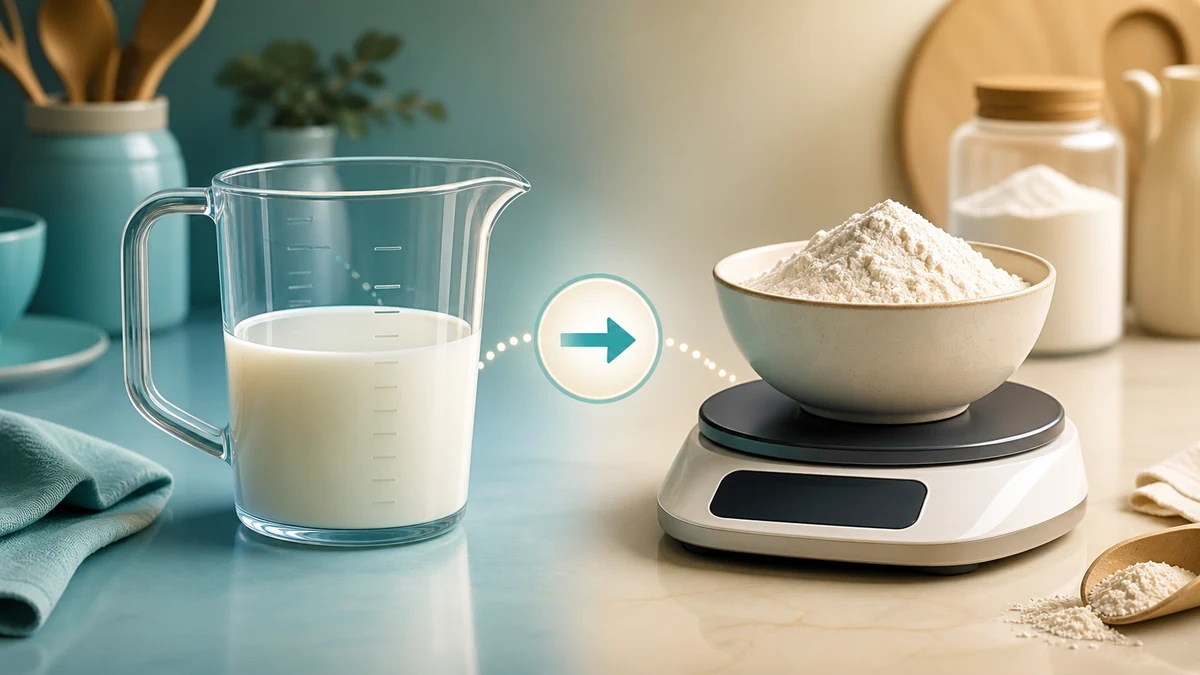
Important: Milliliters measure volume while grams measure mass. There is no universal conversion from mL to grams because different substances have different densities.
mL to Grams Formula
The conversion uses the relationship between mass, volume, and density:
Grams = milliliters × density in g/mL
For the reverse conversion:
Milliliters = grams ÷ density in g/mL
If both mass and volume are known:
Density = grams ÷ milliliters
Why Density Matters
Two ingredients can occupy the same volume but have different weights.
For example, water has a density close to 1 g/mL, so for ordinary kitchen estimates:
100 mL of water ≈ 100 g
However, the same shortcut should not be used for oil, honey, flour, sugar, rice, oats, or other ingredients because their densities differ.
Even water is not exactly 1 g/mL under all conditions because its density changes slightly with temperature.
Worked Example
Suppose you want to convert 250 mL of an ingredient with a density of 0.85 g/mL.
Apply the formula:
Grams = 250 × 0.85
Grams = 212.5 g
So, 250 mL of that ingredient has an estimated mass of 212.5 grams.
Custom Density
If your ingredient is not available in the preset list, use the custom-density option with reliable product-specific density data.
If density is given in kilograms per cubic meter:
Density in g/mL = density in kg/m³ ÷ 1,000
For example:
850 kg/m³ = 0.85 g/mL
Kitchen Volume Units
The converter can also accept common kitchen volume units and convert them internally before applying the density formula.
Useful approximate U.S. kitchen equivalents include:
- 1 teaspoon ≈ 4.93–5 mL
- 1 tablespoon ≈ 14.79–15 mL
- 1 US fluid ounce ≈ 29.57 mL
- 1 US cup ≈ 236.59 mL
Kitchen references sometimes round these values, so small differences between recipe converters are normal.
Important Notes
- Preset ingredient densities are practical estimates rather than exact values for every brand or product.
- Flour, sugar, oats, rice, and other dry ingredients can vary because of packing, settling, moisture, grind size, and measuring technique.
- Liquids can also change density with temperature and composition.
- For precise baking or recipe development, weighing ingredients directly with a kitchen scale is generally more reliable than converting volume to weight.
- A fluid ounce measures volume, while an ounce without “fluid” normally refers to mass or weight. They are not interchangeable.
- For nutrition tracking, use product-specific weights or weigh the actual food when better accuracy is required.
- Do not use approximate kitchen-density conversions for medication dosing, laboratory procedures, industrial formulation, or other safety-critical applications.
How to Use the mL to Grams Converter
- Enter volume in milliliters and the ingredient or its density.
- Keep all entries in the units shown by the calculator and choose the correct ingredient or strength option.
- Select Calculate and review the estimated mass in grams.
- Check the result against the practical notes below before using it in a recipe, batch, or serving plan.
How the Calculation Works
Milliliters measure volume, while grams measure mass. The conversion is mass in grams = volume in milliliters × density in grams per milliliter. Because density belongs to the ingredient, there is no single factor that converts every liquid or powder correctly.
For water near ordinary room conditions, a practical kitchen estimate is about 1 gram per milliliter, so 250 mL is approximately 250 g. An ingredient with a density of 0.85 g/mL would give 250 × 0.85 = 212.5 g. Use the converter’s ingredient option or a reliable density value for the material you actually have.
How to Interpret the Result
The displayed answer is a mathematical estimate based on the values you enter. Keep extra decimal places while calculating, then round only at the end to a precision your measuring tools can actually support. A result should help you plan and check quantities; it cannot correct an inaccurate input or an unsuitable reference value.
Practical Accuracy Checklist
- Confirm that the selected ingredient matches what you are measuring.
- Use the density at a temperature close to the ingredient’s actual temperature when precision matters.
- Avoid assuming that milk, oil, syrup, flour, and sugar weigh the same as water.
- For repeatable baking, weigh the ingredient directly and use this result mainly for planning or recipe translation.
Limits and Good Practice
Ingredient density changes with temperature, composition, aeration, and brand. Powders can settle or become compacted, so their bulk density is especially variable. A kitchen scale is more dependable than a calculated conversion when a recipe needs high precision.
The Grams to Cups Converter handles another common kitchen conversion, while the Grams to Calories Calculator estimates food energy. NIST notes in its SI volume guidance that a milliliter is a special name for a cubic centimeter.
Frequently Asked Questions
Are 100 mL and 100 g always equal?
No. They are approximately equal for water in common kitchen use, but other ingredients have different densities and therefore different masses.
What formula converts mL to grams?
Multiply milliliters by density in grams per milliliter. The density must describe the ingredient you are converting.
Why does flour give a different result from water?
Flour contains air spaces between particles and has a much lower bulk density than water. Scooping and packing also change how much fits in a given volume.
Does temperature affect the conversion?
Yes. Most materials expand or contract as temperature changes, which changes density. The effect may be small in everyday cooking but matters in precise work.
Should I use a scale instead?
Use a scale whenever accuracy is important. This converter is most useful when a recipe gives volume but you need a reasonable mass estimate.
Can I convert grams back to mL?
Yes. Divide mass in grams by density in grams per milliliter, provided the density is known and uses compatible units.
Choosing a Reliable Density
Use a density from a product specification, laboratory reference, or recipe source that identifies the ingredient and temperature. A broad label such as “oil” or “syrup” may hide meaningful differences in composition. If a database gives density in kilograms per liter, the numerical value is the same as grams per milliliter, so it can be used directly after checking the units.
For powders and chopped foods, treat the value as bulk density rather than solid-material density. The air between particles is part of the measured volume, which is why grinding, sifting, settling, and pressing can change the converted mass.